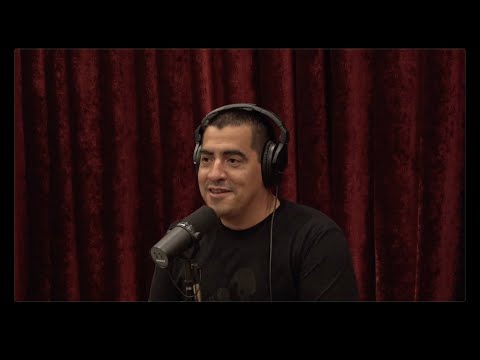
Joe Rogan Experience #2369 - Ed Calderon
Joe Rogan (host), Narrator, Narrator, Ed Calderon (guest), Guest (guest), Narrator, Narrator, Guest (guest), Guest (guest), Guest (guest), Narrator, Guest (guest), Narrator, Joe Rogan (host)
In this episode of The Joe Rogan Experience, featuring Joe Rogan and Narrator, Joe Rogan Experience #2369 - Ed Calderon explores ed Calderon Exposes Cartel Warfare, U.S. Complicity, and Mexico’s Future Joe Rogan and Ed Calderon trace Mexico’s brutal history from Aztec warfare and human sacrifice to modern-day cartel violence, psychological terror tactics, and mass disappearances.
Ed Calderon Exposes Cartel Warfare, U.S. Complicity, and Mexico’s Future
Joe Rogan and Ed Calderon trace Mexico’s brutal history from Aztec warfare and human sacrifice to modern-day cartel violence, psychological terror tactics, and mass disappearances.
Calderon explains how cartels evolved into highly militarized, politically embedded organizations using tanks, drones, TikTok recruiting, and foreign military training, while U.S. guns, drug demand, and policy blunders have fueled the crisis.
They detail the deep intertwining of cartels with Mexican politics and security forces, the likely U.S. covert role in recent high-level cartel arrests, and the risks of any overt U.S. military intervention.
The conversation closes on immigration, mass deportations, cultural mistrust, and Calderon’s own path as a Mexican immigrant who believes the U.S.–Mexico relationship will define both countries’ futures.
Key Takeaways
Modern cartel brutality is rooted in a long cultural history of extreme violence.
From Aztec human sacrifice and bloodletting to today’s beheadings, body displays, and mass graves, Calderon argues there’s a kind of “genetic memory” of ritualized violence in Mexico that cartels consciously weaponize for psychological dominance.
Get the full analysis with uListen AI
Cartels now function as paramilitary, semi-political organizations rather than just drug gangs.
Groups like CJNG operate training camps with current and former military trainers, use armored “narco-tanks,” . ...
Get the full analysis with uListen AI
The Sinaloa cartel’s fragmentation and U.S. takedown of key leaders may be increasing instability.
The covert handover and arrest of longtime Sinaloa boss El Mayo Zambada in Texas triggered open warfare between factions and gave CJNG a strategic opening, illustrating how decapitation strikes can splinter groups and worsen violence.
Get the full analysis with uListen AI
U.S. policy, guns, and drug demand are structurally entangled with Mexico’s cartel problem.
Operations like Fast and Furious funneled high-end U. ...
Get the full analysis with uListen AI
Any direct U.S. military intervention in Mexico risks uniting cartels and corrupt state actors as “freedom fighters.”
Calderon warns that if U. ...
Get the full analysis with uListen AI
Cartels aggressively exploit modern platforms and global conflicts to upgrade their capabilities.
They recruit via TikTok, advertise human smuggling on social media, import tradecraft from Colombia and Afghanistan/Iraq IED experience, and even send fighters to Ukraine to bring drone-warfare lessons back to Mexico.
Get the full analysis with uListen AI
Migration policy on both sides is driven by politics, labor demands, and manipulation, not just humanitarian concerns.
The discussion links mass caravans, Biden-era border chaos, Obama/Bush deportation waves, cheap illegal labor, and the strategic placement of migrants in swing states, while highlighting the human cost for long-term residents suddenly deported to countries they barely know.
Get the full analysis with uListen AI
Notable Quotes
““There’s no way to go after cartels in Mexico without going after the government.””
— Ed Calderon
““If you start fighting the cartels without approval of the Mexican government, you will turn criminal organizations into freedom fighters.””
— Ed Calderon (relaying a Mexican special operator’s warning)
““Modern Mexico is three things: the rural south, the woke capital in the center, and the conservative, hard‑working north.””
— Ed Calderon
““We spent trillions of dollars in Afghanistan for maybe 60,000 Taliban. There are probably way more cartel fighters than that.””
— Joe Rogan
““I’m not a politician or a cartel reporter. I’m a dude that went through some shit, became an American, and wants the best for both countries.””
— Ed Calderon
Questions Answered in This Episode
If cartels and segments of the Mexican state are so deeply intertwined, what realistic levers of reform exist that don’t trigger open civil war or U.S. intervention?
Joe Rogan and Ed Calderon trace Mexico’s brutal history from Aztec warfare and human sacrifice to modern-day cartel violence, psychological terror tactics, and mass disappearances.
Get the full analysis with uListen AI
How could the U.S. practically reduce cartel power by changing domestic drug policy, rather than through enforcement and military tools alone?
Calderon explains how cartels evolved into highly militarized, politically embedded organizations using tanks, drones, TikTok recruiting, and foreign military training, while U. ...
Get the full analysis with uListen AI
What would a cooperative, honest U.S.–Mexico security partnership actually look like, given the mutual distrust and long history of covert operations?
They detail the deep intertwining of cartels with Mexican politics and security forces, the likely U. ...
Get the full analysis with uListen AI
How should the U.S. handle long-term undocumented residents who arrived as children while still addressing legitimate border security and trafficking concerns?
The conversation closes on immigration, mass deportations, cultural mistrust, and Calderon’s own path as a Mexican immigrant who believes the U. ...
Get the full analysis with uListen AI
To what extent are China and other foreign powers intentionally using drugs, money flows, and migration to destabilize North America, and how should that reshape U.S. strategy?
Get the full analysis with uListen AI
Transcript Preview
(drumming music) Joe Rogan podcast, check it out.
The Joe Rogan Experience.
Train by day, Joe Rogan podcast by night, all day. (rock music) Art Bell was the best. Driving home from The Comedy Store at, like, 1:00 in the morning and hearing some dude who claimed he was a time traveler. (laughs)
R- Remember when he, uh ... th- there was a dude that claimed to work at Area 51 and then it cut out, the, the, the- ... radio show cut out?
Yeah, that was a good one.
(laughs)
Art was the man.
He would get ... Yeah.
Yeah, that's why we put that photo up there, 'cause he was, you know, the ... A lot of the subjects that we covered, he was the original guy talking about these things on the radio.
Yeah. And then all -- the, the fact that he just kept the op- the open lines. If you're-
Yeah.
... a time traveler tr- (laughs) if you're a time traveler, just ca- call in and tell what ... Tell us what's going to happen in the future.
Yeah, people that were kidnapped by Bigfoot. Like, no matter what, Art was like, "Interesting, tell me more."
Yeah, yeah.
(laughs)
Like he was open to just-
(laughs)
... talking to anyone, it was great.
And he never called bullshit. (laughs)
No. Uh-uh, no.
So, uh, the last time I saw you, you gave me an Aztec death whistle and, uh, Bryan Callen blew it on the air and it cau- it caused the ca- the pandemic.
He was very good at it out of nowhere.
(laughs)
He'd just, like, grab it and wooo.
We have another one.
Oh, no. Don't.
Look at this one.
Probably that's ... Luke Caverns gave us this one.
Yeah.
That's a good one, right?
That is a beautiful one. Uh, probably let's not repeat it again.
Yeah.
I'm not blowing it. (knocks on wood) I don't know if it's true or not true, but it's an odd coincidence.
(laughs)
(laughs)
It definitely, it definitely was. I got... I got a lot of messages about it, like, "Hey, this was kinda coincidentally at the start of this pandemic." Like I ... don't, don't, don't put this on me.
Listen, man-
(laughs)
... people have been blowing them whistles all over the world.
Yeah, yeah.
There's a bunch of those whistles out there. There's no way.
(laughs)
There's no way, you know. The only thing is I don't think anybody ever blew one on a podcast that was seen by millions of people.
I mean, you were directly responsible for those to become this viral popular thing. No ... Like, a few people knew about them, but they became this international thing now. Like, everybody talks about death whistles now because of it.
Install uListen to search the full transcript and get AI-powered insights
Get Full TranscriptGet more from every podcast
AI summaries, searchable transcripts, and fact-checking. Free forever.
Add to Chrome