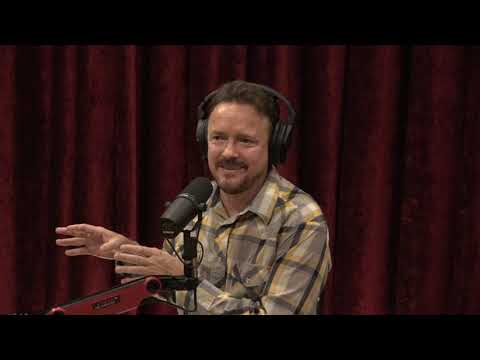
Joe Rogan Experience #1710 - Cullen Hoback
Cullen Hoback (guest), Joe Rogan (host), Narrator
In this episode of The Joe Rogan Experience, featuring Cullen Hoback and Joe Rogan, Joe Rogan Experience #1710 - Cullen Hoback explores qAnon, Free Speech, and Algorithms: Unmasking the Internet’s Dark Theater Joe Rogan and filmmaker Cullen Hoback dissect Hoback’s HBO docuseries *Q: Into the Storm*, using it as a lens to explore QAnon’s origins, spread, and real‑world impact, particularly on January 6th. They trace how anonymous message boards like 4chan/8chan, YouTube “QTubers,” and recommendation algorithms turned a fringe LARP into a mass belief system and political force. The conversation widens into the dangers of opaque algorithms, data harvesting, and privatized censorship by tech platforms acting as de facto speech regulators. Underneath it all is a debate: whether societies should tolerate phenomena like QAnon as the cost of free speech, or empower platforms and governments to intervene—at the risk of deeper polarization and abuse.
QAnon, Free Speech, and Algorithms: Unmasking the Internet’s Dark Theater
Joe Rogan and filmmaker Cullen Hoback dissect Hoback’s HBO docuseries *Q: Into the Storm*, using it as a lens to explore QAnon’s origins, spread, and real‑world impact, particularly on January 6th. They trace how anonymous message boards like 4chan/8chan, YouTube “QTubers,” and recommendation algorithms turned a fringe LARP into a mass belief system and political force. The conversation widens into the dangers of opaque algorithms, data harvesting, and privatized censorship by tech platforms acting as de facto speech regulators. Underneath it all is a debate: whether societies should tolerate phenomena like QAnon as the cost of free speech, or empower platforms and governments to intervene—at the risk of deeper polarization and abuse.
Key Takeaways
QAnon likely evolved from a LARP into a real political force.
Early Q posts on 4chan were anonymous and improvisational; over time, a single operator (very likely Ron Watkins) consolidated control, refined the persona, and leveraged community “research” into an interactive, quasi-religious conspiracy that influenced millions.
Get the full analysis with uListen AI
Algorithms and data-mining supercharged QAnon’s reach beyond fringe boards.
Recommendation systems on YouTube, Twitter, and other platforms rewarded sensational, conspiratorial content, pulling users down rabbit holes and turning niche chan culture into a mass movement that mainstream platforms then struggled to contain.
Get the full analysis with uListen AI
Attempts to algorithmically purge QAnon had broad collateral damage.
Platform crackdowns wiped out not only Q promoters but also critical researchers, journalists, and documentarians, demonstrating how blunt algorithmic moderation can erase context, history, and legitimate analysis along with the harms.
Get the full analysis with uListen AI
Corporate censorship functions as outsourced government control of speech.
Hoback argues that, as with data privacy, governments effectively offload constitutional constraints to private platforms, which then decide what’s “true” or permissible—often in coordination with political actors, and without public accountability.
Get the full analysis with uListen AI
The real root problem is loss of privacy, not just disinformation.
Massive, unregulated data harvesting enables precise psychometric profiling and behavioral manipulation; Hoback contends that if privacy and data ownership had been protected, today’s extreme algorithmic echo chambers and reality splits would be far less severe.
Get the full analysis with uListen AI
Free speech vs. safety is a spectrum, and QAnon tests its limits.
Rogan and Hoback wrestle with whether we should tolerate movements like QAnon as the price of free expression, or empower stronger controls—recognizing that censorship often backfires by validating beliefs and further radicalizing believers.
Get the full analysis with uListen AI
Personal and political incentives drove Q influencers and elites.
QTubers monetized and reinforced content their audiences craved, even while privately doubting it, and figures like Michael Flynn and possibly Trump-world operatives tapped QAnon’s energy for fundraising and post-election “Stop the Steal” efforts.
Get the full analysis with uListen AI
Notable Quotes
“Q wouldn’t have been successful if it wasn’t for big tech.”
— Cullen Hoback
“Q is malware.”
— Cullen Hoback
“This is meme magic at work… a collective imagination that willed something into existence.”
— Cullen Hoback
“If you ever really wanted to suppress free speech, what you would do is engineer something like Q and then have it reach this boiling point… where you have an arguable point.”
— Joe Rogan
“Before we worry about deciding what should or should not be said online, let’s restore privacy rights.”
— Cullen Hoback
Questions Answered in This Episode
If privacy and data ownership are the real root problems, what specific laws or regulations would most effectively restore digital privacy without breaking the current internet?
Joe Rogan and filmmaker Cullen Hoback dissect Hoback’s HBO docuseries *Q: Into the Storm*, using it as a lens to explore QAnon’s origins, spread, and real‑world impact, particularly on January 6th. ...
Get the full analysis with uListen AI
How should societies distinguish between dangerous disinformation that merits intervention and fringe speech that should simply be countered with better ideas?
Get the full analysis with uListen AI
Could there be a transparent, publicly accountable way to govern algorithms used for content recommendation, or are such systems inherently incompatible with a healthy democracy?
Get the full analysis with uListen AI
What ethical responsibility do filmmakers and journalists have when documenting extremist movements—could their work inadvertently amplify the very ideas they’re critiquing?
Get the full analysis with uListen AI
Looking forward, what new forms might QAnon-style movements take, and how can individuals build their own ‘bullshit detection’ immune systems to resist them?
Get the full analysis with uListen AI
Transcript Preview
(drumbeats) Joe Rogan podcast, check it out. The Joe Rogan Experience.
Train by day, Joe Rogan podcast by night! All day! (instrumental music plays) What's up, man? How are you?
Uh, I'm good.
(laughs)
I'm good. You know, it's- it's, uh, it's ex- it's really exciting to be here. I- I... There was this... Right before we got rolling, I was mentioning, you know, I- I d- I tweeted back in April, uh, "Would love to, would love to, uh, go on Joe Rogan's podcast at some point."
Is that when the documentary series came out, in April?
Y- yeah. So it, it, it premiered in March, like end of March.
Oh.
And then it was rolled out in, uh, two-episode-per-weekend installments. So it took three weeks for the whole, the whole thing to, to, you know, release. And, uh, it was actually really exciting because it was y- you had the audience reacting in, in real time.
Mm-hmm.
You know, there, there'd be a week to see, okay, well, how, you know, how is the Q-munity receiving this, you know? How is the-
Did you say-
... mainstream media?
... "the Q-munity"?
The Q-munity, yeah.
You really said that?
Yeah, yeah.
Is that what they call themselves?
I mean, I have so much of this-
(laughs)
... like lexicon now that I can't, that I can't avoid. It's just-
Uh, it was funny.
You know, I say it at the beginning of the series.
Yeah.
Like, it seeps into your thoughts. It really does, you know?
Right. Clinton, body count, right? Like you-
Clinton, body count, 17.
Yeah.
Can't, can't say that without thinking Q.
Right, right.
Uh, impossible. Just a number. (laughs)
Yeah. Well, it was, uh ... Y- it's really well done, I just want to say. You- you've- you did a fantastic job. It's really excellent.
Thank you. Thank you.
And it's such a compelling subject. And it's- it opens up so many conversations on censorship, on t- you know, like, what is the truth? And how, how important is it to know what's, what's real and what's not real? It's a ... It's such a complex and unusual conversation that we have to have today about misinformation, disinformation, propaganda, and this whole Q thing, which is just like ... It, it, to me, embodies the perfect example of what's like worst-case scenario if someone just started making up some wild shit. We, we assume making up wild shit-
(laughs)
... online-
It's a safe assumption.
... and got a- a- an enormous group of people to go along with it, and then they wind up attacking Capitol. I mean, when they, when they attacked the Capitol Building, when, when they stormed the Capitol Building and you realize like, oh my god, like this is literally like the wings of the butterfly create the storm, and then here it is. Like, a thing that y- looked preposterous just a couple a years ago, when people were talking about all the Q drops and all this like, uh, uh ... The people that I knew that are into QAnon ... Jamie pointed out earlier that a lot of 'em were the same people that are into flat Earth.
Install uListen to search the full transcript and get AI-powered insights
Get Full TranscriptGet more from every podcast
AI summaries, searchable transcripts, and fact-checking. Free forever.
Add to Chrome