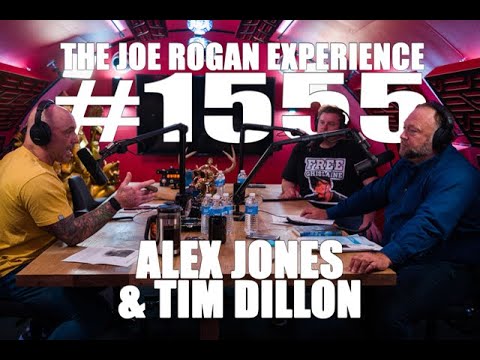
Joe Rogan Experience #1555 - Alex Jones & Tim Dillon
Narrator, Narrator, Joe Rogan (host), Jamie Vernon (guest), Alex Jones (guest), Tim Dillon (guest), Guest (guest), Guest (guest), Guest (guest), Narrator, Alex Jones (guest), Narrator, Narrator
In this episode of The Joe Rogan Experience, featuring Narrator and Narrator, Joe Rogan Experience #1555 - Alex Jones & Tim Dillon explores rogan, Jones, Dillon Clash Over Conspiracy, Censorship, and Control Joe Rogan hosts Alex Jones and Tim Dillon for a freewheeling, contentious conversation that jumps from Epstein, elite blackmail rings, and Skull & Bones to COVID policy, climate change, and Big Tech censorship. Rogan constantly pushes Jones to slow down, fact-check specifics, and separate documented facts from speculation, while Dillon often reframes Jones’s claims in more grounded political terms. The episode repeatedly returns to three core themes: elite abuse of power, the dangers of centralized control over speech and information, and how public fear (from terrorism, climate, or COVID) can be used to expand that control. Mixed into the heavy topics are long tangents, jokes, and personal admissions about stress, health, and the impact of doing this kind of work for decades.
Rogan, Jones, Dillon Clash Over Conspiracy, Censorship, and Control
Joe Rogan hosts Alex Jones and Tim Dillon for a freewheeling, contentious conversation that jumps from Epstein, elite blackmail rings, and Skull & Bones to COVID policy, climate change, and Big Tech censorship. Rogan constantly pushes Jones to slow down, fact-check specifics, and separate documented facts from speculation, while Dillon often reframes Jones’s claims in more grounded political terms. The episode repeatedly returns to three core themes: elite abuse of power, the dangers of centralized control over speech and information, and how public fear (from terrorism, climate, or COVID) can be used to expand that control. Mixed into the heavy topics are long tangents, jokes, and personal admissions about stress, health, and the impact of doing this kind of work for decades.
Key Takeaways
Always separate verifiable facts from interpretation when consuming controversial claims.
Rogan repeatedly forces Jones to slow down, name sources, and pull up documents; the exercise shows how much of Jones’s material is a mix of accurate kernels, outdated reports, and speculative connections.
Get the full analysis with uListen AI
Centralized control over speech on major platforms is already shaping political reality.
The guests argue that Twitter and Facebook blocking the New York Post’s Hunter Biden story, while banning accounts for sharing it, is a clear example of private tech acting as de facto gatekeepers of election-related information.
Get the full analysis with uListen AI
Elite scandals tend to have both real abuse and exaggerated myth layered together.
Discussions of Epstein, Ghislaine Maxwell, and older cases like the Finders and Franklin scandal illustrate that some high-level trafficking and blackmail operations are proven, while internet movements like QAnon often spin these into cartoonish, unfalsifiable narratives.
Get the full analysis with uListen AI
Fear-driven crises can be used to justify lasting expansions of state and corporate power.
By analogizing COVID-19 and climate change to the post‑9/11 ‘war on terror,’ the conversation highlights how emergencies can normalize surveillance, lockdowns, and new controls that outlast the original threat.
Get the full analysis with uListen AI
Policy disagreements on COVID and climate often mask deeper fights over who decides.
The arguments over lockdowns, masks, carbon emissions, and nuclear power are less about raw science in the episode and more about whether nation-states, global bodies, or corporations should define acceptable risk and behavior.
Get the full analysis with uListen AI
Echo chambers and deplatforming can radicalize rather than defuse fringe movements.
Rogan contends that banning people or ideas (e. ...
Get the full analysis with uListen AI
Even ‘truth‑seekers’ face personal limits: burnout and health erosion are real risks.
Jones openly describes stress, substance use, and physical issues from decades of nonstop activism and research, underscoring the personal cost of living perpetually inside worst-case scenarios.
Get the full analysis with uListen AI
Notable Quotes
“The best way to counter wrong speech is correct speech.”
— Joe Rogan
“Once they silence you, they can then make up whatever they want.”
— Alex Jones
“If you take everybody’s ability to communicate away, there’s nothing left to do but commit acts of violence.”
— Tim Dillon
“You get so much right, but when you get something wrong, that’s what people jump on.”
— Joe Rogan (to Alex Jones)
“I’m not trying to make stuff up 99% of the time.”
— Alex Jones
Questions Answered in This Episode
Where exactly should the line be drawn between responsible content moderation and dangerous censorship on major platforms?
Joe Rogan hosts Alex Jones and Tim Dillon for a freewheeling, contentious conversation that jumps from Epstein, elite blackmail rings, and Skull & Bones to COVID policy, climate change, and Big Tech censorship. ...
Get the full analysis with uListen AI
How can an average listener practically distinguish between documented elite wrongdoing and exaggerated or false conspiracy narratives?
Get the full analysis with uListen AI
What long-term social and political effects might arise from normalizing emergency measures like lockdowns, surveillance, and health passes?
Get the full analysis with uListen AI
Is it possible to have a serious, evidence-based debate about climate or COVID policy without it being immediately captured by partisan or corporate interests?
Get the full analysis with uListen AI
Given the personal toll described by Jones, what ethical responsibility do audiences and hosts have when platforming highly charged, conspiratorial content?
Get the full analysis with uListen AI
Transcript Preview
(drumming music) Joe Rogan podcast, check it out.
The Joe Rogan Experience.
Train by day, Joe Rogan podcast by night. All day. (rock music) Young Jamie back in the fucking saddle. How you feeling?
Very well, thank you.
COVID-free four days in a row now.
I've kicked it.
Yeah. And now, uh, you still can't taste anything?
Can't taste s- well, it's, it's-
You like a battery?
... starting to come back today. But yeah, like 5% taste. Yeah, it's gotta be... Pickle juice doesn't even taste like anything.
Really?
Yeah.
It just tastes like water?
Mm-hmm.
Whoa.
Very weird.
But you don't have any residual symptoms? Nothing wrong?
No, all good. Can breathe everything. Yeah.
Good to see you back, buddy.
O2, good.
We're a little worried about you.
Thanks.
Just a little worried about you. Not worried about you. Alex Jones.
This is the most anticipated thing I ever did. I've probably had, no exaggeration, two or 3,000 people in the last year and a half ask me, "When are you going back on Joe Rogan?" And I'm always saying, "I don't know. I don't know." And then I learned you were moving here like three, four months ago. And now we're here, and this is, this is exciting. I don't get, uh, butterflies anymore, but I actually have them here, and this is, this is great. It's good to have butterflies after about 20 years. Didn't get it the last two times I was on, didn't get it when I interviewed Trump, didn't get it on a lot of things, but I've got butterflies here today.
And Tim, motherfucking, Timmy.
Yeah, I'm just a kid in a candy store.
Me too. (laughs)
Thank you. Thank you for making this dream come true.
(laughs)
This is what I've always wanted to do, and we've made it happ-... This is my Make-A-Wish. I can die happy.
Well, I'm happy you're here.
Yeah, I got my Free-Jiz-Lane shirt because I believe all women.
Is that how you say it?
It's... I think so, yeah.
I thought it was-
Jizlane.
... Ghislaine. I thought it was-
It might be Ghislaine.
It's Ghislaine.
(laughs)
Do you know?
Don't look at me. No, I haven't...
Ghislaine?
It's Ghislaine.
Ghislaine? That's a ridiculous name.
Yeah.
Her father was a, uh, famous, uh, MI6 Mossad spy that reportedly used sex operatives to control people. He died being thrown off a yacht, uh, in the middle of the Atlantic Ocean. And, of course, she, uh, got caught in that farmhouse on the East Coast, and she was really the pimp over Epstein in a giant sex network ring over scientists that they were compromising, uh, so they could control not just government, but industry and science. And so, that was the master blackmail operation they were running.
Install uListen to search the full transcript and get AI-powered insights
Get Full TranscriptGet more from every podcast
AI summaries, searchable transcripts, and fact-checking. Free forever.
Add to Chrome