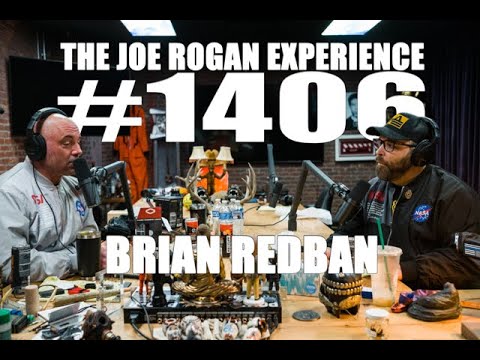
Joe Rogan Experience #1406 - Brian Redban
Jamie Vernon (host), Brian Redban (guest), Joe Rogan (host), Jamie Vernon (host), Brian Redban (guest), Brian Redban (guest), Brian Redban (guest), Brian Redban (guest), Brian Redban (guest), Brian Redban (guest), Narrator, Brian Redban (guest), Jamie Vernon (host), Brian Redban (guest), Brian Redban (guest), Brian Redban (guest), Brian Redban (guest)
In this episode of The Joe Rogan Experience, featuring Jamie Vernon and Brian Redban, Joe Rogan Experience #1406 - Brian Redban explores joe Rogan and Brian Redban Spiral Through Tech, Conspiracy, War, Shit Joe Rogan and Brian Redban spend a long, loose conversation jumping between technology, internet culture, medicine, conspiracy theories, politics, and bodily functions. They speculate on how the internet reshapes society, polarization, and celebrity call‑outs like Greta Thunberg and Ricky Gervais. The episode dives into contentious topics like Jeffrey Epstein’s death, Iran and Trump’s power, sex work, and media manipulation, often through a skeptical or conspiratorial lens. Interspersed are personal anecdotes about health experiments, injuries, diet, psychedelics, and even graphic discussions of diarrhea and bidets.
Joe Rogan and Brian Redban Spiral Through Tech, Conspiracy, War, Shit
Joe Rogan and Brian Redban spend a long, loose conversation jumping between technology, internet culture, medicine, conspiracy theories, politics, and bodily functions. They speculate on how the internet reshapes society, polarization, and celebrity call‑outs like Greta Thunberg and Ricky Gervais. The episode dives into contentious topics like Jeffrey Epstein’s death, Iran and Trump’s power, sex work, and media manipulation, often through a skeptical or conspiratorial lens. Interspersed are personal anecdotes about health experiments, injuries, diet, psychedelics, and even graphic discussions of diarrhea and bidets.
Key Takeaways
The internet accelerates both progress and polarization.
Rogan argues the internet massively boosted technological advancement and information access, but also lets extreme opinions dominate, distorting how representative those views are of the general population.
Get the full analysis with uListen AI
Public figures and children in activism carry heavy psychological risk.
They question the ethics of thrusting Greta Thunberg into a brutal global climate debate at such a young age, noting the hostility and scrutiny she faces regardless of the validity of her views.
Get the full analysis with uListen AI
Institutional trust erodes when high-profile cases look manipulated.
Their breakdown of Epstein’s autopsy photos, broken cameras, and procedural anomalies reinforces a belief that elites can literally ‘get away with murder,’ deepening conspiracy thinking and skepticism toward official narratives.
Get the full analysis with uListen AI
Celebrity and corporate virtue signaling often rings hollow.
Using Ricky Gervais’s Golden Globes monologue, they highlight the disconnect between Hollywood’s moral posturing and its ties to companies accused of sweatshops or exploitative labor practices.
Get the full analysis with uListen AI
Concentrated political power plus social media megaphones is volatile.
They worry that a president with unilateral military power and an unfiltered Twitter presence could spark disproportionate conflicts (e. ...
Get the full analysis with uListen AI
Legal bans don’t erase demand; they just push markets underground.
In discussing prostitution, they argue that making sex work illegal doesn’t stop it, but instead hands control to criminals and pimps, reducing safety and transparency for sex workers.
Get the full analysis with uListen AI
Radical diets and treatments can work—but evidence is still thin.
Rogan details his carnivore diet experiment, CBD use, and interest in stem cells/PRP while openly admitting that nutrition and recovery science is messy, contested, and highly individual.
Get the full analysis with uListen AI
Notable Quotes
“When you’re doing a podcast, you don’t have to be factually accurate. You just have to talk shit.”
— Joe Rogan
“That’s the kind of guy you whack.”
— Joe Rogan (on Jeffrey Epstein)
“If ISIS started a streaming service, you’d call your agent.”
— Ricky Gervais (quoted by Joe Rogan)
“The world’s fucked. We’re fucked. It’s all ending. I’m a little nervous about Iran though.”
— Joe Rogan
“You can’t make life prettier by pulling Donald Trump out of Home Alone.”
— Joe Rogan
Questions Answered in This Episode
How much responsibility do podcasters have to distinguish between speculation and fact when millions treat their conversations as quasi-news?
Joe Rogan and Brian Redban spend a long, loose conversation jumping between technology, internet culture, medicine, conspiracy theories, politics, and bodily functions. ...
Get the full analysis with uListen AI
Does putting teenage activists like Greta Thunberg at the center of global debates do more long-term harm or good—for them and for the causes?
Get the full analysis with uListen AI
What specific reforms or transparency measures would meaningfully rebuild public trust after cases like Jeffrey Epstein’s death?
Get the full analysis with uListen AI
Can celebrity call-outs of corporate hypocrisy (like Gervais’s Apple/ISIS joke) actually change behavior, or do they just entertain and briefly shame?
Get the full analysis with uListen AI
Should sex work be fully legalized and regulated, and if so, what model (e.g., New Zealand, parts of Europe) best balances safety, autonomy, and exploitation concerns?
Get the full analysis with uListen AI
Transcript Preview
(instrumental music plays) Hello, Joe.
Hello, Joe.
Happy New Year.
Happy 2020.
Happy 2020. That doesn't sound real. 2020 sounds like a fake number. Like, we're in the year 2020, that's like a movie about the future.
Yeah.
So-
We've already gone past the Blade Runner date, you know?
When was the Blade Runner date?
I think that was September or October of the ni- or last year.
You know what's interesting about the estimations about the future? No one ever over est- or underestimates. Everyone overestimates, right?
Right.
Like, Space 1999, remember that show?
Yep.
That was a ... I'm older than you, but when that show was on TV, people thought that in 1999, we'd be just fucking flying around through space all the time and living out there. (laughs)
Yeah, like Buck Rogers stuff.
Yeah. All those, all those shows, like ... So Blade Runner was what year?
Uh, this last year. 2019.
2019.
Wow. They missed that, huh?
They ... Yeah. Yeah. 'Cause it's funny when they show it in the movie, it shows like the background looks like, like cr- like s- flying cars and, like-
Mm-hmm.
... crazy, you know, billboards and everything.
I wonder where technology would be if it wasn't for the internet. Imagine if the internet was not possible, but technology still advanced electronically, like the cap- capability of, you know, showing higher resolution images and processing power and all that stuff kept moving, but they never figured out how to link it all up.
Yeah. That's weird.
That's the scariest thing about the internet. It's almost like they put i- uh, like the future put ideas in people's heads and those people just started figuring out a way to connect everybody and then connect all this crazy computing power and all this information and you could translate it in real time and do it all around the world. And the ... What, what a better way to get the technology to advance. 'Cause if it wasn't for the internet, how much ... Where would we, we be at realistically?
We'd still be racist, we'd still be molesting people at war.
Still have nuclear bombs.
We'd still have nuclear bombs.
We'd still have radio, we'd still have TV.
Yeah. 'Cause that's what's, uh, causing all the problems, uh, you know, in Hollywood and everything, and life, and, you know, look at all this s- stuff that's going on right now with, uh, Trump and everything like that. Like, it's the internet getting together going, "No, this is wrong, this is right." It's people-
Mm-hmm.
... uh, becoming gangs immediately.
I think it's a side effect of something that's ultimately gonna be good. That's what I think. I think we're learning how to figure it out. But I think ultimately it's gonna be good. Because w- what it is is like everybody gets to have an opinion. And through those opinions you find out which ones make any sense, which ones are crazy, and which o- ... But, like, right now it's like the people that are really into expressing their opinions on both sides are usually the ones that, like, e- ev- that everybody else is like, "Hey, hey, hey, fucking relax, man. Like w- this isn't it ..." M- I think most of us have some sort of a middle ground on almost everything, but that's not represented right now because right now it's like the most extreme people are the ones who are putting the most energy into talking about things. Like, this Greta Thunberg girl, do they have to go to her every time anybody says anything wrong about the climate? 'Cause apparently Meat Loaf said something.
Install uListen to search the full transcript and get AI-powered insights
Get Full TranscriptGet more from every podcast
AI summaries, searchable transcripts, and fact-checking. Free forever.
Add to Chrome