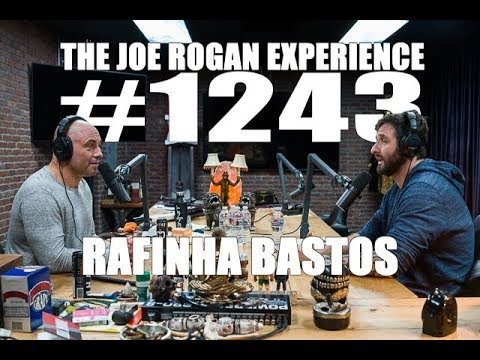
Joe Rogan Experience #1243 - Rafinha Bastos
Rafinha Bastos (guest), Joe Rogan (host), Narrator, Narrator, Narrator
In this episode of The Joe Rogan Experience, featuring Rafinha Bastos and Joe Rogan, Joe Rogan Experience #1243 - Rafinha Bastos explores brazilian Comedy Pioneer Rafinha Bastos on Censorship, Culture, Freedom Joe Rogan interviews Brazilian comedian Rafinha Bastos about pioneering stand-up comedy in Brazil, where comedy was historically based on loud characters and impersonations rather than personal, observational material. Bastos explains how he helped build a stand-up scene from BDSM clubs to 5,000-seat theaters and a 300-seat comedy club, only to be hit by lawsuits, media attacks, and public outrage over controversial jokes. They compare U.S. free speech protections with Brazil and Canada, discussing how weak legal protections plus click-driven media made him a target and eventually pushed him to start over in America in English. The conversation also dives into race and language taboos, social media toxicity, cult-like influence, MMA, and how stand-up functions as a cultural pressure valve and a test lab for ideas.
Brazilian Comedy Pioneer Rafinha Bastos on Censorship, Culture, Freedom
Joe Rogan interviews Brazilian comedian Rafinha Bastos about pioneering stand-up comedy in Brazil, where comedy was historically based on loud characters and impersonations rather than personal, observational material. Bastos explains how he helped build a stand-up scene from BDSM clubs to 5,000-seat theaters and a 300-seat comedy club, only to be hit by lawsuits, media attacks, and public outrage over controversial jokes. They compare U.S. free speech protections with Brazil and Canada, discussing how weak legal protections plus click-driven media made him a target and eventually pushed him to start over in America in English. The conversation also dives into race and language taboos, social media toxicity, cult-like influence, MMA, and how stand-up functions as a cultural pressure valve and a test lab for ideas.
Key Takeaways
Building a new comedy form in a different culture requires education as much as performance.
In Brazil, audiences were used to character-based, slapstick TV comedy, so Bastos and a handful of peers had to explain what stand-up is—original material, personal opinions, and context—before it could gain mainstream traction.
Get the full analysis with uListen AI
Weak free-speech protections make comedians legally vulnerable to ‘offense’ and media framing.
Brazil lacks a First Amendment; celebrities and politicians successfully sued Bastos for defamation and ‘offending honor’ over jokes, and journalists mined late-night sets for lines they could strip of context to generate outrage and clicks.
Get the full analysis with uListen AI
Context is everything in comedy, but it’s the first thing lost in outrage cycles.
Bits tested once in a small club or improvised rape jokes became national scandals once printed without tone or setup; both Bastos and Rogan emphasize that stand-up is a workshop, not a finished product, and judging raw material as final is misleading.
Get the full analysis with uListen AI
Translating comedy across languages and cultures demands more than literal translation.
Some of Bastos’ Portuguese jokes work structurally in English but clash with American racial sensitivities; he’s learned to reframe them (e. ...
Get the full analysis with uListen AI
Overregulating offensive speech can radicalize people instead of reforming them.
They argue that banning, deplatforming, or legally punishing speech—whether on campus, in clubs, or online—doesn’t erase bad ideas; it often strengthens tribal identities, drives conversation underground, and fuels extremist subcultures.
Get the full analysis with uListen AI
Platforms and brands quietly shape what’s ‘allowed’ much more than governments do.
Rogan and Bastos note that Twitter, YouTube, and TV networks respond primarily to advertiser and shareholder pressure, which pushes them to suppress controversial content, demonetize topics, and ban certain opinions, often under the banner of safety.
Get the full analysis with uListen AI
Comedy is both a personal lifeline and a cultural release valve.
For Bastos, escaping lawsuits and a death threat by rebuilding in the U. ...
Get the full analysis with uListen AI
Notable Quotes
““It’s not that easy to do comedy outside of America. You built that freedom.””
— Rafinha Bastos
““The real problem is not the words. The real problem is actual, real racism.””
— Joe Rogan
““I wanna be sued by the good ones… I don’t wanna be known by a bad joke.””
— Rafinha Bastos
““How can you judge if the work is not done? He was just testing stuff.””
— Rafinha Bastos (on Louis C.K.’s leaked set)
““If you wanna be an asshole, just deal with the consequences.””
— Rafinha Bastos
Questions Answered in This Episode
How should legal systems balance protecting individuals’ dignity with preserving genuine free speech for comedians and artists?
Joe Rogan interviews Brazilian comedian Rafinha Bastos about pioneering stand-up comedy in Brazil, where comedy was historically based on loud characters and impersonations rather than personal, observational material. ...
Get the full analysis with uListen AI
When a joke is taken out of context and causes real harm, what responsibility—if any—does the comedian have beyond saying it was ‘just a joke’?
Get the full analysis with uListen AI
Are platforms like Twitter and YouTube acting more like neutral utilities or ideological publishers when they ban or demonetize certain content?
Get the full analysis with uListen AI
How much should comedians adapt their material to cultural sensitivities when performing in a new country versus insisting on their original voice?
Get the full analysis with uListen AI
Could Brazil’s growing stand-up scene eventually push legal and cultural change around censorship and controversial speech, as Lenny Bruce helped do in the U.S.?
Get the full analysis with uListen AI
Transcript Preview
I'm gonna wait for the green sign before I point.
Okay. Boom? Good? Okay. We had some tech-
Yeah.
... technical difficulties.
No problem, brother. Sorry.
Let's try it again.
Okay.
So, anyway, brother, welcome. Thanks for coming here.
Thanks, my friend. Thanks. Thanks for having me.
So, what we were saying before... uh, we actually said this already, but let's say it again-
Okay.
... because the people didn't hear it. You-
Don't worry.
... you were one of the pioneers of stand-up comedy in Brazil.
Yeah. Yeah, it was, uh, I started with, like, four or five guys. We started doing, like, psh- 16, 17 years ago. And, uh, nobody knew about standup. It was something that I found out when I came here to live and play basketball. I had a scholarship to play basketball, and I watched Jim Gaffigan.
Oh, wow.
And Brian Regan.
Ah, I know those guys. (laughs)
And I thought it was so weird, because those guys were, like, that's- I was questioning, "Is- is his, uh, does he call- is his name Brian Regan? Does he- is that actually him?" Because we used to have characters and impersonators. So, it was, uh, kinda weird, but at the same time, it was interesting, because I'm not a guy who does characters. And I do observations, and I write. I was a journalist. I'm- I'm- have a degree in journalism, so it was interesting for me to see those guys doing comedy, and I thought we could do the same in my country.
It's so crazy that it took that long for it to get to Brazil.
Yeah.
You would think that- because everything else, I mean, you guys have movies-
Mm-hmm.
... and, you know, uh, I mean, City of God, you have action movies, you have all these- you have so much that's so similar. The fact that standup comedy made it there is so unusual.
It took, uh, it took a long time, and it was, (sighs) I don't know why, but the image of a comedian speaking, like, with a blazer or f- a- like, a suit or something was-
Like Jerry Seinfeld.
Yeah, it was-
Yeah.
... very American, you know?
Oh.
And those jokes didn't actually connect that much with us. Like, "Oh, I have those pockets," and it was something that we have bigger problems than-
(laughs)
... "Oh, I just have a pocket."
Yeah.
Or, "Where am I gonna put my pen?" It was like- it was- it was something that I couldn't- we couldn't connect that much. But-
Mm-hmm.
... when we- w- when we saw there was other people doing other stuff and y- there was, like, this huge road that we could actually explore, that was when it become interesting for us.
Install uListen to search the full transcript and get AI-powered insights
Get Full TranscriptGet more from every podcast
AI summaries, searchable transcripts, and fact-checking. Free forever.
Add to Chrome