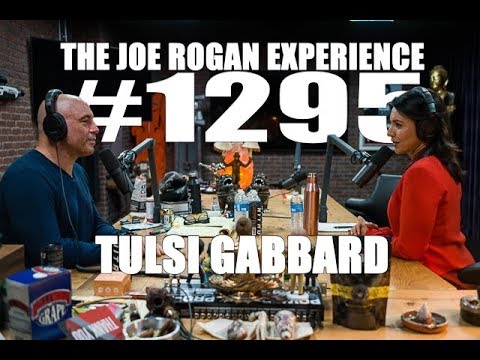
Joe Rogan Experience #1295 - Tulsi Gabbard
Joe Rogan (host), Tulsi Gabbard (guest), Narrator, Narrator
In this episode of The Joe Rogan Experience, featuring Joe Rogan and Tulsi Gabbard, Joe Rogan Experience #1295 - Tulsi Gabbard explores tulsi Gabbard Challenges War Machine, Big Tech, And Party Politics Tulsi Gabbard joins Joe Rogan to explain why she’s running for president, centering her campaign on ending regime-change wars, the new Cold War, and the military‑industrial complex’s grip on U.S. policy.
Tulsi Gabbard Challenges War Machine, Big Tech, And Party Politics
Tulsi Gabbard joins Joe Rogan to explain why she’s running for president, centering her campaign on ending regime-change wars, the new Cold War, and the military‑industrial complex’s grip on U.S. policy.
She argues that trillions wasted on foreign interventions should be redirected to domestic needs like healthcare, infrastructure, education, housing, and environmental protection, and details how war policies actually undermine U.S. security.
The conversation also covers media smears over her Syria visit, the corruption of campaign finance and lobbying, the dangers of Big Tech’s power over speech and data, and structural economic issues such as automation, wages, taxes, and the opioid crisis.
Gabbard positions herself as a soldier‑citizen candidate: anti-interventionist, funded only by individuals, critical of both parties’ establishments, and committed to civil discourse in a hyper‑partisan era.
Key Takeaways
End regime‑change wars to reclaim trillions for domestic priorities.
Gabbard argues Iraq, Libya, Syria, and similar interventions have made target countries more chaotic, strengthened terrorists, and cost the U. ...
Get the full analysis with uListen AI
Confront the military‑industrial complex and close the revolving door.
She highlights Eisenhower’s warning and describes how Pentagon officials and defense contractors trade jobs and contracts, insisting on reforms to ban pay‑to‑play, stop arming terrorists, and end contractor capture of policy.
Get the full analysis with uListen AI
Rebalance foreign policy toward diplomacy and true national security.
Gabbard wants the U. ...
Get the full analysis with uListen AI
Regulate Big Tech like a public utility and break up monopolies.
She warns that a few platforms control what information people see and what speech is allowed, calling for antitrust action (e. ...
Get the full analysis with uListen AI
Attack systemic corruption: PAC money, lobbyists, and think‑tank influence.
Gabbard’s campaign rejects PAC and lobbyist money; she calls for banning PAC donations to members of Congress, regulating the revolving door with Wall Street and defense firms, and forcing disclosure of foreign funding for ‘expert’ think tanks.
Get the full analysis with uListen AI
Prepare for automation and inequality with wage, tax, and UBI reforms.
She supports a higher federal minimum wage (e. ...
Get the full analysis with uListen AI
Protect civil liberties by rolling back mass surveillance and punishing opioid profiteers.
Gabbard wants to reform or replace secretive FISA processes, oppose Assange and Snowden prosecutions, and pass laws to criminally hold companies like Purdue Pharma accountable, while expanding addiction treatment and ending marijuana prohibition to reduce opioid harm.
Get the full analysis with uListen AI
Notable Quotes
“I’m on a mission… ending these wasteful regime‑change wars and this new Cold War and nuclear arms race.”
— Tulsi Gabbard
“Take your tinfoil hat off, because the military‑industrial complex is a real thing.”
— Tulsi Gabbard
“If the best our president can do to help support the creation of jobs is to build weapons that are being dropped on innocent people in Yemen, then we need a new president.”
— Tulsi Gabbard
“This path of hyper‑partisanship and extreme divisiveness ends in civil war.”
— Joe Rogan (paraphrasing his concern about deplatforming and polarization)
“Washington continues to underestimate the power of the people.”
— Tulsi Gabbard
Questions Answered in This Episode
How realistic is it to significantly cut defense and foreign intervention spending given entrenched military‑industrial interests and bipartisan support for high Pentagon budgets?
Tulsi Gabbard joins Joe Rogan to explain why she’s running for president, centering her campaign on ending regime-change wars, the new Cold War, and the military‑industrial complex’s grip on U. ...
Get the full analysis with uListen AI
What specific legal and structural reforms would be necessary to meaningfully ‘break up’ Big Tech while preserving innovation and free expression?
She argues that trillions wasted on foreign interventions should be redirected to domestic needs like healthcare, infrastructure, education, housing, and environmental protection, and details how war policies actually undermine U. ...
Get the full analysis with uListen AI
How can the U.S. pivot away from Saudi Arabia and other abusive ‘allies’ without creating power vacuums or destabilizing global energy markets?
The conversation also covers media smears over her Syria visit, the corruption of campaign finance and lobbying, the dangers of Big Tech’s power over speech and data, and structural economic issues such as automation, wages, taxes, and the opioid crisis.
Get the full analysis with uListen AI
What would a credible, large‑scale transition plan look like for workers displaced by automation, beyond universal basic income—especially for older and low‑skill workers?
Gabbard positions herself as a soldier‑citizen candidate: anti-interventionist, funded only by individuals, critical of both parties’ establishments, and committed to civil discourse in a hyper‑partisan era.
Get the full analysis with uListen AI
How far should the U.S. go in protecting whistleblowers like Snowden and Assange when their disclosures expose illegal government activity but also touch highly classified national security programs?
Get the full analysis with uListen AI
Transcript Preview
Three, two, one. And we're back. What's up? How are you?
We're back.
Good to see you.
Hello. I'm good.
So-
Nice to be back here.
... when you first came here, you were thinking about running for president.
Yeah.
Now, you're out there.
We're all in.
It's happening.
Yes.
Are you nervous?
No.
Is it weird?
No.
No?
Not at all.
None of it? Well, do you feel like this is like destiny?
No, um-
So how does it not feel weird?
I'm on a mission.
Oh.
I'm on a mission. Uh, you know, there, there's a lot of issues I think we're gonna talk about about why I'm running for president, uh, but being out and connecting with people all across this country, bringing this message, um, really of, of ending these wasteful destructive, uh, foreign policies that have been so costly on the American people for so long, costly on our troops, costly on our veterans, ending these wasteful regime change wars, ending this new Cold War and nuclear arms race, and taking the trillions of dollars that we've been spending on these programs and, and that we will continue to spend if the status quo is allowed to continue, and investing those dollars back into serving the people in our communities, serving the people of this country, things like healthcare, education, infrastructure, uh, protecting our environment, clean water. There's so much that we need to do. We've got limited resources to accomplish that.
These are my favorite things that you talk about. Um, my question is always, though, why do we spend so much time and money and at, at such a titanic human cost-
Yeah.
... for these regi- regime ch- change wars?
Yeah.
What do you think is the cause? Like other than the obvious l- if, if we, you have a dictator that's in place, there's an obvious outcry like Saddam Hussein post 9/11.
Mm-hmm.
Other than that, what i- what is the reason why we invest so much time and energy into regime change war-
Yeah.
... so much so that we've just accepted that this is a part of our gross economy? Like, if we're gonna take all the money that the United States earns and all the money that goes to taxes, we just automatically-
Yeah.
... put a gigantic chunk of that into investing in these wars in other countries.
Yeah.
Why-
Blindly.
Why is that?
Blindly, almost, without any kind of, um-
It's a tradition.
... real accountability. Uh, $6 to $8 trillion is what's estimated that's been spent since 9/11 alone on these regime change wars, without even taking into account, uh, what the cost will continue to be to take care of our veterans, those who have gone and, and fought in these wars and have come home dealing with, you know, visible and invisible wounds that, that they'll have to live with for, for the rest of their lives. Let's start back. You mentioned Saddam Hussein. Uh, I don't think it was necessarily an obvious outcry. Saddam Hussein, uh, and the toppling of his regime was done for oil, right?
Install uListen to search the full transcript and get AI-powered insights
Get Full TranscriptGet more from every podcast
AI summaries, searchable transcripts, and fact-checking. Free forever.
Add to Chrome