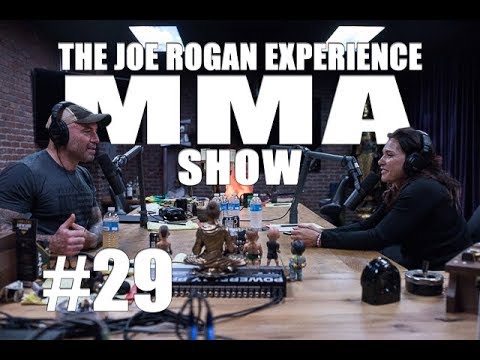
JRE MMA Show #29 with Cat Zingano
Joe Rogan (host), Cat Zingano (guest), Narrator
In this episode of The Joe Rogan Experience, featuring Joe Rogan and Cat Zingano, JRE MMA Show #29 with Cat Zingano explores cat Zingano Reveals Hidden Costs Of Fighting And Brain Recovery Journey Cat Zingano joins Joe Rogan to unpack her tumultuous MMA career, from long layoffs and major injuries to rebuilding her life and skills in San Diego. She details how the Amanda Nunes fight left her with a traumatic brain injury, permanent hypothyroidism, and cascading endocrine issues that Western medicine struggled to address. Zingano explains her experience with an experimental brain treatment (personalized rTMS at Mindset in San Diego), which she credits with restoring her cognition, timing, and emotional stability after years of fog, depression, and PTSD symptoms. Beyond health, they discuss weight-cutting, women’s divisions, gym changes, social media hate, and the deeper psychological drive that keeps her fighting despite the risks.
Cat Zingano Reveals Hidden Costs Of Fighting And Brain Recovery Journey
Cat Zingano joins Joe Rogan to unpack her tumultuous MMA career, from long layoffs and major injuries to rebuilding her life and skills in San Diego. She details how the Amanda Nunes fight left her with a traumatic brain injury, permanent hypothyroidism, and cascading endocrine issues that Western medicine struggled to address. Zingano explains her experience with an experimental brain treatment (personalized rTMS at Mindset in San Diego), which she credits with restoring her cognition, timing, and emotional stability after years of fog, depression, and PTSD symptoms. Beyond health, they discuss weight-cutting, women’s divisions, gym changes, social media hate, and the deeper psychological drive that keeps her fighting despite the risks.
Key Takeaways
Repeated head trauma can quietly devastate hormones and cognition.
Zingano’s TBI from Amanda Nunes led to sharply reduced estrogen, DHEA, testosterone, and permanent hypothyroidism, along with anxiety, poor sleep, memory issues, and emotional volatility—illustrating how much hidden damage a single brutal fight can cause.
Get the full analysis with uListen AI
Advanced brain therapies like personalized rTMS may restore lost function.
At Mindset in San Diego, she underwent EEG-guided magnetic stimulation twice daily for months; she reports regained pattern recognition, timing, focus, better sleep, and reduced PTSD/anxiety, with EEGs showing more normalized brain activity.
Get the full analysis with uListen AI
Fighters often keep competing while cognitively impaired, and fans never see it.
Before treatment, Zingano couldn’t retain drills in practice, couldn’t read opponents’ movements, and relied only on aggression—yet still fought at the UFC elite level, underscoring how invisible decline can be to audiences and matchmakers.
Get the full analysis with uListen AI
Current UFC insurance/treatment windows are poorly matched to brain injuries.
Because she didn’t file a claim within 30 days of the Nunes fight, long-tail neurological and endocrine issues weren’t covered, despite being obviously fight-related—highlighting structural gaps in fighter health protections.
Get the full analysis with uListen AI
Weight-cutting is aging-dependent and hormonally fragile, especially for women.
Zingano went from an easy 135 cut to walking around in the 170s post-TBI due to thyroid damage, and recalls nearly heat-stroking at 125; she argues more weight classes, catchweights, and less rigid contracts would reduce dangerous cuts.
Get the full analysis with uListen AI
Social media can seriously compound fighters’ mental health struggles.
Thrust into managing her own social media after her husband’s death, she read brutal comments while grieving and dealing with brain issues, until others convinced her that online haters are projecting their own misery and should be ignored.
Get the full analysis with uListen AI
For some fighters, the drive isn’t fame or money but existential proof.
Zingano says she fights to know “who gets the bone” if it were a real life‑or‑death struggle—she wants decisive finishes to answer that primal question and to fulfill what she feels is her purpose, not just collect wins.
Get the full analysis with uListen AI
Notable Quotes
““I need to know what would happen… who gets the bone?””
— Cat Zingano
““All I had was a gas pedal… I wasn’t reading patterns of people anymore.””
— Cat Zingano
““This is the head‑injury business. What people like is to see head injuries.””
— Joe Rogan
““I went into that center on two antidepressants and PTSD, and if they couldn’t fix me, I was gonna have to be done.””
— Cat Zingano
““I’ve never met a hater that’s doing great.””
— Joe Rogan
Questions Answered in This Episode
How should combat sports organizations change insurance policies and medical protocols to realistically address long-tail brain and endocrine injuries?
Cat Zingano joins Joe Rogan to unpack her tumultuous MMA career, from long layoffs and major injuries to rebuilding her life and skills in San Diego. ...
Get the full analysis with uListen AI
To what extent can therapies like rTMS become standard care for fighters, veterans, and athletes with TBIs, and what research is still needed?
Get the full analysis with uListen AI
Given what we now know about weight cuts, should MMA move toward hydration-based divisions like ONE Championship and abandon large dehydrating cuts?
Get the full analysis with uListen AI
How can fighters preserve their identity and sense of purpose once they retire, especially if their brains and bodies are already compromised?
Get the full analysis with uListen AI
What responsibility do fans and media have in how they talk about fighters’ losses, health, and mental struggles, given the invisible damage athletes may be dealing with?
Get the full analysis with uListen AI
Transcript Preview
Here we go in four, three, two, one. (claps) Boom. And we're live, Cat. How are you?
I'm good. How are you doing?
Good to see you here.
Yeah. Thanks for having me.
My pleasure. My ple- I've been looking forward to talking to you for a while.
I know. It's, uh, I feel like been a long time coming. I, I don't even know how much time we have. I feel like there's a, a hell of a lot to catch up on. So-
Yeah. There's a lot to talk about, always. You're, uh, getting ready for Boise? That's your, uh, your next fight?
Mm-hmm.
Who you fighting?
Um, Maryan Renau. Um, July 14th at the CenturyLink Arena.
Now, you took ... You took a good stretch off, right?
A couple times.
Yeah.
A couple times. I, um ... Let's see. After I fought Miesha, I blew my knee, and then the world exploded. And so I had, I think, 18 months off between that and fighting, uh, Amanda.
Mm-hmm.
And then, after I fought Amanda, I ... So Amanda was, like, September 27th, something like that. And I fought Rhonda February 28th, and then after Rhonda, uh, took another big stretch off. Fought Juliana the following year, uh, July 9th, and then this was another big stretch off. So yeah, it's been a little bit scattered, but doing what I can.
Yeah, and you were, you were doing some crazy therapy too, right? Some, some interesting stuff down in San Diego.
Yeah, so, um, there's, there's been a few things I've been working on. Like, I'm not a huge fan of Western medicine, you know? Like, uh, even ... Uh, I mean, you can call it alternative medicine, it's like original medicine. I, I appreciate looking at things like that way more than, you know, big farm, but I, uh ... You know, one thing that, um, you know, fighting has gotten me and, and stuff with, you know, I th- I think it's more prevalent in women al- although I'm sh- thinking it's happening with men too, is like, our endocrine systems are not happy with these weight cuts, and they're not happy with us, like, getting hit in the head a lot.
(laughs)
I mean, go figure, right? (laughs)
Yeah, go figure.
So, um, you know, within all of that, I've just, you know, had medical problems and things that, like, I'm constantly working on, and I feel really good. I'm, I'm constantly improving, but, um, one thing I was feeling a little bit stuck on was, uh, one, I was like, some of the endocrine problem issues, but, um, like, uh, I don't know. I, I had, uh, had... I went to this facility in, in San Diego's called, um ... Dang, why can't I remember? Oh, uh, Mindset. And actually the UFC sent me there because, I mean, we have USADA, we have all of these things like, um ... After fighting Amanda, I got my head pounded for a good four minutes there. Um, I had a TBI afterwards, so that was like, uh, immediately lowered my, uh, estrogen, lowered by DHEA, my testosterone, and I'm hypothyroid. Like, I will always be hypothyroid now. Like, I have-
Install uListen to search the full transcript and get AI-powered insights
Get Full TranscriptGet more from every podcast
AI summaries, searchable transcripts, and fact-checking. Free forever.
Add to Chrome