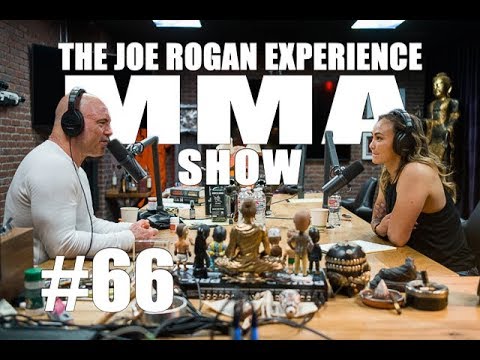
JRE MMA Show #66 with Michelle Waterson
Joe Rogan (host), Michelle Waterson (guest), Narrator
In this episode of The Joe Rogan Experience, featuring Joe Rogan and Michelle Waterson, JRE MMA Show #66 with Michelle Waterson explores karate Hottie Michelle Waterson On Fighting, Motherhood, And Mindset Michelle Waterson joins Joe Rogan to trace her journey from a broke 10-year-old doing church karate to a top UFC strawweight contender and aspiring 'mom champ.'
Karate Hottie Michelle Waterson On Fighting, Motherhood, And Mindset
Michelle Waterson joins Joe Rogan to trace her journey from a broke 10-year-old doing church karate to a top UFC strawweight contender and aspiring 'mom champ.'
She describes how point-karate, Muay Thai in Thailand, and early MMA experiences with Donald Cerrone and the Jackson-Wink team shaped her all‑around game.
They dig into weight cutting, USADA and steroids, extreme knockouts and slams, and the technical evolution of MMA and women’s divisions.
Waterson also shares how becoming a mother reshaped her career, how she uses sports psychology and visualization, and why she believes she deserves a UFC title shot next.
Key Takeaways
Non-linear paths can still lead to the elite level if you keep following the pull.
Waterson went from working at Hooters and being a ring girl to training with Donald Cerrone and dropping out of college to fight, proving that consistent action toward what excites you can redefine your trajectory.
Get the full analysis with uListen AI
Technical breadth and blending skills are now essential in modern MMA.
Her journey from point-karate to Muay Thai, grappling, and then learning to seamlessly connect kicks, punches, and takedowns illustrates that “blending” disciplines beats being great at one isolated art.
Get the full analysis with uListen AI
Mental rehearsal and cue words can dramatically strengthen performance under pressure.
Working with a sports psychologist, Waterson repeatedly ‘fights’ in her head and uses concise “power words” like “confidence” and “mom champ” as mental shortcuts to desired emotional states mid-fight.
Get the full analysis with uListen AI
Weight cutting is a structurally flawed but still normalized part of MMA.
They criticize drastic cuts as sanctioned cheating and health‑damaging, yet Waterson admits the cut feels like a final test; she keeps her own cut relatively small but argues hydration testing (like ONE’s model) would be safer and fairer.
Get the full analysis with uListen AI
PEDs and regulation gaps still shape competitive reality and legacy.
Through examples like TJ Dillashaw, Bob Sapp, and Pride’s lax steroid culture, they highlight how drugs can change durability, power, and gas tanks—and how improved testing both exposes abuse and complicates past legacies.
Get the full analysis with uListen AI
Fairness in women’s sport has hard biological lines in combat contexts.
Rogan and Waterson argue that male-to-female transgender athletes retain inherent physical advantages that make open competition with women unsafe and unfair, suggesting separate divisions rather than pretending categories are identical.
Get the full analysis with uListen AI
Parenthood doesn’t have to end ambition; it can redefine and fuel it.
Waterson describes training while breastfeeding, rebuilding after pregnancy, and bringing her daughter to every fight; she wants to become the first UFC champion who is already a mom to show other parents their goals are still possible.
Get the full analysis with uListen AI
Notable Quotes
“I remember walking around the cage as a ring girl thinking, ‘Man, I wanna be on the inside.’”
— Michelle Waterson
“I came back from Thailand, dropped out of college, and decided to pursue fighting.”
— Michelle Waterson
“I wanna be the first mom champ.”
— Michelle Waterson
“Weight cutting is nothing but sanctioned cheating.”
— Joe Rogan
“There are only a couple things you have to do as a fighter. Cutting weight is one of them.”
— Michelle Waterson
Questions Answered in This Episode
How much further could Waterson push her game if the UFC adopted ONE’s no-weight-cutting, hydration-based system?
Michelle Waterson joins Joe Rogan to trace her journey from a broke 10-year-old doing church karate to a top UFC strawweight contender and aspiring 'mom champ.'
Get the full analysis with uListen AI
In a rematch with Rose Namajunas or a title fight with Jessica Andrade, what specific tactical adjustments would Waterson prioritize based on their styles?
She describes how point-karate, Muay Thai in Thailand, and early MMA experiences with Donald Cerrone and the Jackson-Wink team shaped her all‑around game.
Get the full analysis with uListen AI
How might widespread, structured sports psychology change MMA if more fighters treated mental rehearsal as seriously as pad work and sparring?
They dig into weight cutting, USADA and steroids, extreme knockouts and slams, and the technical evolution of MMA and women’s divisions.
Get the full analysis with uListen AI
What is the fairest, most practical way to include transgender athletes in combat sports while protecting women’s divisions?
Waterson also shares how becoming a mother reshaped her career, how she uses sports psychology and visualization, and why she believes she deserves a UFC title shot next.
Get the full analysis with uListen AI
If Waterson achieves her ‘mom champ’ goal, how might that reshape expectations and support structures for future fighters who want both families and titles?
Get the full analysis with uListen AI
Transcript Preview
Two, one. Hello, Michelle.
(laughs) How's it going?
(laughs)
I was getting ready to crack my neck. So (laughs) it-
Oh, go ahead. Crack your neck.
I feel like I'm-
Put it on, put the microphone to it so we can hear it. Does it pop?
I think I just popped it.
Okay. Ooh.
Did you hear-
That was a good one.
(laughs)
That was a good one. Do you do that all the time?
Just when I'm getting ready to fight.
Throw down? (laughs)
Yeah. (laughs)
Pull this, uh, microphone like a fist from your face. There we go.
Is that better?
Yeah, perfect, perfect.
All right.
So what's happening?
No, we're just in town, um, uh, my brother-in-law just moved, just got stationed here in California, so we drove him down, and then we did the whole Disney thing.
San Diego?
Um, no. I think it's, it's actually an hour f- south of here, I think. S- it, it's not-
Oh, okay.
... close by, but mm-hmm.
Cool.
Air Force.
Oh, okay.
And so we did the whole Disney thing.
Is that Edwards?
Yes.
Oh, okay.
I think it is.
Yeah, oh, okay. I know where that is, yeah.
Mm-hmm. Yeah, so he got stationed there.
That was the first time I ever saw a, a, a stealth bomber. It was, like, uh, right after 9/11 when we were filming, um, uh, Fear Factor out there.
Mm-hmm.
And I saw one fly overhead. It was like a UFO. I was like, "Wow, that is crazy."
Does it look like a UFO?
Yeah, it doesn't even look real.
Really?
You ever seen one in real life?
I've never. Mm-mm.
Cr- it looks like a, like a Batmobile, like, like Batman's plane.
Mm-hmm.
It's so crazy. When you see one flying, you're like, "Wow, the engineering involved in something like that is insane."
And that was a while back.
Yeah.
'Cause it was Fear Factor.
Sure, it was 2001.
Mm-hmm.
'Cause it was right after 9/11, so it's 2000... That's it right there. That's what we saw. That's one of 'em. There's two. That's one of 'em? It's, uh, there's a B2 and then there's, like, a F1-16 or something like that. Mm. I don't know which one we saw, but it was black and wicked-looking.
Nice.
Yeah.
That's crazy. Looks like your Tesla (laughs) working.
Yeah, like, f- flying around in one of those things. That's what we saw.
And, well, imagine back then-
Mm-hmm.
... that's what it looked like back then. So what, what, what is there now?
Right, you probably can't see 'em. They'll probably look at the sky.
Install uListen to search the full transcript and get AI-powered insights
Get Full TranscriptGet more from every podcast
AI summaries, searchable transcripts, and fact-checking. Free forever.
Add to Chrome