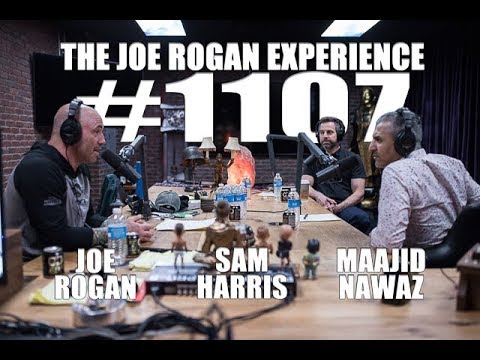
Joe Rogan Experience #1107 - Sam Harris & Maajid Nawaz
Joe Rogan (host), Maajid Nawaz (guest), Sam Harris (guest), Maajid Nawaz (guest), Sam Harris (guest), Joe Rogan (host), Joe Rogan (host)
In this episode of The Joe Rogan Experience, featuring Joe Rogan and Maajid Nawaz, Joe Rogan Experience #1107 - Sam Harris & Maajid Nawaz explores ex-Islamist, free speech, and identity politics collide on Rogan Joe Rogan hosts Sam Harris and Maajid Nawaz for a wide-ranging discussion on extremism, liberalism, and the current culture-war climate. Nawaz recounts his journey from British Islamist activist to political prisoner in Egypt and later founder of the counter‑extremism think tank Quilliam, explaining how torture, Amnesty International’s support, and debates with jihadists transformed his views. They dissect how organizations like the Southern Poverty Law Center and media outlets mislabel reformers as “anti‑Muslim extremists,” and how social-justice ideology blurs crucial distinctions between criticism of Islam and bigotry against Muslims. The conversation broadens to social media toxicity, deplatforming, race and IQ debates, transgender athletes in sports, the refugee crisis, and why ignoring Islamist ideology itself—not just its violent offshoots—remains dangerous.
Ex-Islamist, free speech, and identity politics collide on Rogan
Joe Rogan hosts Sam Harris and Maajid Nawaz for a wide-ranging discussion on extremism, liberalism, and the current culture-war climate. Nawaz recounts his journey from British Islamist activist to political prisoner in Egypt and later founder of the counter‑extremism think tank Quilliam, explaining how torture, Amnesty International’s support, and debates with jihadists transformed his views. They dissect how organizations like the Southern Poverty Law Center and media outlets mislabel reformers as “anti‑Muslim extremists,” and how social-justice ideology blurs crucial distinctions between criticism of Islam and bigotry against Muslims. The conversation broadens to social media toxicity, deplatforming, race and IQ debates, transgender athletes in sports, the refugee crisis, and why ignoring Islamist ideology itself—not just its violent offshoots—remains dangerous.
Key Takeaways
Distinguish criticism of Islam from bigotry against Muslims.
Nawaz and Harris argue that labeling Muslim reformers like Nawaz and Ayaan Hirsi Ali as “anti‑Muslim extremists” collapses a vital distinction: one can challenge doctrines, blasphemy laws, or treatment of gays and women while still advocating for Muslim communities’ wellbeing.
Get the full analysis with uListen AI
Mislabeling reformers has real-world costs and increases risk.
Being put on terrorist or ‘hate’ lists damaged Nawaz’s organization’s banking, chilled media engagement, and plausibly heightens personal security threats—showing how sloppy or ideological designations by groups like SPLC can materially endanger people trying to counter extremism.
Get the full analysis with uListen AI
Ideology, not just grievance, drives Islamist violence.
Nawaz stresses that while racism, wars, and events like Bosnia or Iraq fuel anger, the coherent project behind groups like Hizb ut‑Tahrir, Al‑Qaeda, and ISIS is rooted in specific Islamist doctrines (caliphate, Sharia punishments, apostasy laws) that must be confronted intellectually, not just militarily.
Get the full analysis with uListen AI
Social-justice frameworks often conflate facts with oppression.
Harris describes how postmodern-influenced thinking recasts empirical claims—about IQ distributions, sex differences, or religious attitudes—as inherently political, making some topics undiscussable without being branded racist or bigoted, which impedes honest policy-making.
Get the full analysis with uListen AI
Scientific facts about group differences don’t dictate policy.
In discussing IQ and gender differences, Harris argues we must decouple empirical findings from moral commitments: even if populations differ statistically, liberal societies should still treat individuals as individuals and aim for equal rights and opportunities, not engineer outcomes to match group averages.
Get the full analysis with uListen AI
Deplatforming and opaque moderation create ideological blind spots.
They highlight how platforms aggressively ban Western far‑right figures while known terrorist organizations like Hezbollah and Hamas retain accounts, revealing a cultural and linguistic blind spot that underestimates non‑Western forms of extremist incitement online.
Get the full analysis with uListen AI
ISIS’s territorial defeat doesn’t mean jihadist ideology is gone.
Nawaz warns that while ISIS’s bureaucracy has been rolled back, its ideas persist, Al‑Qaeda has quietly rebuilt in Syria, Yemen, North and East Africa, and Pakistan, and the grooming of Hamza bin Laden as a potential leader could reunify jihadist factions under a more charismatic brand.
Get the full analysis with uListen AI
Notable Quotes
““I was both a Muslim terrorist and an anti‑Muslim extremist according to two separate lists.””
— Maajid Nawaz
““The problem isn’t Al‑Qaeda‑inspired extremism; it’s extremism that inspired Al‑Qaeda.””
— Maajid Nawaz
““On the left there is this sense that the only way to move toward equality is to lie about what is scientifically plausible and demonize anyone who won’t lie with you.””
— Sam Harris
““It’s as absurd as arguing that the Spanish Inquisition had nothing to do with Catholicism.””
— Maajid Nawaz
““I don’t think a guy should be able to get his penis removed and beat the shit out of women.””
— Joe Rogan
Questions Answered in This Episode
How can liberal societies protect both Muslims from bigotry and critics of Islamist ideas from being smeared as ‘Islamophobic’?
Joe Rogan hosts Sam Harris and Maajid Nawaz for a wide-ranging discussion on extremism, liberalism, and the current culture-war climate. ...
Get the full analysis with uListen AI
What concrete criteria should organizations like the SPLC or tech platforms use when labeling or banning individuals, and who should hold them accountable?
Get the full analysis with uListen AI
Where should we draw the line between socially dangerous ideas that merit restriction and controversial ideas that should be debated openly?
Get the full analysis with uListen AI
How can policymakers and educators discuss sensitive data on group differences (race, gender, religion) without fueling prejudice or suppressing truth?
Get the full analysis with uListen AI
What long-term strategy—beyond military action—is needed to counter the ideological appeal of groups like Al‑Qaeda and ISIS to the next generation?
Get the full analysis with uListen AI
Transcript Preview
Four, three, two, one. Boom! And we're live. Gentlemen. Sam, Maajid, how are you?
Good, thanks.
Pleasure to meet you.
Pleasure, Joe.
Thanks for, uh, coming here.
Yeah. I'm re- very happy to get you guys together. I mean, that was, uh ... I've been kind of looking to do this for at least two years, and finally it's arrived.
What's been your ultimate goal? Like what was it ...
Well, he ... I mean, Maajid is just a superstar that needs more exposure. I mean, he's like-
Don't listen to that.
He should be running half of civilization. I mean, uh, he's, he's really a, just a fantastically ethical-
That's one of those quotable things you can put on the back of a book, isn't it?
Yeah. (laughs)
(laughs)
It's a good one.
You should be running half of civilization.
Yeah, but you should, shouldn't put that one. It has to be on the back of the book for sure.
(laughs)
Definitely not on the front.
(laughs)
People read it and go, "Superstar? Who the fuck is this guy?"
(laughs)
I c- I can't blurb the book we wrote together, unfortunately, so ...
Yeah.
Yeah.
That is an issue.
You're too kind, Sam. Thank you. It's, uh, it's very generous of you.
Um, are y- are you, are you suing the Southern Poverty Law Center?
(laughs)
Is that what's going on?
Yeah. I, I, in fact have an update for everybody 'cause, uh, you know, we crowdfunded, uh, a lot of the early costs for the case against the Southern Poverty Law Center.
What, what did they do? What is it, what is it based on?
Yeah. Let me back up a bit.
Please.
Um, once upon a time, uh, yours truly, a British Muslim, uh, of Pakistani origin was listed in the United Kingdom on the Thomson Reuters World-Check database under a category red terrorism designation, while at the same time being listed across the Atlantic in the United States by the Southern P- Poverty Law Center as an anti-Muslim extremist. So I was both a Muslim terrorist and an anti-Muslim extremist according to two separate lists. And of course, that speaks to some of the polarization in our times, in how irrational this conversation around extremism, Islam integration, Muslims in the West has become. I sued Thomson Reuters World-Check, the database. This database is no joke. It's like HSBC and, and many, many other banks use this database, uh, for background checks on whether clients can have a bank account with them. So as a result of, for example, Thomson Reuters and their database, uh, Quilliam, which is a counter-extremism organization I founded 10 years ago, had its bank account shut down in the United States because of the Thomson Reuters World-Check database system that HSBC subscribes to. Anyway, we sued them. They paid damages. They issued an apology, and they, uh, uh, uh, re- took my name off this, uh, terrorism designation list they have on their World-Check database.
Install uListen to search the full transcript and get AI-powered insights
Get Full TranscriptGet more from every podcast
AI summaries, searchable transcripts, and fact-checking. Free forever.
Add to Chrome