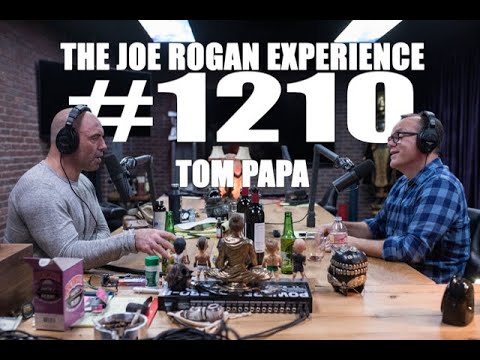
Joe Rogan Experience #1210 - Tom Papa
Joe Rogan (host), Tom Papa (guest), Guest (guest), Guest (guest), Narrator, Narrator
In this episode of The Joe Rogan Experience, featuring Joe Rogan and Tom Papa, Joe Rogan Experience #1210 - Tom Papa explores joe Rogan and Tom Papa Debate Violence, Faith, Tech, and Tranquility Joe Rogan and Tom Papa range widely from boxing and wine to pool cues, protests in Paris, family annihilators, religion, and the nature of good and evil.
Joe Rogan and Tom Papa Debate Violence, Faith, Tech, and Tranquility
Joe Rogan and Tom Papa range widely from boxing and wine to pool cues, protests in Paris, family annihilators, religion, and the nature of good and evil.
They examine how narratives form in modern media, how people search for meaning and community, and why men commit most extreme violence and war.
The conversation moves into technology, future human evolution, AI, and space travel, before returning to personal practices like meditation, exercise, and floating for mental health.
Throughout, they frame everything with dark humor, personal stories, and a recurring question: how do we live sanely and kindly in a chaotic, hyper-connected world?
Key Takeaways
Modern narratives are built from fragments, not full events.
Rogan and Papa note that most people only see clips, headlines, or emotional posts (like Tyson Fury's mental health story) and then feel as if they 'experienced' the whole event, which massively shapes public opinion without depth.
Get the full analysis with uListen AI
Extreme success often hides severe mental health and addiction issues.
Using Tyson Fury’s post-championship spiral into depression, weight gain, cocaine, and a near-suicide attempt, they show how reaching a life goal can trigger identity collapse, and how drugs and alcohol compound preexisting vulnerabilities.
Get the full analysis with uListen AI
Expert guides unlock far more value than price tags and brands.
Their wine and pool-cue stories illustrate that asking a passionate expert for underrated options (e. ...
Get the full analysis with uListen AI
Lack of real-world community is quietly crushing people.
They echo David Brooks’ argument that Americans are richer but less happy and dying younger, in part because church, workplace, and local hangout communities have eroded, leaving people isolated in gig jobs and apartments where no one knows their neighbors.
Get the full analysis with uListen AI
Violence is overwhelmingly a male problem, but context matters.
Rogan argues men commit almost all war, murder, and rape, raising the 'demon = men' idea, while also exploring how personality, genetics (epigenetics), culture, substances, and status pressures push some men into monstrous acts like family annihilation.
Get the full analysis with uListen AI
Institutions can be deeply flawed yet still meet real human needs.
They wrestle with the Catholic Church: genuine comfort, ritual, and community vs. ...
Get the full analysis with uListen AI
Deliberate mental 'reboots' dramatically improve daily bandwidth.
Papa describes daily transcendental meditation as adding “four extra hours” of good energy to his day, while Rogan compares it to other perspective resets (exercise, travel, float tanks) that release nervous-system overload and restore clarity.
Get the full analysis with uListen AI
Notable Quotes
“If a demon was real, the demon would be men.”
— Joe Rogan
“We’re richer than we’ve ever been, but we’re unhappier than ever before.”
— Tom Papa (paraphrasing David Brooks)
“I behave as if God exists.”
— Joe Rogan (quoting Jordan Peterson’s stance on God)
“We haven’t been here that long. We were monkeys just a couple weeks ago.”
— Joe Rogan
“Everybody’s drowning in insecurity. That’s how I try to walk around and see people.”
— Tom Papa
Questions Answered in This Episode
How much responsibility do we each have to verify stories before forming strong opinions in a social-media-driven narrative culture?
Joe Rogan and Tom Papa range widely from boxing and wine to pool cues, protests in Paris, family annihilators, religion, and the nature of good and evil.
Get the full analysis with uListen AI
If most extreme violence is committed by men, what practical cultural or structural changes could reduce that without demonizing all men?
They examine how narratives form in modern media, how people search for meaning and community, and why men commit most extreme violence and war.
Get the full analysis with uListen AI
Can you genuinely separate the value a religious community provides from the moral failures of its institution, and where is your personal line?
The conversation moves into technology, future human evolution, AI, and space travel, before returning to personal practices like meditation, exercise, and floating for mental health.
Get the full analysis with uListen AI
Is humanity’s obsessive drive to build technology and accumulate 'stuff' just ego, or could it be serving some larger evolutionary or cosmic purpose?
Throughout, they frame everything with dark humor, personal stories, and a recurring question: how do we live sanely and kindly in a chaotic, hyper-connected world?
Get the full analysis with uListen AI
What daily practice—meditation, exercise, community, creative work—most effectively resets your nervous system and keeps you from burning out?
Get the full analysis with uListen AI
Transcript Preview
... interesting how, how promotions work.
(laughs) Yeah. (laughs)
Here we go. Four, three, two, one. So, Tom Pop and I are sitting here.
Yeah.
And I say, "Do you s- did you see the fight on Saturday night?"
(laughs)
And he said, "The guy that got knocked down? Mental health guy?"
The mental health guy?
(laughs) No.
The guy who got up for everyone with mental health? (laughs)
Yeah. But he said, "No, I didn't see the fight." Like-
"I only saw, (laughs) I only saw that."
... this is how narratives work.
Yeah.
You know what I mean? Like, in this day and age especially-
(laughs)
... there's way too much information out there, right?
Yeah.
Like, there's no way you could see every television show or watch every sporting event-
No.
... or, or know every scandal.
(laughs) Yeah.
So when something happens, you're like, "Oh, uh, the blurb, the, the, the little summary that I have absorbed..."
Yeah. My, my one buddy watched it on Instagram. He posted a thing.
(laughs)
And it was very heartfelt that he got up for all the (laughs) people with mental health.
Yeah.
And, uh, I read that and I feel like I experienced the whole thing. (laughs) But, you know, it's funny. I don't know if he won or lost. I know he got up.
It was a draw.
Oh, okay.
And, uh, I don't have a, a firm opinion on whether or not the, the draw was justified.
Uh-huh.
'Cause I only watched it once. I thought, I thought that Tyson Fury won most of the rounds, except the two that he got knocked down in.
Tyson's the anti-
He's the t-
... mental health guy.
No, he's the white guy.
Oh, he's the white guy.
He's the white, the guy that got knocked down.
Okay.
And Deontay Wilder, it's, he is, he's str- it is, he's strange, in that he has, like, the, the most freaky punching power I think I've ever seen ever.
That's what I heard too.
He's not a big guy. I mean, uh, for a heavyweight, he's 212 pounds.
He looks pretty big, though.
Oh, he's jacked.
Yeah, he's like-
But he's, he's shredded. He has no fat on him whatsoever.
Yeah.
His back is where all the power is, and that's where all his, his m- muscle is. Like, you see his back, it's just-
(laughs)
... fucking, uh, just a bundle of snakes. His back is huge.
When I saw the clip, it was like, he knocked him out and then, like, backed up and did a little dance.
Yeah, and Tyson got up.
I was like... Yeah, that guy looked pretty bad ass.
Install uListen to search the full transcript and get AI-powered insights
Get Full TranscriptGet more from every podcast
AI summaries, searchable transcripts, and fact-checking. Free forever.
Add to Chrome