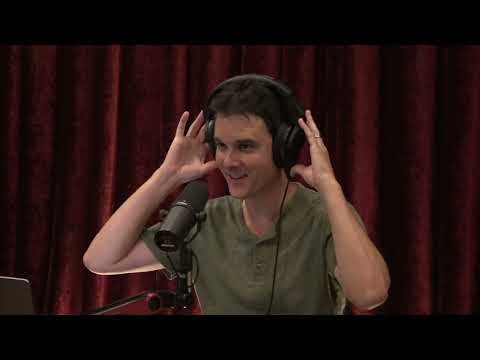
Joe Rogan Experience #2047 - Brian Muraresku
Joe Rogan (host), Narrator, Narrator, Brian C. Muraresku (guest), Guest (Brian C. Muraresku side-conversation) (guest), Guest (Brian C. Muraresku side-conversation) (guest), Narrator, Narrator, Guest (Brian C. Muraresku side-conversation) (guest), Narrator, Guest (Brian C. Muraresku side-conversation) (guest)
In this episode of The Joe Rogan Experience, featuring Joe Rogan and Narrator, Joe Rogan Experience #2047 - Brian Muraresku explores ancient psychedelics, buried hominins, and UFOs reshape human origins Joe Rogan and Brian Muraresku explore evidence that ancient religious and cultural practices—from Greek mystery rites to early Christianity and Egyptian cults—may have involved psychoactive potions and rituals aimed at confronting death and the afterlife.
Ancient psychedelics, buried hominins, and UFOs reshape human origins
Joe Rogan and Brian Muraresku explore evidence that ancient religious and cultural practices—from Greek mystery rites to early Christianity and Egyptian cults—may have involved psychoactive potions and rituals aimed at confronting death and the afterlife.
They discuss new archaeochemical findings (ergotized beer, Datura and yaupon holly brews, Egyptian ‘blood cocktails’) and underground Christian hypogea, arguing that ancient wine and sacraments were often pharmacologically complex rather than simple alcohol.
The conversation expands into paleoanthropology (Homo naledi’s deliberate burials, cave rituals, small-brain intelligence), endogenous altered states (yoga, breathwork, dreams, DMT), and how creativity, ritual, and psychedelics might have influenced religion, democracy, and human cognition.
They close by touching on AI, UFO/UAP mysteries, and human health and training, framing all of these as different lenses on the same questions: what consciousness is, how humans seek transcendence, and what truly makes us human.
Key Takeaways
Psychoactive sacraments likely played a role in multiple ancient religions.
Evidence such as ergotized beer vessels in Hellenistic Spain, Datura- and yaupon-laced brews in Mississippian North America, Datura at California’s Pinwheel Cave, and Egyptian Bes-vessels with psychoactive plant and human-blood residues all support the idea that many ancient ‘wine’ or ritual drinks were pharmacologically enhanced.
Get the full analysis with uListen AI
The Eleusinian Mysteries remain unproven but highly suggestive for psychedelic use.
While no direct drug residues have been found at Eleusis itself, ergotized beer cups linked culturally to Eleusinian iconography in Spain, and the broader Greek tradition of spiked wines, keep the hypothesis alive—yet leading site archaeologists remain unconvinced, highlighting the need for more data from Greek contexts.
Get the full analysis with uListen AI
Non-human hominins may have had complex rituals around death and possibly proto-spirituality.
Homo naledi, with brains only one-third the size of ours, appears to have deliberately transported bodies through an extremely difficult cave system, buried them in pits, used fire, cooked food, and carved abstract markings—suggesting culture, symbolism, and a sophisticated engagement with mortality long before Homo sapiens’ dominance.
Get the full analysis with uListen AI
Ritual, preparation, and dose-control are as important as the drug itself.
Whether discussing Eleusis, Datura rites, early Christian agape meals, or modern ayahuasca circles, they emphasize that set, setting, and posology (correct dosing) are critical to safety and meaning; uncontrolled or ego-driven use easily leads to harm, guru abuse, or psychological destabilization.
Get the full analysis with uListen AI
Endogenous and exogenous altered states may tap similar “spaces” of consciousness.
Practices like Kundalini yoga, holotropic breathwork, sensory deprivation tanks, and lucid dreaming can induce experiences akin to psychedelics, while DMT—which is endogenous—is accessible in seconds via smoking; this raises questions about whether the brain is generating or tuning into these realms.
Get the full analysis with uListen AI
Early Christianity may have absorbed and re-coded pagan wine and initiation rites.
Underground hypogea controlled by the Vatican show banquet scenes, female figures mixing drinks (‘mix it for us’, ‘give the calda’), and frescoes of the witch Circe with her loom and transformed men—iconography that aligns with Greek mystery traditions and suggests a pagan continuity in early Eucharistic practice.
Get the full analysis with uListen AI
Our picture of intelligence and culture must expand beyond big brains and modern humans.
Cases like Homo naledi, corvid tool-use, learning jellyfish, and fox and dog domestication experiments all challenge simple brain-size narratives, suggesting that ritual, burial, art, and perhaps even ‘religious’ behavior can arise in unexpected neural and ecological configurations.
Get the full analysis with uListen AI
Notable Quotes
“The dead themselves participated.”
— Brian Muraresku (citing Ramsay MacMullen on Roman/early Christian grave feasts)
“We’re sitting on this incredibly potent chemical and we don’t know how to release or control it.”
— Brian Muraresku (on endogenous DMT and brain research)
“If you weren’t a human and took a drug that let you experience human life in a big city, you’d be like, ‘This is crazy.’”
— Joe Rogan
“We have this knack for producing things that we know will resonate—with us.”
— Brian Muraresku
“When the long-awaited solution to the UFO problem comes… it will prove to be a mighty and unexpected quantum leap.”
— Brian Muraresku (paraphrasing J. Allen Hynek)
Questions Answered in This Episode
If archaeochemical testing of more ancient vessels confirms widespread psychedelic use, how should that change modern theology’s understanding of its own origins?
Joe Rogan and Brian Muraresku explore evidence that ancient religious and cultural practices—from Greek mystery rites to early Christianity and Egyptian cults—may have involved psychoactive potions and rituals aimed at confronting death and the afterlife.
Get the full analysis with uListen AI
What ethical and legal frameworks are needed to reintroduce powerful entheogens into contemporary culture without recreating guru abuse or cult dynamics?
They discuss new archaeochemical findings (ergotized beer, Datura and yaupon holly brews, Egyptian ‘blood cocktails’) and underground Christian hypogea, arguing that ancient wine and sacraments were often pharmacologically complex rather than simple alcohol.
Get the full analysis with uListen AI
Does Homo naledi’s apparent burial and cave ritual behavior imply that spirituality or ‘religion’ is older—and less human-specific—than we think?
The conversation expands into paleoanthropology (Homo naledi’s deliberate burials, cave rituals, small-brain intelligence), endogenous altered states (yoga, breathwork, dreams, DMT), and how creativity, ritual, and psychedelics might have influenced religion, democracy, and human cognition.
Get the full analysis with uListen AI
Could AI, given complete access to human data and no ego or mortality, develop a deeper model of consciousness and death than humans can—and would we trust it?
They close by touching on AI, UFO/UAP mysteries, and human health and training, framing all of these as different lenses on the same questions: what consciousness is, how humans seek transcendence, and what truly makes us human.
Get the full analysis with uListen AI
To what extent are modern experiences with psychedelics, breathwork, and tanks genuinely new, versus rediscoveries of ancient techniques for navigating the same inner landscapes?
Get the full analysis with uListen AI
Transcript Preview
(drumbeats) Joe Rogan podcast, check it out.
The Joe Rogan Experience.
Train by day, Joe Rogan podcast by night. All day. (instrumental music)
All right, we're up. 'Sup, Joe Rogan?
What's up, man?
How are you? What's heh. up? Last time I saw you, we were on another continent.
Uh, the European continent.
Yeah.
Yeah.
It was fun. That was exciting. Thank you very much for that. It was-
You're welcome.
... going to visit the, the Greek ruins with you was really special. That was very cool.
That was, uh, was that your first time seeing, like, the Acropolis-
Yeah.
... in the downtown?
It was my first time in Greece.
Yeah.
Yeah.
Really?
Mm-hmm.
And the girls too?
Mm-mmm. My wife had been, but-
Yeah, that's right.
... the, the girls hadn't been. It was exciting. It was fun, man. J- j- it's so crazy just to be there in that place where all this started, is, j- just to be on, in that, on that soil, standing there, in the, the place where those people were 2,500 years ago-
Mm.
... was very special.
Or longer.
Or longer, yeah.
Yeah, by thousands of years, potentially.
Yeah.
Yeah.
Really exciting stuff.
It's cool, man.
What's also interesting, you know, when you're there, how l- it seems like your work is, uh, it's getting out there.
Mm.
But it seems like the people that are involved in the day-to-day there, like y- the people that are giving tours and the people that ... they don't really know.
Yeah. That's, it's still, I think it's still ... I wouldn't say it's controversial, but I think it's still a subject of debate, which i- which is the way it should be.
Yeah.
And what we're talking about is the, the potential of the ancient Greeks using psychedelics-
Yeah.
... to find God, which is a big idea.
Well, it seems not just likely.
(laughs) Yeah.
You j- uh, it all, all the pieces, I mean, it's, it's like, oh, duh.
Yeah.
You know, like, if you found a murder weapon in the house where someone was suspected of being a murderer-
Yeah. (laughs)
... you go, oh, that guy's probably a ... that's probably what happened.
(laughs)
(laughs) Like, if you find vessels that contain psychedelic compounds in an area where people experience these profound rituals-
Right.
... well, uh, they're probably doing drugs, man. Heh.
(laughs) Well, at least in Spain, they were.
Yeah.
The fact that there, there were no vessels found in Greece, in mainland Greece, and most especially by the, at the sanctuary in Eleusis, I think that that leaves healthy room for debate.
Install uListen to search the full transcript and get AI-powered insights
Get Full TranscriptGet more from every podcast
AI summaries, searchable transcripts, and fact-checking. Free forever.
Add to Chrome