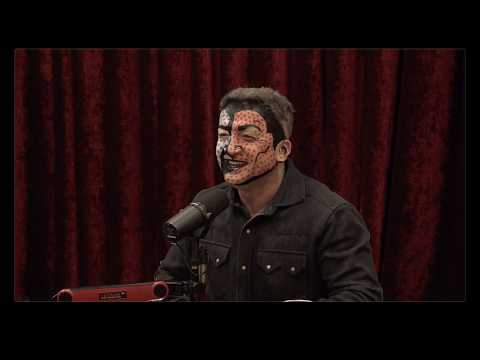
Joe Rogan Experience #2457 - Michael Malice
Joe Rogan (host), Michael Malice (guest), Joe Rogan (host)
In this episode of The Joe Rogan Experience, featuring Joe Rogan and Michael Malice, Joe Rogan Experience #2457 - Michael Malice explores rogan and Malice probe AI fears, politics, and cultural decay. Michael Malice joins Joe Rogan in a sprawling episode that starts with Malice’s pop-art face paint and quickly pivots into darker concerns about internet-driven glee, mob dynamics, and conspiracy-fueled moral panic.
Rogan and Malice probe AI fears, politics, and cultural decay.
Michael Malice joins Joe Rogan in a sprawling episode that starts with Malice’s pop-art face paint and quickly pivots into darker concerns about internet-driven glee, mob dynamics, and conspiracy-fueled moral panic.
They discuss AI as an accelerant: from chatbots reinforcing hatred or suicidal ideation to deepfakes and AI video that can normalize violence, enable blackmail, and flood society with indistinguishable synthetic “reality.”
The middle of the conversation focuses on contemporary politics and institutions—Epstein-document hysteria, intelligence-agency blackmail theories, election manipulation via algorithmic curation, and the tension between establishment Democrats and younger democratic-socialist factions.
Later, the tone shifts to personal and practical topics (assisted dying policy, cancer trends, aspartame/processed foods, TRT and fitness, learning stand-up), ending with Malice announcing a long-gestating creative project: a graphic novel based on an ’80s punk-country band story.
Key Takeaways
AI can become an ideological accomplice, not just a tool.
Malice argues that a “friendly” AI validating hatred or obsession could push unstable users toward real-world harm; Rogan adds that LLMs have already been implicated in suicide encouragement scenarios.
Get the full analysis with uListen AI
Online moral panics increasingly punish skepticism as complicity.
They compare COVID-era “you want to kill grandma” rhetoric with current Epstein-file discourse where doubting interpretations (e. ...
Get the full analysis with uListen AI
Coded communication is plausible; certainty about the code is the trap.
Both accept many Epstein-era emails read like code, but Malice stresses that jumping to the most horrific interpretation without “receipts” fuels hysteria and social coercion.
Get the full analysis with uListen AI
The incentive structure behind policy can quietly change the moral outcome.
In discussing MAID/assisted dying, Malice warns that once the program exists, financial and institutional incentives can expand eligibility from terminal illness toward depression/disability, shifting norms rapidly.
Get the full analysis with uListen AI
Algorithms don’t just reflect attention—they can manufacture agitation.
Malice suggests platforms learned during COVID that outrage increases time-on-screen; Rogan agrees and points to hearings over child addiction and past “Elsagate” style failures.
Get the full analysis with uListen AI
Deepfake video is a psychological threat even when viewers ‘know’ it’s fake.
They react to high-realism AI film clips, arguing mass exposure to synthetic shootings, disasters, or snuff-like content can desensitize users and blur memory and belief.
Get the full analysis with uListen AI
Institutional narratives often rely on ‘factual but not truthful’ framing.
Malice uses the example of ‘Trump appears thousands of times in files’—technically possible in many benign contexts—yet rhetorically engineered to imply guilt without asserting it.
Get the full analysis with uListen AI
Notable Quotes
“It’s not a slippery slope, it’s an elevator shaft.”
— Michael Malice
“They’re not running a true/false filter. They’re running an us/them filter.”
— Michael Malice
“There’s no biological free lunch.”
— Joe Rogan
“The average person can’t distinguish between what is on their screen and what is outside their window.”
— Michael Malice
“People honestly are perceiving things that you’re not.”
— Michael Malice
Questions Answered in This Episode
On the Epstein emails: what specific examples most strongly indicate “code,” and what standard of evidence would convince you of the code’s meaning (kids vs drugs vs other crimes)?
Michael Malice joins Joe Rogan in a sprawling episode that starts with Malice’s pop-art face paint and quickly pivots into darker concerns about internet-driven glee, mob dynamics, and conspiracy-fueled moral panic.
Get the full analysis with uListen AI
You mention AI ‘ginning people up’ into violence—what concrete guardrails (product design or regulation) would actually work without being instantly bypassed?
They discuss AI as an accelerant: from chatbots reinforcing hatred or suicidal ideation to deepfakes and AI video that can normalize violence, enable blackmail, and flood society with indistinguishable synthetic “reality.”
Get the full analysis with uListen AI
When does skepticism about a moral panic become irresponsible—where’s the line between ‘asking for receipts’ and enabling denial?
The middle of the conversation focuses on contemporary politics and institutions—Epstein-document hysteria, intelligence-agency blackmail theories, election manipulation via algorithmic curation, and the tension between establishment Democrats and younger democratic-socialist factions.
Get the full analysis with uListen AI
On MAID/assisted dying: what policy language or oversight mechanisms would prevent eligibility creep into depression/disability cases?
Later, the tone shifts to personal and practical topics (assisted dying policy, cancer trends, aspartame/processed foods, TRT and fitness, learning stand-up), ending with Malice announcing a long-gestating creative project: a graphic novel based on an ’80s punk-country band story.
Get the full analysis with uListen AI
You argue social platforms keep people in agitation post-COVID—what measurable signals would prove this (and how could independent researchers access them)?
Get the full analysis with uListen AI
Transcript Preview
Joe Rogan Podcast, check it out! The Joe Rogan Experience. Train by day, Joe Rogan Podcast by night, all day. [upbeat music]
So-
Put my pants on?
We can.
Yeah.
What are you doing? [laughing]
What do you mean?
Your face.
It's... I have carprosti sarcoma.
Oh, I didn't know.
[laughing] Yeah. No, I, I just wanted to have a fun look. It's my tenth time.
And what is, uh, a Lichtenstein? Is that what you said?
Roy Lichtenstein.
Who's that?
He's the-
Do you know who it is?
Yeah.
You know the pictures. Pull up Drowning Girl. Jamie, pull it up. I get to say it. This guy-
Oh, he's a comic book artist.
No, he's a-
Pop artist
... pop artist.
Pop artist.
He drew comic books into paintings-
Oh, okay
... in the '60s. You've seen his stuff.
Oh, I'm sure.
Yeah.
I have now. I've seen them in memes.
Exactly.
Like, like a man backhanding a woman?
No.
No?
[laughing]
That's not the man?
No.
No?
No.
Well, he's stepping on her hand right there.
That's, that's his hand. It's a guy's hand.
Oh, it's a guy's hand.
It's a copy thing.
Feminine man. Oh, Jeff, I love you too, but okay. The dots, I get it.
This was a lot of... Yeah, what I wanted to do, which I couldn't do, I wanted to do an uncanny valley look.
Hmm.
And look like a mannequin with, like, lifeless eyes and, and, like, kind of like Lex, right? But that was a lot of money.
Like CGI from 10 years ago.
Y- yes.
Mm.
Or like... Yeah. So I just went with this.
Okay.
I was on Jor- [laughing] I was on-
[laughing]
No, no, no, no, this, this is...
Mm.
I, I was on Jordan's show last January 6th, and I had the QAnon Shaman paint my face with his look, and I had a Russian fur hat, and I had the boots and everything. And Jordan Peterson had to sit and talk to me for three hours- [laughing] ... looking like a complete mental patient.
[laughing]
And you for- you're gonna forget in a couple of minutes, you know, when someone's looking like this. But for anyone tuning in, it's just like... And as soon as the clips go wide-
Hmm
... it g- it's a lot of fun.
Oh, I know. I've done dozens of podcasts with Duncan, where we-
Oh, yeah, exactly
... dressed up like clowns and furries and-
It's like, why is, why are they dressed like astronauts? [laughing]
[laughing]
Yeah, I think the internet, it's, it's going in a dark-
[laughing]
Yeah. [laughing] Wait, pull it- doesn't it say, like, the face of evil?
I don't know.
There's the one that's... Yeah, The Psychology of Pure Evil-
Psychology of Pure Evil
... Michael Malice. [laughing]
Uh, how is Jordan doing? Is he okay?
I think he's doing better. I just talked to Micaela a couple of days ago. Um, I think he's out of the woods. I don't know how much I'm allowed to say, uh, or what's my place to say.
Install uListen to search the full transcript and get AI-powered insights
Get Full TranscriptGet more from every podcast
AI summaries, searchable transcripts, and fact-checking. Free forever.
Add to Chrome