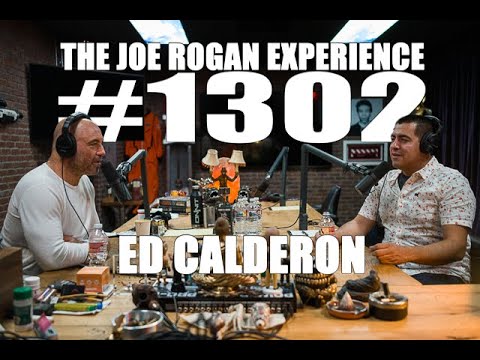
Joe Rogan Experience #1302 - Ed Calderon
Joe Rogan (host), Ed Calderon (guest)
In this episode of The Joe Rogan Experience, featuring Joe Rogan and Ed Calderon, Joe Rogan Experience #1302 - Ed Calderon explores ex-Mexican Cop Exposes Cartel War, Corruption, and U.S. Blindspots Joe Rogan interviews Ed Calderon, a former Mexican law-enforcement officer and non‑permissive environment specialist, about his years fighting drug cartels in northern Mexico and how that experience now informs his survival training work.
Ex-Mexican Cop Exposes Cartel War, Corruption, and U.S. Blindspots
Joe Rogan interviews Ed Calderon, a former Mexican law-enforcement officer and non‑permissive environment specialist, about his years fighting drug cartels in northern Mexico and how that experience now informs his survival training work.
Ed describes the rapid evolution from basic community policing into full-scale urban warfare after Mexico’s government militarized the drug war, detailing cartel firepower, corruption, and the extreme violence that became routine.
He explains how U.S. drug demand, weapons flows, and short-term Mexican political cycles fuel a hydra-like cartel ecosystem that has diversified into multiple criminal enterprises and deeply embedded itself in Mexican society and culture.
The conversation underscores that cartel power is not just a “Mexican problem,” but a binational issue with growing influence inside the United States, and that current approaches—walls, six‑year security plans, and symbolic crackdowns—are structurally inadequate.
Key Takeaways
Short political cycles make sustained cartel strategy almost impossible.
Every six-year Mexican presidential term brings a new anti-cartel plan, then discards the previous one, creating a cycle of institutional “amnesia” that prevents long-term, coherent security policy.
Get the full analysis with uListen AI
Cartels function like diversified corporations, not just drug gangs.
Beyond drugs, they control human trafficking, extortion, protection rackets, piracy, real estate, and even legitimate businesses, making simple “drug war” approaches far too narrow.
Get the full analysis with uListen AI
Corruption and fear-based coercion hollow out law enforcement.
Ed estimates roughly 30% of officers he worked with were compromised, and many others lived under credible threats to themselves and their families, making trust and operational security almost impossible.
Get the full analysis with uListen AI
Legalization of some drugs shifts, rather than eliminates, cartel revenue.
U. ...
Get the full analysis with uListen AI
Cartel power is sustained by local legitimacy and “hearts and minds” tactics.
Figures like El Chapo become Robin Hood-style folk heroes by funding roads, schools, medical care, holidays, and migration, creating communities that actively shield them from authorities.
Get the full analysis with uListen AI
The U.S.–Mexico border wall only addresses a slice of the problem.
Cartels already use tunnels, drones, submarines, and northern routes via Canada; people smuggling can even become more profitable when walls make crossing appear harder and justify higher fees.
Get the full analysis with uListen AI
Cartel violence is increasingly transnational and culturally influential.
Ed notes cartel execution tactics and media have inspired groups like ISIS, and many cartel-linked actors are now U. ...
Get the full analysis with uListen AI
Notable Quotes
“This isn’t a policing problem, this is a counter‑insurgency problem.”
— Ed Calderon, quoting Lt. Col. Julián Leyzaola
“We were fighting a hydra. You cut one head off, two or three more pop up.”
— Ed Calderon
“Mexico has a six‑year cycle of amnesia. Every president comes in with a new plan, then throws the old one away.”
— Ed Calderon
“It’s not a Mexican problem anymore. Cartel influence is on both sides of the border.”
— Ed Calderon
“I burned tons of weed in Mexico, and then two weeks later I’m in Denver watching a grandma buy cookies in a beautiful store. That’s what we were dying for.”
— Ed Calderon
Questions Answered in This Episode
If Mexican six‑year political cycles are structurally incompatible with sustained security strategy, what specific constitutional or institutional reforms would be required to break that pattern?
Joe Rogan interviews Ed Calderon, a former Mexican law-enforcement officer and non‑permissive environment specialist, about his years fighting drug cartels in northern Mexico and how that experience now informs his survival training work.
Get the full analysis with uListen AI
Given cartels’ deep community support and economic influence, what realistic alternatives exist to pure force—such as economic development, amnesty deals, or “buyouts”—and what risks would each carry?
Ed describes the rapid evolution from basic community policing into full-scale urban warfare after Mexico’s government militarized the drug war, detailing cartel firepower, corruption, and the extreme violence that became routine.
Get the full analysis with uListen AI
How should the U.S. reframe its own role in the problem, considering drug demand, gun exports, and operations like Fast and Furious that directly strengthened cartel firepower?
He explains how U. ...
Get the full analysis with uListen AI
What practical steps could U.S. citizens and policymakers take now to prepare for the growing presence of cartel-linked actors and tactics inside the United States?
The conversation underscores that cartel power is not just a “Mexican problem,” but a binational issue with growing influence inside the United States, and that current approaches—walls, six‑year security plans, and symbolic crackdowns—are structurally inadequate.
Get the full analysis with uListen AI
If cartels were formally designated as terrorist organizations, what would be the likely humanitarian, economic, and geopolitical consequences on both sides of the border?
Get the full analysis with uListen AI
Transcript Preview
Boom, boom, boom, boom. Boom. What's up, Ed? How are you, man?
Great.
Thanks for coming here, man. I appreciate it.
Thank you for extending the invitation.
Well, I love your Instagram. It's very in- it's very informational and, uh, well, tell everybody what you do so people get a, a handle on this first.
Yes. Um, uh, I'm a non-permissive environments specialist. Basically, I teach people how to live, move, and travel in places where they probably shouldn't be traveling.
Mm.
Um, you know, how to get out of handcuffs, how to get out of zip ties. Um, and, uh, you know, I show people how to survive in s- such environments. Uh, my background is in law enforcement in Mexico, so, you know, I spent a lot of time down there.
(laughs)
And, um, over the years, that's kind of led me into teaching myself how to survive in that environment. And, uh, apparently, after a while, that, uh, made me kind of, uh, sought after as far as teaching other people how to survive in such environments. So I've been doing that, uh, uh, for a while here in the US to military, law enforcement, civilians also.
Yeah, and you started working in law enforcement what year?
Uh, it's 2004, 2004, uh, north-
So you started before everything got really crazy in Mexico.
Yes, yes. Um, so you can, you can kind of trace back where it officially kicked off, uh, by the, uh, the start of the, uh, Felipe Calderon's presidency, which is the, uh, uh, the second to last president we had. Uh, he basically said, you know, full on war against the cartels. Um, and by that time, I was kind of just, uh, getting done with my training, um, in northern Mexico as a, uh, police officer. And what I thought was gonna be, you know, community policing and stuff like that turned into a full on, you know, "Here's an assault rifle and just go climb up on that Humvee with those military guys and let's go arrest cartel members."
Oh, Jesus Christ. So you thought you were just getting a regular law enforcement gig?
Uh, yeah. I mean, (laughs) realistically there was no such sort of kind of job description. This was post 9/11. I was actually in med school and that, uh, the economy and all over the border with the, uh, tightened security and stuff like that kind of went down, you know, down the drain. And most of, uh, most of the money that I was using for med school, you know, went away. And, uh, you know, ad in the newspaper, young unmarried individuals that don't have any kids, y- you're welcome to join type thing.
Wow. Young unmarried individuals with no kids. They want that specifically.
Yeah, that was, uh, probably a big alarm bells sort of sound in my head, but the, uh, but the, but the, um, the, the, you know, there were, there weren't a lot of opportunities for somebody my age there that didn't have a career. And I thought it would be... You know, everybody said, "Don't go." You know? But-
Install uListen to search the full transcript and get AI-powered insights
Get Full TranscriptGet more from every podcast
AI summaries, searchable transcripts, and fact-checking. Free forever.
Add to Chrome