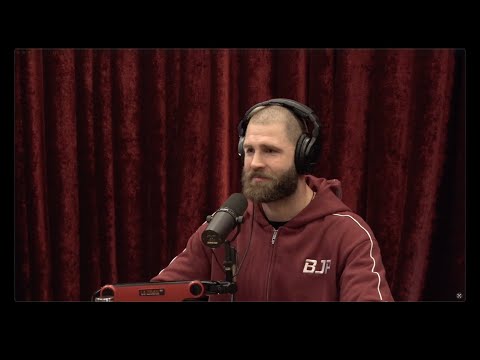
JRE MMA Show #165 with Jiri Prochazka
Jiří Procházka (guest), Joe Rogan (host), Narrator, Narrator
In this episode of The Joe Rogan Experience, featuring Jiří Procházka and Joe Rogan, JRE MMA Show #165 with Jiri Prochazka explores jiri Prochazka Reveals Samurai Mindset, Nature Training, and Evolution Joe Rogan and Jiri Prochazka dive deep into Jiri’s unique approach to fighting, preparation, and personal evolution, from training in nature and dark rooms to high-altitude camps and Japanese martial philosophy.
Jiri Prochazka Reveals Samurai Mindset, Nature Training, and Evolution
Joe Rogan and Jiri Prochazka dive deep into Jiri’s unique approach to fighting, preparation, and personal evolution, from training in nature and dark rooms to high-altitude camps and Japanese martial philosophy.
Jiri explains how overtraining, illness, and losses—especially to Alex Pereira—forced him to rethink everything, abandon spiritual ‘shortcuts,’ and return to simple, disciplined work focused on reality and self-belief.
They break down technical elements of his style—hands-down defense, head movement, timing, and flow—along with broader issues like ego, constant improvement (kaizen), weight cutting, and the modern comfort crisis.
The conversation frames Jiri as a rare blend of violent artist and philosopher-warrior, obsessed with mastering body, mind, and spirit while staying loyal, humble, and authentic inside and outside the cage.
Key Takeaways
Overtraining can be as dangerous as undertraining.
Jiri admits he routinely pushes too hard in camp and that a pre-fight flu actually forced him to rest, likely saving him from entering the Jamahal Hill fight overtrained and depleted.
Get the full analysis with uListen AI
True defense comes from awareness and feeling, not just a high guard.
His hands-down style is built on sensing space, reading intention, and head movement; he only raises his guard in close range where structure and calm are more important than showy risk.
Get the full analysis with uListen AI
Constant, incremental improvement (kaizen) beats obsession without structure.
Jiri uses the Japanese concept of kaizen—daily small improvements—to refine technique, mindset, and life habits, but warns that obsession without rest or perspective becomes self-destructive.
Get the full analysis with uListen AI
Losses can catalyze deep psychological and technical evolution.
The second loss to Pereira was so painful he saw it as showing his ‘worst self’ to the world; it forced him to drop spiritual distractions, recommit to honest self-talk, and rebuild around simple, effective preparation.
Get the full analysis with uListen AI
Belief in external ‘magic’ or forces weakens self-confidence.
Jiri confesses he went too deep into spiritual ideas and even suspected ‘black magic,’ but realized that placing power outside himself only strengthened his opponent; his solution was to shut that door and trust his own work.
Get the full analysis with uListen AI
Extreme comfort in modern life erodes character and resilience.
Both discuss how easy access to food, entertainment, and distraction makes young people avoid hard challenges; Jiri argues that knowingly choosing difficulty—through training, nature, and discomfort—is essential for real growth.
Get the full analysis with uListen AI
Authenticity in fighting outlasts manufactured trash talk.
Jiri rejects performative shit-talk and promotional personas, insisting a truly self-confident fighter doesn’t need to intimidate verbally; the fight itself is the promotion, and he wants his behavior pre- and post-fight to be identical.
Get the full analysis with uListen AI
Notable Quotes
““I don’t need to defend myself when I see everything, when I feel everything.””
— Jiri Prochazka
““A great servant but a bad boss—that’s what the mind is.””
— Jiri Prochazka
““Every time when there is a challenge, there is a new you.””
— Jiri Prochazka
““If you just live your life in comfort, you will have a terrible life.””
— Joe Rogan
““The biggest special weapon is to be yourself—the realest yourself. That’s all.””
— Jiri Prochazka
Questions Answered in This Episode
How can a regular person apply Jiri’s ‘kaizen’ mindset and nature-based training to everyday life without becoming extreme or obsessive?
Joe Rogan and Jiri Prochazka dive deep into Jiri’s unique approach to fighting, preparation, and personal evolution, from training in nature and dark rooms to high-altitude camps and Japanese martial philosophy.
Get the full analysis with uListen AI
Where is the line between deep spiritual exploration and getting lost in beliefs that actually weaken your performance or confidence?
Jiri explains how overtraining, illness, and losses—especially to Alex Pereira—forced him to rethink everything, abandon spiritual ‘shortcuts,’ and return to simple, disciplined work focused on reality and self-belief.
Get the full analysis with uListen AI
If MMA removed drastic weight-cutting and moved to more ‘natural’ rule sets, how would that change who becomes champion and how fights look?
They break down technical elements of his style—hands-down defense, head movement, timing, and flow—along with broader issues like ego, constant improvement (kaizen), weight cutting, and the modern comfort crisis.
Get the full analysis with uListen AI
What practical methods can fighters use to keep ego as a ‘servant, not a boss’ when success, fame, and pressure increase?
The conversation frames Jiri as a rare blend of violent artist and philosopher-warrior, obsessed with mastering body, mind, and spirit while staying loyal, humble, and authentic inside and outside the cage.
Get the full analysis with uListen AI
Is it possible to maintain Jiri’s level of authenticity and philosophical depth in a sport that increasingly rewards trash talk and spectacle?
Get the full analysis with uListen AI
Transcript Preview
(drumbeats) Joe Rogan podcast, check it out. The Joe Rogan Experience. (drumbeats)
Train by day, Joe Rogan podcast by night, all day. (rock music) Great to have you in, man.
Yeah, great to be here. Yeah.
How you feeling? You must be feeling fantastic.
Uh, many things, uh, were successful, so even if I, like, was a little bit, uh, had a flu, uh, many things-
You had the flu before that fight?
Mm-hmm. Yeah, for one, one week, like, five, five days, five day- five days before fight week, I was in, uh, uh, like... How to say that? Uh, uh, heat, like body is warm.
Fever?
Fever. Fever. Yeah, fever.
Yeah.
So, (laughs) yeah.
That's crazy.
That was, that was, yeah. That was something what I- But every time, maybe I'm little bit glad for that, because I'm every time trying to push my preparation too much-
Mm-hmm.
... that I am every time, like, hurt myself or, or I'm overtrained.
Right.
So, so that's why I'm maybe, maybe just a little bit glad for that.
Y- That's interesting, right? Like, it's, it's so hard, because you wanna prepare so hard, you, you're so disciplined, so driven, but you can do yourself a disservice. You can go too far, and then you don't recover enough, and then you go into the fight a little compromised.
Yep. That's right.
Yeah, we've seen that many times with fighters-
Yeah.
... who just get so enthusiastic about their training.
Yeah. I- 'Cause I feel like self-confidence, and still, there is something what you can do better, yeah? Every day.
Mm-hmm.
And that's my idea of, of the training, life, life idea, to, to, to go better every day, 1% better, 1% better.
Mm-hmm.
Even if you don't, if you can't train, you can sit in a meditation and visualize how you train, how the, how this body's working.
Mm-hmm.
But sometimes, is the most, uh, biggest, like, the biggest thing what you can do is just-
Rest.
... like, like you show me the floating.
Yes. Yeah, you need one of those, man.
Yeah.
If... All the people that I know-
That's right.
... you nee- you need one.
Yes.
Sensory deprivation tank.
Yeah.
You should get one of those.
Yeah.
'Cause I know you're into meditation. I know you spend a lot of time in dark rooms. That's-
Yeah.
That's meditation times 100.
That's right.
Do you monitor your heart rate every day to see what your recovery's at? Or you just go by feel?
Feeling.
Feeling?
Feeling, feeling. I did that in, uh, high altitude training in, uh, all the November in, uh, Mexico, Mexico City, where is, uh, 2,300, 200 meters-
Install uListen to search the full transcript and get AI-powered insights
Get Full TranscriptGet more from every podcast
AI summaries, searchable transcripts, and fact-checking. Free forever.
Add to Chrome