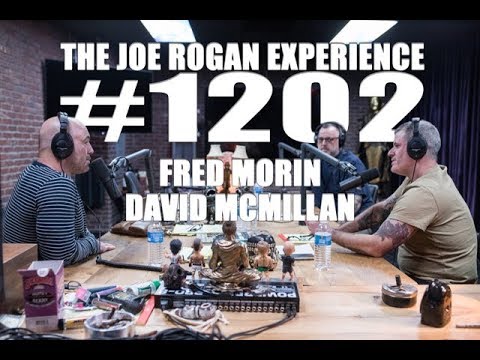
Joe Rogan Experience #1202 - Fred Morin & David McMillan
David McMillan (guest), Joe Rogan (host), Fred Morin (guest), Guest (Fred Morin or David McMillan) (guest), Guest (Fred Morin or David McMillan) (guest), David McMillan (guest), Guest (Fred Morin or David McMillan) (guest), Fred Morin (guest), Guest (Fred Morin or David McMillan) (guest)
In this episode of The Joe Rogan Experience, featuring David McMillan and Joe Rogan, Joe Rogan Experience #1202 - Fred Morin & David McMillan explores chefs, Survivalists, and Sobriety: Joe Beef’s Philosophy Beyond Food Joe Rogan talks with Montreal chefs Fred Morin and David McMillan of Joe Beef about their new book, “Joe Beef: Surviving the Apocalypse,” which blends cooking with off-grid living, foraging, and preparedness. They dive into traditional French and Quebec food culture, nose-to-tail eating, sustainable seafood, and the ethics of wild protein. A big portion of the conversation explores addiction, the drinking culture of restaurant work, and how both chefs got sober while still operating wine-centric restaurants. Throughout, they connect food to community, family, resilience, and a slower, more intentional way of living.
Chefs, Survivalists, and Sobriety: Joe Beef’s Philosophy Beyond Food
Joe Rogan talks with Montreal chefs Fred Morin and David McMillan of Joe Beef about their new book, “Joe Beef: Surviving the Apocalypse,” which blends cooking with off-grid living, foraging, and preparedness. They dive into traditional French and Quebec food culture, nose-to-tail eating, sustainable seafood, and the ethics of wild protein. A big portion of the conversation explores addiction, the drinking culture of restaurant work, and how both chefs got sober while still operating wine-centric restaurants. Throughout, they connect food to community, family, resilience, and a slower, more intentional way of living.
Key Takeaways
Food can be a gateway to broader skills for resilience.
Morin and McMillan frame their cookbook as part survival manual—covering fermentation, foraging, off-grid cabins, and first-aid kits—arguing that cooking well overlaps with knowing how to live and endure disruptions like blackouts or ice storms.
Get the full analysis with uListen AI
Eating “nose-to-tail” aligns ethics, nutrition, and tradition.
They advocate using the whole animal—organs, blood, and “unpopular” cuts—both out of respect for the animal and because these parts are nutrient-dense and central to classic French and Quebec cuisine.
Get the full analysis with uListen AI
Sustainable seafood and mollusks are underused protein solutions.
They highlight oysters, clams, and stone crab as examples where farming or partial harvest (like stone crab claws) can provide protein while regenerating ecosystems and avoiding the damage of industrial bycatch and overfishing.
Get the full analysis with uListen AI
Dining culture is shaped more by history and taboo than by logic.
From the British ban on horse meat to Americans’ narrow protein choices, they show how politics, royal decrees, and cuteness biases determine what we see as “acceptable” food, even when many animals are nutritionally similar.
Get the full analysis with uListen AI
Addiction in restaurant culture is normalized but deeply destructive.
Both chefs describe a work world where alcohol is a nightly reward and coping tool; they only recognized their alcoholism after years of “successful” careers, ultimately needing intervention and rehab to get sober and stay present for family and staff.
Get the full analysis with uListen AI
Restriction, not excess, leads to clarity and health.
Whether it’s sobriety, cutting gluten, or eliminating ultra-processed foods, they echo Rogan’s guests and their own experience: less alcohol, sugar, and empty carbs reduces anxiety, inflammation, and autoimmune problems and sharpens mental focus.
Get the full analysis with uListen AI
True hospitality is an intimate, high-skill, communal craft.
They see restaurants not as celebrity platforms but as small, intensely choreographed spaces where long-term staff bond “like soldiers,” guests are hosted like family, and old-school touches (tableside service, cheese carts, digestifs) create meaningful shared experiences.
Get the full analysis with uListen AI
Notable Quotes
“Cooking doesn’t define me or Fred. If we’re not cooking, we’re building first aid kits and survival kits for real.”
— David McMillan
“We’ve been promoted and taught that you’ll get paid if you learn how to promote excessive eating and excessive drinking.”
— David McMillan
“Restriction brings clarity.”
— Fred Morin
“My relationship with my kids is better than any relationship I have with my best friends. My kids are more interesting.”
— David McMillan
“Being a chef is like one-dimensional really. To be a great chef you should have a minor in electricity, plumbing, and refrigeration.”
— David McMillan
Questions Answered in This Episode
How much of modern “taste” is really cultural conditioning, and what foods would you reconsider if you stripped away taboos?
Joe Rogan talks with Montreal chefs Fred Morin and David McMillan of Joe Beef about their new book, “Joe Beef: Surviving the Apocalypse,” which blends cooking with off-grid living, foraging, and preparedness. ...
Get the full analysis with uListen AI
If restaurants normalized organs, off-cuts, and sustainable seafood, how quickly do you think mainstream diners would adapt?
Get the full analysis with uListen AI
What concrete changes would you make to school design and curricula to reconnect kids with movement, cooking, and real food?
Get the full analysis with uListen AI
How can chefs and restaurateurs keep their deep connection to wine and hospitality while protecting themselves and staff from addiction?
Get the full analysis with uListen AI
In a real prolonged crisis, which skills from this conversation—hunting, foraging, fermentation, or community-building—would matter most?
Get the full analysis with uListen AI
Transcript Preview
I don't know. No, here we go.
Good?
Okay.
Here we go. Three, two, live.
Yeah.
Boom, we're live. Gentlemen. Joe-
David.
Fred.
Hey, good to be here.
Good to see you guys. What's happening?
Not much, we're in sunny California.
Yeah, it's, uh, too close to the sun.
(laughs)
Little bit.
Yeah.
Been barbecued over the last week and a half, I've been hiding in a hotel for six days.
How proper that we're here to talk about, uh-
The apocalypse. (laughs)
... surviving the apocalypse, yeah.
Yeah, that's what I was gonna say, your book is Joe Beef Surviving the Apocalypse. Um, a cookbook for surviving the apocalypse? What is the, what's the purpose of the, uh, the title? Just a goof?
We haven't written a book in years, you know. We, I don't think we really wanted to write a second book. Uh, when we started getting a bit of pressure to write a second one, we kind of, you know, laid down the gauntlet to the editors and said, "We're gonna write what we want. Are you in or are you out?" And they said, "Well, you know, show us a little bit of the framework of what this is gonna be." I said, "I wanna talk..." You know, cooking doesn't define me or Fred, it's not all that we do. Like, it's, you know, so you see some people, they seem to like eat, live, and breathe cooking. Um, I said, "No, I'm into the outdoors, I'm into mushroom picking, I'm into fermentation of berries. I'm into, you know, canoeing. I know all about canoes. I love swimming in lakes. I wanna talk about multiple subjects. I wanna talk about the native Mohawks of Quebec. I wanna..." You know, so I said, "Let us write a book about the multiple subjects of which we're into." You know?
Uh, hey, Joe, if, if we're not cooking, we're building first aid kits and, like, survival kits for real.
Really?
The, yeah, David-
Oh, yeah, yeah.
... goes to, like, L.L. Bean, he has a lifetime membership there and...
I have an off-grid cabin up north, like north of Montreal, about an hour and a half. You can only get there by, by boat.
(laughs)
Uh, it's eight kilometers from the, the landing. Uh, you know, 2,000 watts of solar power. Completely off grid, you can't even... You can barely walk in 'cause of the jagged cliffs all around it, and behind me is an old growth forest that's protected federally.
And I have a suture kit and, uh, saline-
(laughs)
... in my car.
Always?
Oh, dude-
Yeah, yeah, yeah.
... his car is outfitted, like he's got shovels on the roof and, uh, propane tanks on the roof and...
Yeah, two years ago I drove through Alaska, down South, Arizona, back home.
Install uListen to search the full transcript and get AI-powered insights
Get Full TranscriptGet more from every podcast
AI summaries, searchable transcripts, and fact-checking. Free forever.
Add to Chrome