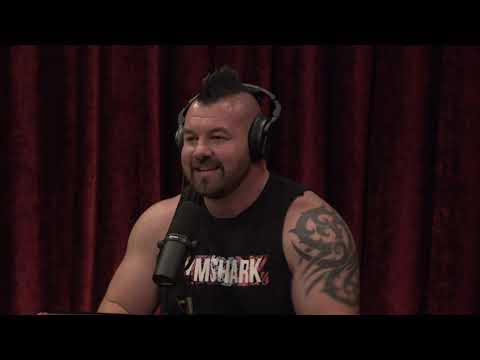
Joe Rogan Experience #1727 - Rob Kearney
Rob Kearney (guest), Narrator, Joe Rogan (host), Narrator, Narrator, Narrator, Narrator, Narrator, Narrator
In this episode of The Joe Rogan Experience, featuring Rob Kearney and Narrator, Joe Rogan Experience #1727 - Rob Kearney explores gay Strongman Rob Kearney On Injury, Cancer, Strength, And Identity Joe Rogan and world‑class strongman Rob Kearney cover his brutal triceps tear during a log-press world record attempt, his long rehab, and the realities of elite strength training and recovery.
Gay Strongman Rob Kearney On Injury, Cancer, Strength, And Identity
Joe Rogan and world‑class strongman Rob Kearney cover his brutal triceps tear during a log-press world record attempt, his long rehab, and the realities of elite strength training and recovery.
Kearney details a rapid-onset testicular cancer diagnosis at 29, losing a testicle, the medical and financial fallout, and how publicizing his story led other men to discover their own cancers early.
They explore how the body adapts to extreme demands (from strongman to ultrarunning), PEDs, diet, recovery tools, and the economics of strongman—culminating in Kearney becoming CEO and co‑owner of Strongman Corporation.
A major thread is identity and prejudice: Kearney’s experience as an openly gay athlete in a hyper‑masculine sport, global anti‑LGBTQ laws, online hate and troll farms, and nuanced discussion of trans athletes and Dave Chappelle’s controversial comedy.
Key Takeaways
Small, weird pains can signal serious problems—check them early.
Kearney’s testicular cancer started as a tiny ‘hard string’ that grew from nothing to nearly a half‑dollar in about two weeks; his quick decision to get an ultrasound likely kept it at stage one and spared him chemo.
Get the full analysis with uListen AI
Public honesty about health issues can literally save other people’s lives.
By openly sharing his cancer story and what the lump felt like, Kearney says 5–6 men messaged him later saying they’d been diagnosed with testicular cancer because his posts pushed them to get checked.
Get the full analysis with uListen AI
Elite performance often requires structure and constraints, not unlimited free time.
Kearney found that having no job made him a “lazy strongman”—he drifted in the gym for hours. ...
Get the full analysis with uListen AI
Strength sports rely on simple, repeatable nutrition with strategic indulgence.
Most top strongmen, including Kearney, live on large portions of rice, meat, and some vegetables, then add a few high‑calorie ‘cheat’ meals weekly to support six‑hour training sessions and maintain functional mass.
Get the full analysis with uListen AI
Recovery is multi‑layered: tissue work, heat, light cardio, and skilled bodywork matter.
Kearney uses sauna, light conditioning, compression boots, and frequent deep‑tissue/soft‑tissue treatments to manage scar tissue and keep training volumes high after major surgery and years of heavy lifting.
Get the full analysis with uListen AI
Visibility and representation in sports can dramatically impact queer youth mental health.
Kearney regularly hears from LGBTQ+ teens who say seeing an openly gay world‑class strongman helped them reconsider suicide or feel less alone; he cites data that just one accepting adult drastically cuts suicide risk.
Get the full analysis with uListen AI
Sports fairness around trans participation is complex and policy should target rules, not individuals.
They discuss hormone-driven advantages and cases like Laurel Hubbard, arguing that trans athletes are simply following IOC rules; criticism, Kearney suggests, is better directed at governing policies than at athletes themselves.
Get the full analysis with uListen AI
Notable Quotes
“My tendon looked like a firecracker had gone off in it.”
— Rob Kearney
“In two weeks it went from a little hard string to just under the size of a half dollar.”
— Rob Kearney (on his testicular tumor)
“I’m stronger than you and I suck dick.”
— Rob Kearney (describing how he responds to homophobic hecklers)
“At the end of the day, we have to be able to perform. What we do doesn’t make sense, and I do it.”
— Rob Kearney (on strongman competition)
“Those messages from kids saying they didn’t kill themselves because they saw my page outweigh every single negative comment I’ve ever gotten.”
— Rob Kearney
Questions Answered in This Episode
How should sports governing bodies balance inclusion of trans athletes with competitive fairness across different age groups and performance levels?
Joe Rogan and world‑class strongman Rob Kearney cover his brutal triceps tear during a log-press world record attempt, his long rehab, and the realities of elite strength training and recovery.
Get the full analysis with uListen AI
What are realistic, science‑based limits on how much long‑term male puberty confers athletic advantages even after hormone suppression?
Kearney details a rapid-onset testicular cancer diagnosis at 29, losing a testicle, the medical and financial fallout, and how publicizing his story led other men to discover their own cancers early.
Get the full analysis with uListen AI
Given the U.S.’s prison numbers, what structural changes would most effectively reduce non‑violent incarceration without compromising public safety?
They explore how the body adapts to extreme demands (from strongman to ultrarunning), PEDs, diet, recovery tools, and the economics of strongman—culminating in Kearney becoming CEO and co‑owner of Strongman Corporation.
Get the full analysis with uListen AI
How can strength sports leverage social media and storytelling (like Kearney’s) to grow into mainstream, million‑dollar-title events without losing their authenticity?
A major thread is identity and prejudice: Kearney’s experience as an openly gay athlete in a hyper‑masculine sport, global anti‑LGBTQ laws, online hate and troll farms, and nuanced discussion of trans athletes and Dave Chappelle’s controversial comedy.
Get the full analysis with uListen AI
What practical steps can schools, teams, and families take to be that “one accepting adult” who dramatically lowers suicide risk for LGBTQ+ youth?
Get the full analysis with uListen AI
Transcript Preview
(drumming) Joe Rogan podcast, check it out.
The Joe Rogan Experience. (rock music) Train by day, Joe Rogan podcast by night, all day. (rock music)
He's obsessed. It's kinda interesting to watch because he never used to play golf.
To be fair, I have a pretty terrible golf swing though.
Um, for real.
I don't have much of a back swing.
Yeah, I, I hit the ground most... (laughs)
(laughs)
I've done that Topgolf place, but, uh, I just whack the ground. It's not good.
(laughs)
I'm not... I'm scared of golf. That's why when I see Jamie, like, full on, completely obsessed-
Going at it.
... six months in, I'm like, "That's what I thought. That's what happens to people."
(laughs)
I don't want that shit. I don't have any time.
And it's deceivingly expensive.
Is it really?
Well, yeah, like, every time you go out it's, you know, depending on the course you play, it's anywhere between, like, $80 and $150 every time you go play. And if you suck like I do, you're losing, you know, a dozen golf balls (laughs) every time you play as well.
And a lot of people gamble as well.
True.
So if you suck-
And drink.
... and gamble, and then you drink.
Yeah.
Yeah, but, well, the thing that, that freaks me out is the, uh, the cost of time.
Yeah, 'cause it's... I mean, four hours at least.
Yeah, at least. Jamie, what do you do? Like, what's a normal day?
If you suck, I found out that's why it takes so long. (laughs)
(laughs)
(laughs)
What's your longest day?
The longest is over... it's five and a half hours, I think.
Oh.
And that's just the round. That doesn't include the, you know, half an hour to hour warm up and-
Oh, see, I don't warm up.
Oh, you... Oh.
(laughs)
I use the first, like, six holes as a warm up.
Yeah, I've started... like, I kinda like... it's a waste of time if you can't warm up. But I've also played as fast as an hour and 20 minutes, so-
How do you... how does one warm up for golf?
It's like a driving range. It kinda... it depends on what you need to do, but you almost wanna have to putt. You need to get a couple putts in.
Mm.
'Cause that's completely different than driving and hitting hard.
Right.
And that's half of your shots are gonna be putting.
Mm.
More than half for me.
And that's where most people fuck up, so... Uh, you need a couple chips, and then you gotta get your body warm 'cause, like, the pro... literally, the pros go warm up for an hour and a half to two to three hours swinging.
Install uListen to search the full transcript and get AI-powered insights
Get Full TranscriptGet more from every podcast
AI summaries, searchable transcripts, and fact-checking. Free forever.
Add to Chrome