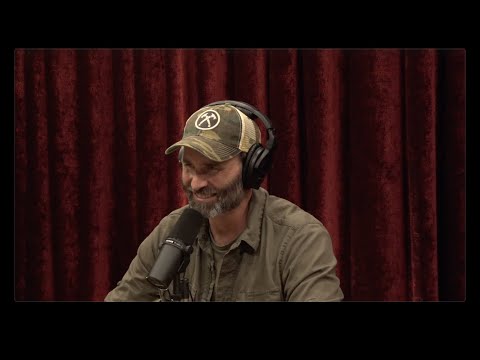
Joe Rogan Experience #2390 - Jack Carr
Narrator, Joe Rogan (host), Jack Carr (guest), Narrator, Narrator
In this episode of The Joe Rogan Experience, featuring Narrator and Joe Rogan, Joe Rogan Experience #2390 - Jack Carr explores jack Carr, Vietnam 1968, AI, and America’s Fractured Future Explored Joe Rogan and author/former SEAL Jack Carr discuss Carr’s new Vietnam‑era novel set in 1968, detailing the extreme research he did to authentically capture the mindset, language, and culture of that time, especially around MACV-SOG operations and the human cost of that war.
Jack Carr, Vietnam 1968, AI, and America’s Fractured Future Explored
Joe Rogan and author/former SEAL Jack Carr discuss Carr’s new Vietnam‑era novel set in 1968, detailing the extreme research he did to authentically capture the mindset, language, and culture of that time, especially around MACV-SOG operations and the human cost of that war.
They dive into how Vietnam exposed the darker realities of American power—false flags, profiteering, media distortion—and how fiction can humanize those events more deeply than history books by building empathy through characters.
The conversation then shifts to modern threats: the collapse of reading, AI-generated art and media, deepfakes, and how technology, social media, and political polarization are reshaping culture, free speech, and even what it means to be human.
They also cover Carr’s TV adaptations (The Terminal List, Dark Wolf, True Believer), stunt work, Hollywood notes vs. creative freedom, hunting, watches, military selection standards, border policy, political manipulation, and the growing sense of societal fragility.
Key Takeaways
Historical fiction can restore emotional truth missing from bare facts.
Carr argues that while statistics (like 58,000 Americans killed in Vietnam) are abstract, inhabiting characters in meticulously researched fiction lets readers viscerally feel those costs and carry that experience forward, building compassion and context.
Get the full analysis with uListen AI
Writing convincingly in another era requires thinking with that era’s limits.
To avoid dropping a modern thriller into 1968, Carr used period dictionaries, maps, manuals, music, and contemporary sources so every sentence reflected what people *then* knew—without hindsight about Tonkin, profiteering, or the war’s ultimate futility.
Get the full analysis with uListen AI
Vietnam exposed the gap between America’s myth and America’s reality.
Rogan frames WWII as the story we tell ourselves—fighting clear evil—while Vietnam, with its lies, false flag (Gulf of Tonkin), profiteers, media spin on events like Tet, and broken veterans returning to scorn, revealed a far messier, more cynical America.
Get the full analysis with uListen AI
Deep reading is becoming a rare superpower in the attention economy.
Carr links the crash in reading since 2003 almost directly to smartphones; he believes kids who choose books over TikTok, combined with physical training and combat sports, will be dramatically more capable, empathetic, and independent thinkers than peers.
Get the full analysis with uListen AI
AI will flood culture with convincing content, forcing us to revalue the human.
Rogan shows hyper-real AI interviews and AI music, noting it can already outperform many humans; both men foresee a world where labeling AI vs. ...
Get the full analysis with uListen AI
Creative freedom in TV comes *after* a hit proves itself.
Carr explains that Season 1 of The Terminal List faced heavy studio notes (who could die, how violent to be), but strong performance data flipped the relationship—Amazon now mostly says “don’t mess it up,” enabling riskier, more character-driven choices in sequels and spin‑offs.
Get the full analysis with uListen AI
Institutions and narratives are eroding trust, driving people toward alternative voices.
Rogan sees his own popularity as evidence that legacy media and politics have failed; when politicians openly invert past positions (e. ...
Get the full analysis with uListen AI
Notable Quotes
“World War II was what we think America is. Vietnam is what America really is.”
— Joe Rogan
“Any sentence had to be written through the lens of 1968 without the benefit of 50 plus years of hindsight.”
— Jack Carr
“If kids today put down that phone and just read, that is a superpower.”
— Jack Carr
“AI is not a cover band. AI’s a lot smarter than us. That’s the problem.”
— Joe Rogan
“I’m not writing this for a reader. I’m writing this for the story, and that’s the way I honor the reader.”
— Jack Carr
Questions Answered in This Episode
How does experiencing Vietnam through a deeply researched thriller like Carr’s change your understanding compared to documentaries or history books?
Joe Rogan and author/former SEAL Jack Carr discuss Carr’s new Vietnam‑era novel set in 1968, detailing the extreme research he did to authentically capture the mindset, language, and culture of that time, especially around MACV-SOG operations and the human cost of that war.
Get the full analysis with uListen AI
If AI can convincingly write novels and make music, what criteria will you personally use to decide which art is worth your time?
They dive into how Vietnam exposed the darker realities of American power—false flags, profiteering, media distortion—and how fiction can humanize those events more deeply than history books by building empathy through characters.
Get the full analysis with uListen AI
In what ways did Vietnam’s media coverage and government deception echo patterns you see in modern conflicts and political crises?
The conversation then shifts to modern threats: the collapse of reading, AI-generated art and media, deepfakes, and how technology, social media, and political polarization are reshaping culture, free speech, and even what it means to be human.
Get the full analysis with uListen AI
How much do you think the decline in reading and rise of short-form content is affecting our collective ability to reason, empathize, and resist manipulation?
They also cover Carr’s TV adaptations (The Terminal List, Dark Wolf, True Believer), stunt work, Hollywood notes vs. ...
Get the full analysis with uListen AI
What safeguards—technical, legal, or cultural—should exist to prevent AI and deepfakes from completely undermining trust in what we see and hear?
Get the full analysis with uListen AI
Transcript Preview
(drumbeats) Joe Rogan podcast, check it out. The Joe Rogan Experience.
Train by day, Joe Rogan podcast by night. All day. (rock music plays) All right, bro. My man. What's happening?
What's up?
Good to see you, my brother.
How are ya? Great to see you.
Always great to see you.
S- ah, been so looking forward to this. Been going a thousand miles an hour for, it seems like-
Me too, man.
... a long time.
And I've, I've been really looking forward to talking to you about this book, 'cause I know-
Yeah.
... that you've been obsessed. You've been obsessed by this era in human history.
Yeah. Yeah.
And tell us about it. Talk-
Yeah, yeah. So this is 1968 Vietnam, and, uh, I just launched the book tour, not last night but the night before, 'cause last night was Comedy Mothership, Kill Tony, which was amazing.
Best show in the world.
We had a blast. It was so crazy.
The best show to go to.
Do they v- vet any of those people, by the way, before they come up?
Nope. Yeah, they're insane people-
Yeah. Didn't look, didn't look like it.
... brilliant people, great comics, terrible comics.
(laughs)
That was fantastic. That's the best show ever.
Oh, my gosh. That was fantastic. But, yeah, I kicked off the book tour with, uh, David Morrell, who, who created Rambo back in 1972 with First Blood.
Oh, wow.
So that was a huge honor for me. He's been a inspiration to me my whole life. And, uh, wrote a series of books, uh, in the '80s, Brotherhood of the Rose, Fraternity of the Stone, League of Night and Fog, which were just incredible. And, uh, I got to kick off the book tour with him out there. Signed a baby for the first time. I've never signed a baby.
(laughs)
So, someone brought a baby through and asked me to sign their kid.
Oh, God.
I was like, "Uh."
That seems wrong.
It does. And then, uh-
Yeah.
... then I realized they just wanted me to sign the shirt on the baby-
Okay.
... which is a little better than the actual-
That's fine.
... skin of the baby. So-
Yeah.
Uh, so I did that.
I'd be worried they would tattoo the baby.
That was, uh, uh, two new tattoos came through. So I saw two new very large tattoos of crossed tomahawks.
Oh, they had the crossed tomahawks?
Yeah.
Nice.
That's crazy. I mean, you've been ha- had that for a while.
(laughs)
You've had people doing that for a while for you. But I remember the first time I got one, I think it was after, I think it was after I was on, or right around the same time of the first time I was on. So, like, 20/20 the first time I saw it and I texted you and sent it.
Install uListen to search the full transcript and get AI-powered insights
Get Full TranscriptGet more from every podcast
AI summaries, searchable transcripts, and fact-checking. Free forever.
Add to Chrome