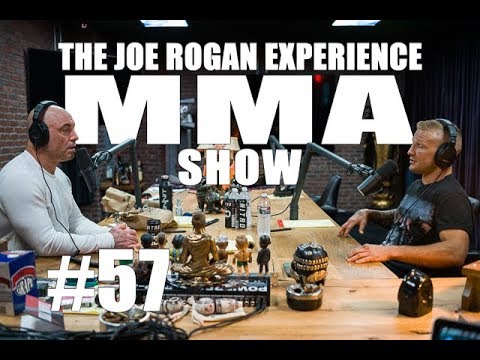
JRE MMA Show #57 with TJ Dillashaw
Joe Rogan (host), TJ Dillashaw (guest), Narrator, Narrator, Narrator
In this episode of The Joe Rogan Experience, featuring Joe Rogan and TJ Dillashaw, JRE MMA Show #57 with TJ Dillashaw explores tJ Dillashaw Dissects Cejudo Loss, Extreme Weight Cut, Future Plans TJ Dillashaw joins Joe Rogan to break down his controversial TKO loss to Henry Cejudo at flyweight, arguing the fight was prematurely stopped and that the behind-the-ear knockdown affected his balance, not his consciousness.
TJ Dillashaw Dissects Cejudo Loss, Extreme Weight Cut, Future Plans
TJ Dillashaw joins Joe Rogan to break down his controversial TKO loss to Henry Cejudo at flyweight, arguing the fight was prematurely stopped and that the behind-the-ear knockdown affected his balance, not his consciousness.
He explains in detail the science-driven 12‑week process he used to safely reach 125 pounds under performance coach Sam Calavita, claiming he felt stronger and better conditioned than ever, rehydrating to 149 pounds on fight night.
The conversation widens into training methodology, overtraining, recovery, and long-term health, including advanced monitoring, altitude simulation, red light therapy, and float tanks, as well as the importance of drilling versus hard sparring.
They also discuss broader MMA topics: ESPN’s impact, matchmaking issues, heavyweight greats like Cain Velasquez, Bellator’s rise, and TJ’s business ventures and future ambitions at 125, 135, and even 145 pounds.
Key Takeaways
Use data, not guesswork, to plan training and weight cuts.
Dillashaw’s camp tracked heart-rate variability, sleep, hydration, body fat, and weekly target weights so precisely that Calavita could predict TJ’s morning weight and manage his cut to 125 with minimal last‑minute dehydration.
Get the full analysis with uListen AI
Prioritize structured drilling over constant hard sparring to extend your career.
TJ credits Duane Ludwig with shifting him from three–four brutal spars a week to intensive, technical drilling and selective live work, improving skills while reducing injuries and cumulative brain trauma.
Get the full analysis with uListen AI
Recovery days and cortisol management are as important as hard sessions.
Using overnight HRV data, TJ’s coaches adjust daily workloads and schedule true rest days; he emphasizes that hammering yourself without enough recovery crashes hormones like testosterone and ultimately performance.
Get the full analysis with uListen AI
Combine multiple recovery modalities for compound benefits, not as magic fixes.
Dillashaw stacks infrared sauna, red light therapy, massage, float tanks, occasional hyperbaric oxygen, and cryotherapy—but always within a larger program of sleep, nutrition, and load management rather than relying on any single tool.
Get the full analysis with uListen AI
Altitude adaptation can be trained via controlled hypoxia, not just moving to high elevation.
Instead of living and training at altitude full-time, TJ uses AltoLab hypoxic breathing sessions with strict protocols to safely boost red blood cell production and capillary density while still training hard at sea level.
Get the full analysis with uListen AI
Plan financially and professionally for life after fighting.
TJ is actively building businesses—an online training platform, a healthy seasoning brand, and a cold‑pressed juice franchise—so he isn’t forced to fight beyond his prime or for financial necessity.
Get the full analysis with uListen AI
Channel competitive obsession but pair it with honest coaches and self-awareness.
He openly owns being a “sore loser” and an obsessive competitor, but stresses the value of coaches like Ludwig who will give brutal, technical feedback after a loss and prevent him from sliding into delusion or complacency.
Get the full analysis with uListen AI
Notable Quotes
““Show me a champion or a high-level competitor that likes losing, and I’ll call you a liar.””
— TJ Dillashaw
““I walked out at 149, a glycogen battery ready to go. I’ve never felt better before a fight.””
— TJ Dillashaw
““I didn’t get beat because I was a 25‑pounder. I felt better than I’ve ever felt in my entire life.””
— TJ Dillashaw
““This is the best time in the history of the world to see martial arts. There’s never been better martial arts, never.””
— Joe Rogan
““I want to fight Henry Cejudo at whatever weight he wants… I want that win back.””
— TJ Dillashaw
Questions Answered in This Episode
How much responsibility should referees bear in high-stakes fights when an early stoppage might alter a fighter’s legacy and earning potential?
TJ Dillashaw joins Joe Rogan to break down his controversial TKO loss to Henry Cejudo at flyweight, arguing the fight was prematurely stopped and that the behind-the-ear knockdown affected his balance, not his consciousness.
Get the full analysis with uListen AI
If Dillashaw truly felt stronger and better conditioned at flyweight, should extreme but ‘scientific’ cuts like his be seen as models—or as red flags—for the rest of the sport?
He explains in detail the science-driven 12‑week process he used to safely reach 125 pounds under performance coach Sam Calavita, claiming he felt stronger and better conditioned than ever, rehydrating to 149 pounds on fight night.
Get the full analysis with uListen AI
At what point does using advanced tech (HRV tracking, hypoxia devices, red light therapy) provide diminishing returns compared to simple sleep, diet, and good coaching?
The conversation widens into training methodology, overtraining, recovery, and long-term health, including advanced monitoring, altitude simulation, red light therapy, and float tanks, as well as the importance of drilling versus hard sparring.
Get the full analysis with uListen AI
Given rising awareness of CTE and long-term damage, where is the ideal balance between necessary sparring and safety in elite MMA training?
They also discuss broader MMA topics: ESPN’s impact, matchmaking issues, heavyweight greats like Cain Velasquez, Bellator’s rise, and TJ’s business ventures and future ambitions at 125, 135, and even 145 pounds.
Get the full analysis with uListen AI
From a competitive and promotional standpoint, what is the fairest next step: a flyweight rematch with Cejudo, a bantamweight title defense, or a new challenger at 135?
Get the full analysis with uListen AI
Transcript Preview
5, 4, 3, 2, 1. TJ.
Yo.
How are you, brother?
I'm doing good, man.
What is it like now? What is this, uh- what did- what- first of all, what was it like that night? For people who don't know-
Mm-hmm.
... let me just g- give you the rundown just so you don't have to say it.
Cool.
You were involved in, uh, one of the most high-profile flyweight fights ever.
Mm-hmm.
You're the bantamweight champion, you dropped down to flyweight, you went through this extensive training routine to get your body down to a manageable weight where you can cut the last 10 pounds or so-
Mm-hmm.
... and make 125. The fight starts, Cejudo lands a good shot early, there's a lot of- a lot of action, and the referee stops the fight.
Mm-hmm.
And I was- I was s- shook by it. Everybody that I was watching the fight with was like, "What the fuck?"
Dude, it-
And it was almost universal. Like, no one thought it was a good stoppage.
Yeah.
It's one of those stoppages where no one goes, "Yeah, it was a good stoppage, good stoppage."
Mm-hmm.
No one.
Yeah.
Everybody was like, "What the fuck?" You jumped off and you're like, "Dude, come on. Come on, man."
It's been rough, man. It's a rough one to- r- rough one to swallow on- on multiple reasons, you know. Um, like you say, he th- he landed a good shot. Um, the- the- everything's being overshadowed by this shot that landed behind my ear, you know. Um, I was over- uh, off balance, I threw a right hand that came in a little too aggressive. That's the way I fight, right? He pushed me over, I was off balance. He threw a kick, I blocked it, and he went to throw a right hand and I tried to dip out of the way, and it was one of those shots that hits you behind the head, like right behind the ear. Not illegal, right? We're on our feet. It's completely legal, but, uh, it was an unfortunate situation. One of those punches just kind of takes your feet out from underneath you. You're 100% there, but your equilibrium's off, you know, and he jumps on me. Um, I remember hearing the ref say, "Dillashaw, show me something," I told him, "I'm good." And I remember talking to him before the fight in the back, and he said, like, "If I'm telling you that, make sure you're talking to me. Give me- show me something," you know?
But how were you talking when-
I said it, I said, "I'm good."
I mean, but- but, uh, in his, you know, from- from his percep- perspective-
Yeah.
... how does he expect you to talk while you're blocking punches?
Install uListen to search the full transcript and get AI-powered insights
Get Full TranscriptGet more from every podcast
AI summaries, searchable transcripts, and fact-checking. Free forever.
Add to Chrome