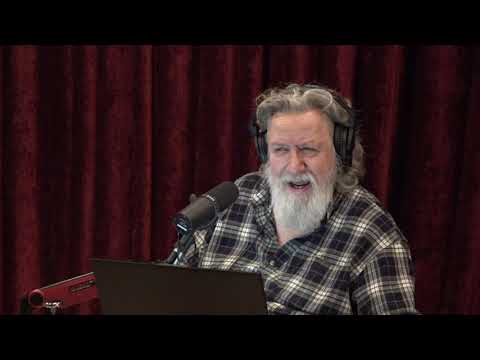
Joe Rogan Experience #1772 - Randall Carlson
Joe Rogan (host), Randall Carlson (guest), Narrator
In this episode of The Joe Rogan Experience, featuring Joe Rogan and Randall Carlson, Joe Rogan Experience #1772 - Randall Carlson explores randall Carlson Warns: Forgotten Catastrophes, Cosmic Threats, and Lost Civilizations Randall Carlson joins Joe Rogan to argue that Earth’s recent geological history is far more catastrophic and rapid than mainstream models suggest, centering on the Younger Dryas period ~12,800–11,600 years ago. He outlines evidence for massive meltwater pulses, abrupt climate swings, and a likely series of comet/asteroid impacts that coincided with megafaunal extinctions and human cultural collapses. Carlson connects this science to myth and history—Plato’s Atlantis, Phaeton, ancient cataclysms—and to controversial ideas like a submerged Azores Plateau matching parts of Plato’s story. The conversation then shifts to modern existential risks from impacts and solar storms, our unpreparedness, and Carlson’s vision for a new kind of hands-on, nature-based education to build a more resilient, reality-aware society.
Randall Carlson Warns: Forgotten Catastrophes, Cosmic Threats, and Lost Civilizations
Randall Carlson joins Joe Rogan to argue that Earth’s recent geological history is far more catastrophic and rapid than mainstream models suggest, centering on the Younger Dryas period ~12,800–11,600 years ago. He outlines evidence for massive meltwater pulses, abrupt climate swings, and a likely series of comet/asteroid impacts that coincided with megafaunal extinctions and human cultural collapses. Carlson connects this science to myth and history—Plato’s Atlantis, Phaeton, ancient cataclysms—and to controversial ideas like a submerged Azores Plateau matching parts of Plato’s story. The conversation then shifts to modern existential risks from impacts and solar storms, our unpreparedness, and Carlson’s vision for a new kind of hands-on, nature-based education to build a more resilient, reality-aware society.
Key Takeaways
Earth’s last ice age ended via abrupt, catastrophic pulses, not smooth gradual warming.
Radiocarbon dating and sea-level data show two major meltwater spikes (14,600 and 11,600 years ago) and very rapid ice retreat across North America, creating an ‘energy paradox’ that gradual solar geometry changes (Milankovitch cycles) alone can’t explain.
Get the full analysis with uListen AI
A series of cosmic impacts likely triggered the Younger Dryas cooling and mass extinctions.
Evidence at the Younger Dryas boundary includes ‘black mat’ layers with soot/charcoal, melt glass (trinitite-like), microspherules, nanodiamonds, and spikes in iridium and other platinum-group metals—classic impact proxies—coinciding with megafaunal die-offs and the disappearance of Clovis culture.
Get the full analysis with uListen AI
Megaflood landscapes in the Pacific Northwest show what days-long cataclysms can do.
Features like Dry Falls and Moses Coulee—canyons up to ~1,000 feet deep and miles wide—appear to have been carved in days to weeks by flows 10–20 times larger than all modern Earth’s rivers combined, pointing to enormous meltwater outbursts from the ice sheet, likely impact-driven.
Get the full analysis with uListen AI
Ancient myths may encode real cosmic disasters and sea-level rises.
Plato’s dating of Atlantis’ demise (~11,600 years ago) matches Meltwater Pulse 1B, and his Phaeton story explicitly describes heavenly bodies deviating from their path and setting the world on fire—Carlson argues this is likely a memory of impact events preserved as myth, not mere fantasy.
Get the full analysis with uListen AI
Our civilization is extremely vulnerable to both asteroid impacts and solar superstorms.
Near-Earth object detections have exploded in recent decades, with multiple ‘city-killer’ and larger asteroids passing within or inside the Moon’s orbit—many discovered only days in advance—and a Carrington-level or larger solar event today could knock out power grids and satellites globally; yet planetary defense remains rudimentary.
Get the full analysis with uListen AI
Human history likely includes multiple ‘Great Resets’ driven by natural catastrophes.
Carlson suggests the Younger Dryas was one of several Holocene-scale resets where advanced or complex cultures were wiped back to near-zero by exogenic (impacts) and endogenic (volcanism, seismic) events, with survivors preserving fragments of knowledge that later re-emerged as ‘sudden’ civilization.
Get the full analysis with uListen AI
Modern education neglects nature, practical skills, and real risk awareness.
Carlson criticizes large, stratified, test-driven schooling for producing bored, fragile students disconnected from the natural world; he advocates small, mixed-age, hands-on programs that integrate geometry with building, science with fieldwork, and real planetary risk (impacts, climate swings) into the curriculum.
Get the full analysis with uListen AI
Notable Quotes
“Where the hell did all the energy come from to melt that much ice?”
— Randall Carlson
“We’re not the perpetrators of these previous mass extinction events. We’ve been the victims.”
— Randall Carlson
“It just seems logical. We know the Moon is covered with craters… we know we’re in the middle of space and it happens all the time.”
— Joe Rogan
“If we don’t move into space, we’re going to go the way of the dinosaurs.”
— Randall Carlson
“Our civilization is actually way more vulnerable than we’ve assumed.”
— Randall Carlson
Questions Answered in This Episode
If the Younger Dryas impact hypothesis becomes fully accepted, how would it rewrite mainstream narratives about the origins and pace of human civilization?
Randall Carlson joins Joe Rogan to argue that Earth’s recent geological history is far more catastrophic and rapid than mainstream models suggest, centering on the Younger Dryas period ~12,800–11,600 years ago. ...
Get the full analysis with uListen AI
What specific types of field evidence or discoveries (e.g., impact craters under ice, submerged ruins on the Azores Plateau) would most decisively confirm or refute Carlson’s catastrophic models?
Get the full analysis with uListen AI
Given the demonstrated frequency of near misses, what is the most realistic, near-term planetary defense architecture humanity could deploy, and who should control it—governments or private actors?
Get the full analysis with uListen AI
How might education systems practically integrate geomythology, deep-time catastrophes, and real planetary risks without tipping into fearmongering or pseudoscience?
Get the full analysis with uListen AI
If multiple advanced or semi-advanced cultures were wiped out in past ‘Great Resets,’ what forms of knowledge or technology would be most likely to survive and reappear, and are we seeing any signs of that in the archaeological record today?
Get the full analysis with uListen AI
Transcript Preview
(drumming music plays) Joe Rogan podcast, check it out.
The Joe Rogan Experience. Train by day, Joe Rogan podcast by night, all day. (rock music plays)
Randall Carlson, how are you, sir?
I'm doing well, Joe.
It's great to see you. It really is.
It's, it's even greater to see you.
I was so looking forward to this podcast. I was s- s- I'm, I'm just, I'm so excited about this subject, so whenever you're in town, uh, I'm happy.
Well, you know, Joe, I drove 1,000 miles to get here.
(laughs)
That's how much I'm...
That's a long drive. How long did that take?
Uh, we did two days. It's, it's a 14.5-hour drive. But we got slowed down because of the weather, you know, the last...
Yeah. I was worried about that.
Yeah.
We've had some ice storms out here, for people that don't know.
Yeah. Right. We had it...
So...
It was nasty for a while, but...
And you're gonna be out here. You're doing some exploring. You're doing some cave exploring as well?
Well, we were gonna go to s- see Halls Cave, which is a, um...
Pull that microphone up to you.
Halls Cave-
Maybe get the, get the, the arm.
Like this?
There you go. Yeah.
How's this?
Perfect.
Good. Um, yeah, Halls Cave is near here, and this was a site that has, uh, extinct megafauna remains in it, and it also has some Clovis remain- Clovis tools, and it has the Younger Dryas black mat stuff in it. So basically-
W- black mat stuff meaning the, uh, whatever the impact was? What, what was settled?
Yes. So, right. So when you had the impact, or I think impacts plural, you had this dusting of stuff, and a lot of fires. So the fires produced soot, charcoal. So at that layer, you have this black mat layer, and below it, you have megafauna, and above it, they're mostly gone. Below it you have the Clovis culture. Above it, they're mostly gone. Um, so Halls Cave was a repository, and, um, we were gonna go in it. The, it's belongs to an elderly couple that's on private property, but then when the COVID hit, they got worried about letting people in there, so it's been postponed.
Mm.
Thomas Stafford was the lead archeologist on the job, on the, on the project, and he had agreed to set it up for us, but then they got, like I said, the elderly couple that owns the cave, they got cold feet, so.
So is this because of the recent strains of COVID? Is this like...
No. This woulda been...
So two years ago you were-
We were gonna go, let's see, well, two years, was it last summer? We were planning to go a year, uh, a year ago last summer.
Install uListen to search the full transcript and get AI-powered insights
Get Full TranscriptGet more from every podcast
AI summaries, searchable transcripts, and fact-checking. Free forever.
Add to Chrome