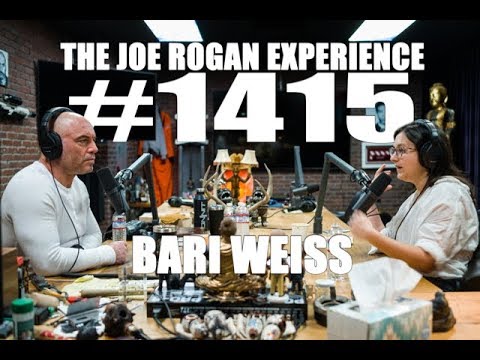
Joe Rogan Experience #1415 - Bari Weiss
Joe Rogan (host), Bari Weiss (guest), Guest (secondary in-room voice) (guest), Narrator, Joe Rogan (host), Narrator, Narrator
In this episode of The Joe Rogan Experience, featuring Joe Rogan and Bari Weiss, Joe Rogan Experience #1415 - Bari Weiss explores bari Weiss and Joe Rogan Confront Free Speech, Tribalism, Antisemitism, Israel Joe Rogan and Bari Weiss explore how social media, Trump-era polarization, and cancel culture have narrowed acceptable opinion and driven people into more extreme, underground spaces.
Bari Weiss and Joe Rogan Confront Free Speech, Tribalism, Antisemitism, Israel
Joe Rogan and Bari Weiss explore how social media, Trump-era polarization, and cancel culture have narrowed acceptable opinion and driven people into more extreme, underground spaces.
They discuss the tension between biological reality and gender ideology, the chilling effect on journalists and academics, and why figures who 'just say what they think' are resonating with audiences.
Weiss explains her book on antisemitism, arguing that it’s a shape‑shifting conspiracy theory baked into Western civilization, now resurfacing from both the far right (white nationalism) and the far left (anti‑Zionism).
They also dive into U.S. politics (Yang, Sanders, Warren, Trump), the Israeli‑Palestinian conflict, and how rising antisemitism signals a deeper sickness in American and Western societies.
Key Takeaways
Narrowing acceptable opinion drives people into more radical spaces.
Weiss argues that when mainstream institutions punish even modest dissent, people retreat to underground forums where bigotry and conspiracies flourish instead of being challenged.
Get the full analysis with uListen AI
Cancel culture disproportionately harms the least powerful, not celebrity contrarians.
High‑status figures like Ricky Gervais or J. ...
Get the full analysis with uListen AI
Contradictory truths can coexist, but the culture increasingly demands binaries.
They stress that you can acknowledge biological sex differences and still support trans people, or condemn bigotry against Ilhan Omar while also criticizing her own antisemitic remarks—yet public discourse forces people to pick a side.
Get the full analysis with uListen AI
Antisemitism functions less like a prejudice and more like a conspiracy theory.
Weiss describes it as a shape‑shifting worldview in which Jews are alternately blamed as racial contaminants, capitalist exploiters, or secret puppet‑masters, used to explain complex crises with a simple scapegoat.
Get the full analysis with uListen AI
Rising antisemitism signals deeper societal breakdown, not just a ‘Jewish problem.’
She compares it to an opportunistic infection: when a society’s immune system (norms, civic health) is strong, antisemitism is suppressed; when it resurges, it indicates broader democratic and cultural decay.
Get the full analysis with uListen AI
Anti‑Zionism today often means denying the legitimacy of an existing Jewish state.
Weiss distinguishes critique of Israeli policy from the claim that Israel has no right to exist; she argues the latter position, common in parts of the left, implies catastrophic real‑world consequences for millions of Jews already living there.
Get the full analysis with uListen AI
Populist energy and economic anxiety are reshaping U.S. politics beyond Trump.
They note that candidates like Sanders and Yang tap into anger over automation, inequality, and corporate power, and that Trump is both catalyst and symptom of deeper structural upheavals.
Get the full analysis with uListen AI
Notable Quotes
“Normalcy is closeted. Normal people I know with very sensible beliefs are scared to even say those things out loud.”
— Bari Weiss
“When reasonable opinions get pushed out of the mainstream, people radicalize.”
— Bari Weiss
“Antisemitism is built into the scaffolding of Western civilization. It’s like an intellectual disease in the foundations of the world we live in.”
— Bari Weiss
“When antisemitism shows itself in a culture, it means that culture is extremely broken or in some stage of death.”
— Bari Weiss
“If you live your life like God is real, it’s better… and if you say there’s a God or there’s no God, you don’t really know. No one knows.”
— Joe Rogan
Questions Answered in This Episode
Where should platforms draw the line between protecting free expression and preventing extremist recruitment and livestreamed violence?
Joe Rogan and Bari Weiss explore how social media, Trump-era polarization, and cancel culture have narrowed acceptable opinion and driven people into more extreme, underground spaces.
Get the full analysis with uListen AI
How can institutions expand the range of acceptable debate without legitimizing genuinely hateful or conspiratorial views?
They discuss the tension between biological reality and gender ideology, the chilling effect on journalists and academics, and why figures who 'just say what they think' are resonating with audiences.
Get the full analysis with uListen AI
In practical terms, how can societies ‘strengthen their immune system’ against antisemitism and other forms of dehumanization?
Weiss explains her book on antisemitism, arguing that it’s a shape‑shifting conspiracy theory baked into Western civilization, now resurfacing from both the far right (white nationalism) and the far left (anti‑Zionism).
Get the full analysis with uListen AI
Is it possible to design a durable peace framework for Israel–Palestine that accounts for both security realities and Palestinian self‑determination, or is ‘shrinking the conflict’ the best achievable goal?
They also dive into U. ...
Get the full analysis with uListen AI
To what extent are populist movements on the left and right both responding to the same economic and social dislocations, and how could that energy be channeled constructively instead of toward scapegoats?
Get the full analysis with uListen AI
Transcript Preview
3, 2, 1. (hands clap) Hello, Bari.
Hi, Joe.
Great. Oh-
(laughs)
... double, double guns. Good to see you. (hands clapping)
Great to see you, too.
So, uh-
I'm enjoying my turmeric.
You are, right?
Super food.
It's good. Laird Hamilton's onto something, right?
Very. Laird Hamilton and Gwyneth Paltrow-
No.
... I guess.
No, don't put them together.
They've never done the turmeric thing.
No, no, no.
(laughs)
One is a world champion athlete, one of the greatest surfers the world has ever known.
Okay.
The other one is a wonderful actress, who is Iron Man's girlfriend.
(laughs)
There's a difference. There's a big difference.
And, you know, a major mogul, who-
And wants you to put-
... determines what people like me want to purchase, buy, and look like.
She wants you to put vagina rocks-
Yes.
... in there, right?
Jade, jade, jade stones?
Jade stones? Something like that? (sighs) I don't know. Maybe there's a placebo effect to that?
(laughs)
Um, so l- ... I ... When we were talking so well before the podcast rolled out, lo- ... I just wanted to just, just start it. You know? And we don't, we don't have to talk about presidential candidates. We don't have to talk about all that. But w- we're in a weird time, you know? And, uh, uh, to speak to what we were talking about before, we were just talking about how people are so strange. There's so much, so many people ... There's a, just a big disconnect between what people actually think and what they actually say. And I think this is, in my life, this is the first time that I've ever really experienced it this, at this level. There's a hysteria because people are being punished for their real beliefs instead of, like, having, uh, the ability to express themselves and have other people disagree and have some sort of rational discussion. There's ... This is a, a strange time where you have to toe the status quo. You have to toe the line. And I'm try- ... I've been trying to figure out what it is, but I think a big part of it is the opposition to Trump. I think people's opposition to Trump is so strong that-
People have lost their minds.
Yeah. It seems like the, the people that oppose him, they, they, they just want complete and total compliance-
Mm-hmm.
... with, with opposition, with, with this different way of thinking. Does that make sense?
Yeah, it's like the stakes are so high that everyone needs to be on side and an active part of the resistance. And if you deviate in any way, it shows that you're a squish or that you're actually loyal to the other side. And in fact what that side of things is doing is that they're limiting the spectrum of what's allowed to say so, so, so narrowly, that people, I think, are becoming kind of secretly radicalized because they can't-
Install uListen to search the full transcript and get AI-powered insights
Get Full TranscriptGet more from every podcast
AI summaries, searchable transcripts, and fact-checking. Free forever.
Add to Chrome