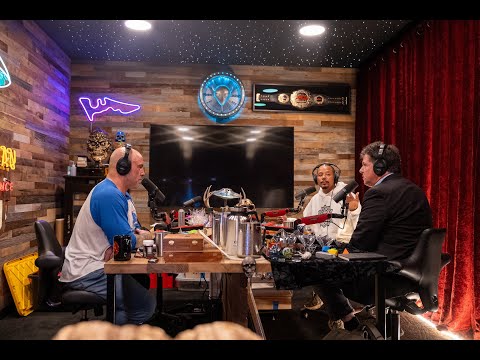
Joe Rogan Experience #2171 - Eric Weinstein & Terrence Howard
Terrence Howard (guest), Narrator, Joe Rogan (host), Eric Weinstein (guest), Eric Weinstein (guest), Terrence Howard (guest), Eric Weinstein (guest), Eric Weinstein (guest), Terrence Howard (guest), Joe Rogan (host), Joe Rogan (host), Eric Weinstein (guest), Eric Weinstein (guest), Eric Weinstein (guest), Joe Rogan (host)
In this episode of The Joe Rogan Experience, featuring Terrence Howard and Narrator, Joe Rogan Experience #2171 - Eric Weinstein & Terrence Howard explores eric Weinstein dissects Terrence Howard’s radical geometry and physics claims Joe Rogan hosts Eric Weinstein and Terrence Howard to revisit Howard’s controversial mathematical and physical ideas, especially his claims about redefining basic arithmetic, geometry, and fundamental forces. Weinstein attempts to “steelman” Howard: carefully reconstructing what Howard is actually proposing, separating interesting geometric insights from outright errors and overreach. They dive into topics like the Flower of Life, curved Platonic solids, electromagnetism, the ether, gravity, and the politics of academia and peer review. The episode becomes both a technical critique and a meta‑conversation about how heterodox ideas should be examined in a broken scientific culture.
Eric Weinstein dissects Terrence Howard’s radical geometry and physics claims
Joe Rogan hosts Eric Weinstein and Terrence Howard to revisit Howard’s controversial mathematical and physical ideas, especially his claims about redefining basic arithmetic, geometry, and fundamental forces. Weinstein attempts to “steelman” Howard: carefully reconstructing what Howard is actually proposing, separating interesting geometric insights from outright errors and overreach. They dive into topics like the Flower of Life, curved Platonic solids, electromagnetism, the ether, gravity, and the politics of academia and peer review. The episode becomes both a technical critique and a meta‑conversation about how heterodox ideas should be examined in a broken scientific culture.
Key Takeaways
Separate geometric creativity from physical claims.
Weinstein notes that some of Howard’s curved Platonic solids and the ‘linchpin’ structure are genuinely interesting geometric/engineering constructions, but they do not automatically justify sweeping claims about redefining physics, gravity, or fundamental forces.
Get the full analysis with uListen AI
Language precision matters when entering a technical field.
Howard uses reserved technical terms like “supersymmetry” and “zero” in idiosyncratic ways; Weinstein explains that misusing such terms triggers instant rejection from experts and obscures any valid underlying ideas.
Get the full analysis with uListen AI
Peer review is not the neutral gold standard it’s sold as.
Weinstein argues that modern peer review is historically recent, often functions as “peer injunction” (blocking outsiders), and can protect bad orthodoxy while excluding potentially valuable heterodox work.
Get the full analysis with uListen AI
Fixed points and ‘loops’ are a known, not forbidden, phenomenon.
Howard treats the equation involving √2 that maps back to itself under iteration as “unnatural,” but Weinstein shows this is a standard fixed‑point behavior (hairy ball theorem, Nash equilibria) and not a fatal flaw in mathematics.
Get the full analysis with uListen AI
The vacuum and the ether idea have modern reformulations.
While the old luminiferous ether was discarded, Weinstein explains that modern concepts like vector bundles and gauge fields effectively reintroduce an ‘ether‑like’ structure without contradicting relativity.
Get the full analysis with uListen AI
Presentation style can make or break outsider ideas.
Weinstein insists that when someone from outside academia teaches sweeping ‘replacements’ for established theories on huge platforms, without showing how they fit existing formalism, they incur a large credibility and social penalty.
Get the full analysis with uListen AI
Podcasts now function as de facto review venues.
Because trust in universities and agencies is collapsing, Weinstein argues that long‑form conversations like Rogan’s—where ideas can be challenged in public—have become one of the only remaining spaces to critically examine both orthodox and heterodox science.
Get the full analysis with uListen AI
Notable Quotes
“I can’t critique a man if I haven’t built a model of what he’s actually saying in my own mind that he agrees with.”
— Eric Weinstein
“When I say one times one equals two, that’s a metaphor for challenging the status quo.”
— Terrence Howard
“From a single contradiction, if you can sneak one contradiction through TSA, the entire airport collapses.”
— Eric Weinstein
“Peer review isn’t even peer review, it’s peer injunction.”
— Eric Weinstein
“What you’ve produced is something that is part bullshit and part real contribution, and we don’t have a system to pull it apart.”
— Eric Weinstein
Questions Answered in This Episode
Which of Terrence Howard’s geometric constructions (like the linchpin and curved Platonic solids) could realistically be formalized and tested within mainstream mathematics or engineering?
Joe Rogan hosts Eric Weinstein and Terrence Howard to revisit Howard’s controversial mathematical and physical ideas, especially his claims about redefining basic arithmetic, geometry, and fundamental forces. ...
Get the full analysis with uListen AI
How should the scientific community handle self‑taught polymaths who mix valid insights with clear errors—what process would be fair but rigorous?
Get the full analysis with uListen AI
Is Weinstein right that modern peer review often blocks genuine innovation, and if so, what alternative systems of evaluation could work better?
Get the full analysis with uListen AI
How far can analogies between waves, vibration, and geometry be pushed before they stop being helpful and start becoming pseudoscientific?
Get the full analysis with uListen AI
Given the breakdown of trust in institutions, what responsibilities do large podcasts like Rogan’s have when showcasing radical or unvetted scientific ideas?
Get the full analysis with uListen AI
Transcript Preview
(drum music) Joe Rogan podcast, check it out.
The Joe Rogan Experience.
Train by day, Joe Rogan podcast by night, all day. (rock music) Gentlemen, here we go. Terrence, thank you for coming back. It was, uh, a lot of fun having you on the first time. Obviously, a lot of people wanted to talk to you after they heard all these, uh, ideas of yours. And, and then my friend Eric reached out, and he said he would love to do it. Eric, one of my most brilliant friends. Um, y- tell everybody your background, like your academic background so people understand what you...
Sure. So I'm, I'm a PhD in mathematics, specifically in mathematical physics. Uh, I've had positions in economics, mathematics, and physics departments at places like MIT, Hebrew University of Jerusalem, Harvard, after my doctorate, uh, Oxford, um, and I'm a podcaster in part-
Very good podcaster.
(laughs)
Boosted- Bring it back to Portal?
Uh, you have a lot to do with all of these things, Joe.
This is my f- my, one of my favorite episodes of any podcast was your interview with Werner Herzog.
Oh, man.
That was a great episode.
Have you had him in here?
I have not, but I would love to.
'Cause it seems to me like that's the conversation I wanna listen to-
I would like to corner him-
... is you, you, and Werner.
... because I believe that Grizzly Man was a secret comedy.
(laughs)
I really do. There's something about h- the way he edited Grizzly Man, I'm like, "This motherfucker is being funny on purpose." I know he is. I know he's, like, editing these, like, short clips so it's- the guy's so ridiculous-
Yeah.
... that you start laughing.
I didn't see it 'cause I, for-
You haven't seen Grizzly Man?
We have different tastes, sir.
How dare you.
By the way-
It's a work of art.
... I, I need to also just say that I was not, uh, Terrence, I think, you know, I heard him on TMZ, um, the, I, I am not, I was not looking for a debate. I wanted to make sure that Terrence had his position steel manned so that anything that he didn't know how to do within mathematics that was legit, uh, gave a chance to put his best foot forward before he got, like, reviewed. And, uh, I didn't ask to come on. You asked to have me on. I'm happy to do it 'cause a friend of the show, but I'm just-
Well, you reached out about the episode specifically-
Yeah, sure.
... and I felt like if anybody could talk to Terrence and actually-
Oh, I-
... understand what they're talking about, it'd be you.
Yeah, and after I watched the interview with you and Brian Keating, um, I realized that you weren't trying to eviscerate me or anything like that. You actually wanted to hear, um, uh, a, a, a well-put-together argument concerning these things. So I appreciated you taking the time to come and examine these things and love to hear your stuff. But I wanted to say thank you to you, Joe, and for putting me on the show initially, and for your audience, for how they responded, and, you know, the support and the people that were against it, because it raises the idea of critical thinking, 'cause that's what we're s- we're supposed to be doing at this crucial time is the critical thinking. So I, I, I, I thank all the haters, and I thank all the supporters, and I thank the people that's on the fence. And I'm hoping that today we can move people over to one side or the other.
Install uListen to search the full transcript and get AI-powered insights
Get Full TranscriptGet more from every podcast
AI summaries, searchable transcripts, and fact-checking. Free forever.
Add to Chrome