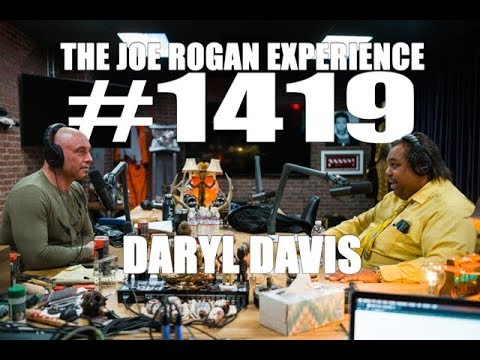
Joe Rogan Experience #1419 - Daryl Davis
Joe Rogan (host), Daryl Davis (guest), Narrator
In this episode of The Joe Rogan Experience, featuring Joe Rogan and Daryl Davis, Joe Rogan Experience #1419 - Daryl Davis explores black musician dismantles the Ku Klux Klan through radical friendship Daryl Davis, a Black blues and rock musician, recounts his decades-long effort to befriend and directly engage Ku Klux Klan members and other white supremacists to understand the roots of their hatred. Motivated by a childhood experience of racist violence and the question, “How can you hate me when you don’t even know me?”, he systematically sought out Klan leaders, interviewed them, attended their rallies, and invited them into his home.
Black musician dismantles the Ku Klux Klan through radical friendship
Daryl Davis, a Black blues and rock musician, recounts his decades-long effort to befriend and directly engage Ku Klux Klan members and other white supremacists to understand the roots of their hatred. Motivated by a childhood experience of racist violence and the question, “How can you hate me when you don’t even know me?”, he systematically sought out Klan leaders, interviewed them, attended their rallies, and invited them into his home.
Through sustained, calm, face‑to‑face conversations, he challenged their beliefs, exposed the ignorance undergirding their ideology, and modeled humanity and respect, eventually becoming friends with several high‑ranking leaders. Over time, more than 200 members left the Klan or similar groups, many symbolically giving Davis their robes, hoods, and insignia.
Davis and Rogan also explore the broader ecosystem of racism: how economic anxiety, family tradition, religious institutions, and online radicalization feed hate; why rebranding from “white supremacy” to “alt‑right” doesn’t change the core ideology; and how events like Charlottesville reveal attempts to spark a race war.
Davis argues that ignorance is the true root of racism and calls for early education, honest dialogue, and platforms for uncensored but civil discourse (like Minds.com) to “de‑radicalize” people and help American social values catch up to its technological progress.
Key Takeaways
Target ignorance, not just symptoms like fear or hatred.
Davis frames racism as a chain—ignorance breeds fear, fear breeds hatred, hatred breeds destruction—and insists the only durable solution is education and exposure that break ignorance at the source.
Get the full analysis with uListen AI
Sustained, respectful contact can humanize even hardened extremists.
By repeatedly meeting Klan leaders in their spaces and his, calmly listening and challenging their logic, Davis built trust and friendships that led many to voluntarily renounce their beliefs and organizations.
Get the full analysis with uListen AI
You cannot change minds if people aren’t allowed to speak theirs.
He criticizes deplatforming and social taboos that shut down racist or extremist speech, arguing that you must hear the full, ugly ideology to effectively rebut it and plant seeds of doubt.
Get the full analysis with uListen AI
Show, don’t tell: use contradictions and lived examples to puncture dogma.
Instead of trading insults, Davis uses analogies (like “white serial killer genes”) and factual corrections (Biblical misreadings, crime demographics) that force extremists into cognitive dissonance they later resolve by leaving.
Get the full analysis with uListen AI
Support systems are critical for people leaving hate groups.
Ex‑Klan and ex‑Nazi members often lose family, friends, and status when they exit; Davis helps by offering social support and connection so they don’t fall into isolation, addiction, or new extremist circles.
Get the full analysis with uListen AI
Labels and rebrands (alt‑right, white nationalist) obscure the same core ideology.
Davis traces a lineage from “white supremacy” to “white separatism,” “white nationalism,” and “alt‑right,” arguing that changing the name doesn’t alter the underlying belief in racial hierarchy.
Get the full analysis with uListen AI
Early, honest education about race and radicalization is essential.
He calls for civics and race education in elementary school, plus more moral courage from churches and institutions, so children learn how propaganda works and see all groups’ contributions as part of American history.
Get the full analysis with uListen AI
Notable Quotes
“How can you hate me when you don't even know me?”
— Daryl Davis
“Ignorance breeds fear. If you do not keep that fear in check, that fear in turn will escalate and breed hatred. If you don't check that hatred, it in turn will escalate and breed destruction.”
— Daryl Davis
“You cannot change somebody's mind by disallowing them to express what's on their mind.”
— Daryl Davis
“I never set out to convert anybody. I will say that I am the impetus for over 200 leaving the Klan – they converted themselves.”
— Daryl Davis
“Before we can call ourselves the greatest, our ideology needs to catch up to our technology.”
— Daryl Davis
Questions Answered in This Episode
Is Davis’s one‑on‑one, high‑patience approach scalable, and if so, what would it look like at a community or institutional level?
Daryl Davis, a Black blues and rock musician, recounts his decades-long effort to befriend and directly engage Ku Klux Klan members and other white supremacists to understand the roots of their hatred. ...
Get the full analysis with uListen AI
Where is the line between giving extremists a platform for dialogue and inadvertently amplifying or legitimizing their ideology?
Through sustained, calm, face‑to‑face conversations, he challenged their beliefs, exposed the ignorance undergirding their ideology, and modeled humanity and respect, eventually becoming friends with several high‑ranking leaders. ...
Get the full analysis with uListen AI
How could schools practically integrate meaningful anti‑racism and de‑radicalization education without triggering political backlash from parents and boards?
Davis and Rogan also explore the broader ecosystem of racism: how economic anxiety, family tradition, religious institutions, and online radicalization feed hate; why rebranding from “white supremacy” to “alt‑right” doesn’t change the core ideology; and how events like Charlottesville reveal attempts to spark a race war.
Get the full analysis with uListen AI
What psychological or life events most reliably open extremists up to the kind of doubt and reflection Davis uses to plant seeds of change?
Davis argues that ignorance is the true root of racism and calls for early education, honest dialogue, and platforms for uncensored but civil discourse (like Minds. ...
Get the full analysis with uListen AI
In the age of algorithm‑driven social media, what kinds of platforms or policies best balance free speech with limiting recruitment into violent hate movements?
Get the full analysis with uListen AI
Transcript Preview
Two, one. (clapperboard snaps) Good? Hello, Daryl.
Hey, Joe. How are you doing?
My pleasure, for, uh, thank you for being here. Really, really-
Uh, pleasure's all mine.
... really appreciate it.
Thank you.
Um, I read your story. Uh, I saw a thing about you on NPR and, uh, it's crazy. You've converted how many people? 200 KKK members? You've got them to drop their robes?
Right. Some directly, some indirectly, yes.
How did that all happen?
Wow. (laughs) Uh, you know, (clears throat) I keep running into these guys. I'm a, I'm a musician by trade.
Right.
So, uh-
Blues musician, right?
Rock and roll, blues, swing, jazz. My degree's in jazz, but hey, I'll, I'll play whatever you want me to play.
(laughs)
You're paying, I'm playing. (laughs) So, um, you know, everybody likes music, you know, even the KKK.
(laughs)
So used that to, uh, to my advantage. Um, I was playing in a bar one night in, uh, Frederick, Maryland, an all-white bar. And when I say all white, I don't mean that Blacks couldn't go in. What I mean is that, uh, Blacks chose not to go in. They weren't welcome. And here I was in this bar with this country band, a friend of mine's band. I was only Black guy in the band, only Black guy in the bar. And upon finishing the first set, this, um ... I'm walking to the, to the band table and somebody came up and put their arm around my shoulder. I turn around to see who it was. It was a white gentleman, maybe 15, 18 years older than me. And, um, he says, "Yeah, yeah, I really enjoy your all's music." I said, "Thank you," and shook his hand. And he pointed at the stage and said, "You know, I've seen this here band before, but I ain't never seen you before. Where'd you come from?" And I explained, "Yeah, you know, they told me they played here before, but this is my first time in this place. I just joined the band." And he said, "Well, man, I really like your piano playing. This is the first time I ever heard a Black man play piano like Jerry Lee Lewis."
(laughs)
And (laughs) I wasn't, um, I wasn't offended, but I was rather surprised 'cause as, as I said, you know, this guy's, like, maybe 15 years older than me, and he didn't, he did not know the, uh, Black origin of Jerry Lee Lewis's style of piano playing. Um, I, I explained it to him, "I got it from the same place Jerry Lee did, from Black blues and boogie-woogie piano players." Well, the guy was incredulous, "Oh, no, no, no. Jerry Lee invented that. I never heard no Black man play like that, except for you." So I'm thinking, "Okay, well this, this guy never heard of Little Richard or, or, uh, Fats Domino." And, uh, (clears throat) I said, "Look, man, I know Jerry Lee Lewis. He's a friend of mine. He's told me himself where he learned how to play." The guy did not buy that I knew Jerry Lee. He didn't buy that Jerry Lee learned anything from Black people. But he was so fascinated that he wanted to buy me a drink. I was, I was like a novelty to him. So went back to his table, I had a cranberry juice, and then he announces, "This is the first time I ever sat down and had a drink with a Black man." And now I'm, I'm the one who's incredulous. Like, how can that be? You know, I'd sat down with thousands of white people, anybody else, had a meal, a beverage, a conversation. How was it that this guy had never done that? And innocently, I asked him, I said, "Why?" He didn't answer me at first. He stared down at the tabletop. And I asked him again, and his buddy sitting next to him elbowed him in the side and said, "Tell him, tell him, tell him." I said, "Tell me." You know, I'm trying to figure out what is this mystery. He looks at, at me just as plain as day and he says, "I'm a member of the Ku Klux Klan." Well, I burst out laughing.
Install uListen to search the full transcript and get AI-powered insights
Get Full TranscriptGet more from every podcast
AI summaries, searchable transcripts, and fact-checking. Free forever.
Add to Chrome