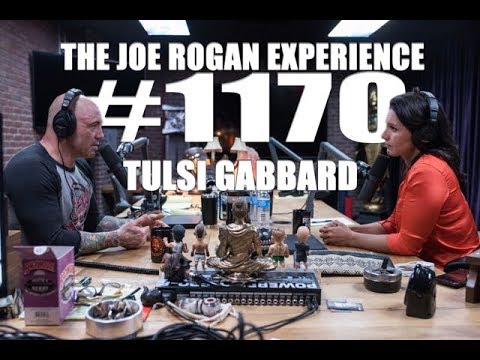
Joe Rogan Experience #1170 - Tulsi Gabbard
Tulsi Gabbard (guest), Joe Rogan (host), Narrator, Narrator
In this episode of The Joe Rogan Experience, featuring Tulsi Gabbard and Joe Rogan, Joe Rogan Experience #1170 - Tulsi Gabbard explores tulsi Gabbard condemns regime-change wars, corruption, and broken U.S. democracy Tulsi Gabbard joins Joe Rogan to discuss U.S. foreign policy, election integrity, criminal justice, and systemic political corruption through the lens of her military and congressional experience.
Tulsi Gabbard condemns regime-change wars, corruption, and broken U.S. democracy
Tulsi Gabbard joins Joe Rogan to discuss U.S. foreign policy, election integrity, criminal justice, and systemic political corruption through the lens of her military and congressional experience.
She criticizes regime-change wars in places like Iraq, Libya, and Yemen, arguing they worsen humanitarian crises, strengthen terrorism, and primarily serve the military‑industrial complex and allied regimes like Saudi Arabia.
Domestically, Gabbard highlights vulnerabilities in U.S. elections, the corrupting influence of Wall Street and corporate money, superdelegate abuses in the Democratic Party, and the failures of the drug war and private prisons.
She advocates for paper-backed voting, ending federal marijuana prohibition, serious campaign finance reform, and a less interventionist foreign policy, while calling for more authentic, younger, and tech‑literate leadership in government.
Key Takeaways
Regime-change wars often make countries and Americans less safe.
Gabbard argues interventions in Iraq, Libya, and Syria toppled dictators but left failed states, empowered ISIS and Al‑Qaeda, and created massive humanitarian crises—showing U. ...
Get the full analysis with uListen AI
War policy is heavily shaped by profit and foreign lobbying.
She cites the military‑industrial complex and countries like Saudi Arabia using U. ...
Get the full analysis with uListen AI
U.S. elections remain technically and structurally vulnerable.
Hackers—including an 11‑year‑old—have easily compromised voting system replicas, yet Congress resists simple fixes like mandatory paper ballots or voter‑verified paper backups, preferring to fundraise off the ‘Russia interference’ issue instead of solving it.
Get the full analysis with uListen AI
Party mechanisms like superdelegates can override voters’ will.
Gabbard details how in Hawaii Bernie Sanders won over 70% of the vote but most superdelegates still went to Clinton, calling the system undemocratic and noting party insiders openly defend it as a way to ‘save’ the country from voters’ choices.
Get the full analysis with uListen AI
Corporate money and Wall Street skew policy away from the public interest.
She connects paid speeches, campaign contributions, and lobbying to post‑2008 deregulation, arguing Congress is peeling back even limited safeguards because both parties are financially tied to major financial institutions.
Get the full analysis with uListen AI
The drug war, private prisons, and marijuana prohibition are deeply harmful.
Gabbard highlights how criminalizing marijuana and feeding people into private prisons destroys families, wastes taxpayer money, and blocks safer alternatives in the opioid crisis, even as evidence shows legal cannabis reduces opioid deaths.
Get the full analysis with uListen AI
Younger, tech‑literate, and authentic leaders are essential for reform.
She emphasizes that many current leaders neither understand nor regulate modern technologies (social media, data privacy, voting tech) effectively, and that generational change plus small‑donor funded candidates can reduce corruption and polarization.
Get the full analysis with uListen AI
Notable Quotes
“We need to be pragmatic about the world that exists, not some kind of idealistic world that is a fantasy.”
— Tulsi Gabbard
“Is it really in our place to go in and take action and say, ‘Okay, we're gonna remove this person, and then we're gonna put this person in, and this is how you're gonna govern this country’?”
— Tulsi Gabbard
“There are bad people in the world who do horrifying things. But as a result of our regime change wars, the people in those countries are far worse off than they were before.”
— Tulsi Gabbard
“I shouldn't have any… My vote shouldn't count for any more than yours or anyone else's.”
— Tulsi Gabbard (on being a superdelegate)
“One of the problems with politics is a lot of these people are just really good at being full of shit.”
— Joe Rogan
Questions Answered in This Episode
If the U.S. stopped all regime-change wars, how would it realistically handle threats from hostile regimes without creating power vacuums?
Tulsi Gabbard joins Joe Rogan to discuss U. ...
Get the full analysis with uListen AI
What concrete steps could be taken in the next two years to implement secure, paper‑backed voting nationwide, and who is blocking them?
She criticizes regime-change wars in places like Iraq, Libya, and Yemen, arguing they worsen humanitarian crises, strengthen terrorism, and primarily serve the military‑industrial complex and allied regimes like Saudi Arabia.
Get the full analysis with uListen AI
How can campaign finance reform practically reduce Wall Street and corporate influence without unintentionally entrenching incumbents or big media?
Domestically, Gabbard highlights vulnerabilities in U. ...
Get the full analysis with uListen AI
What would a responsible, evidence‑based federal drug policy look like if it fully incorporated cannabis, psychedelics, and alternatives like ibogaine for addiction treatment?
She advocates for paper-backed voting, ending federal marijuana prohibition, serious campaign finance reform, and a less interventionist foreign policy, while calling for more authentic, younger, and tech‑literate leadership in government.
Get the full analysis with uListen AI
How can voters better distinguish genuinely independent, principled candidates from those who are simply rebranding within the same corrupt structures?
Get the full analysis with uListen AI
Transcript Preview
... thank you.
Okay. Five, four, three, two, one. Boom! And we're live. Hawaii in the house.
Aloha.
Good to see you.
Nice to see you.
Thanks for doing this.
Thanks for having me.
What a great place to be a congressperson.
The best.
Ho- You're in paradise.
Yeah. It's, it's hard to leave to go to Washington, I tell you what.
That's one place, if it wasn't for the storms and the fact that it's really a volcano... (laughs)
Yeah. (laughs) As we've seen all too evident just recently.
Yeah. I have a friend who goes to the Big Island every year for Thanksgiving, and he convinced me to go, uh, two years in a row. It was awesome. I loved it, but then this year, I'm like, "Uh, I don't know, bro."
(laughs)
It seems like it's shooting rocks into the sky-
Yeah.
... and, uh, half of it's on fire.
Yeah. That, that's been, uh, that's in- So, that's my district. My district in Hawaii covers basically the whole state, except for the, the densely populated urban corridor of Honolulu.
Oh, so you're lucky.
Yeah.
You, you c- you cover everything except the problem spot. (laughs)
(laughs) The city. The city. So, um, no, it's, it's been tough. It's been a tough year because of those folks in the, the District of Puna with the volcano.
Yeah.
Um, we have gone through a few near misses with hurricanes, some big flooding on Kauai, and now we've got another one that's, uh, knocking on our door.
Yeah. You guys just, uh, uh, s- What was it? A level four just passed.
It was five. It was five. They were expecting-
And then it got knocked down.
... it to be kind of the same intensity that Puerto Rico and the Virgin Islands saw. So, we were really, like, encouraging everyone to get prepared, getting prepared ourselves, like boarding up all the doors and windows. And then, thank God, it turned into a tropical storm at the end and we had some, a lot of rain. We still had some flooding, but w- compared to what it could have been, we're fortunate.
And then on top of that, you guys had a false alarm-
(laughs)
... where a text went out to everybody in the islands-
Oh.
... saying that a nuclear missile was headed your way, and this was not a drill. What the hell happened there?
On top of all that. My gosh. Um, I was in Washington when that happened. It was a Saturday-
Oh.
... afternoon-ish in DC time, you know, early morning in Hawaii. And, uh, somebody f- from Hawaii sent me a, a, a screen capture of that alert that went out to over a million cell phones across our state saying, uh, you know, "Ballistic missile headed towards Hawaii. Seek cover. This is not a drill."
Install uListen to search the full transcript and get AI-powered insights
Get Full TranscriptGet more from every podcast
AI summaries, searchable transcripts, and fact-checking. Free forever.
Add to Chrome