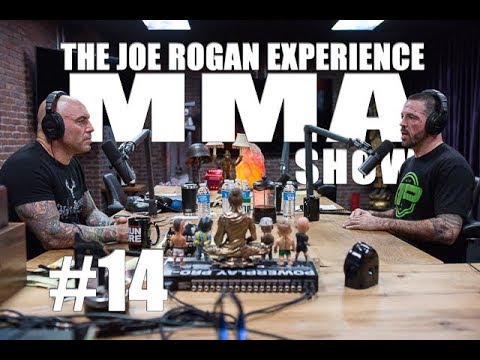
JRE MMA Show #14 with Matt Brown
Joe Rogan (host), Matt Brown (guest), Guest (Matt Brown’s interviewer-style follow-up / co-conversationalist segment) (guest), Narrator, Narrator
In this episode of The Joe Rogan Experience, featuring Joe Rogan and Matt Brown, JRE MMA Show #14 with Matt Brown explores matt Brown on violence, redemption, and redefining the fighter’s mind Joe Rogan and UFC welterweight Matt Brown cover Brown’s journey from small-town anger, hardcore drug use, and a near‑fatal heroin overdose to becoming a revered, all‑action MMA veteran. Brown explains why he ‘un‑retired’ to fight Carlos Condit, how he thinks about ring rust, fighting styles, and the balance between violence and tactics. A large part of the conversation explores mental training, meditation, and sports psychology, alongside deep dives into strength and conditioning, ketogenic dieting, and unusual training tools. They also branch into broader topics like steroids and USADA, Cuban and Thai combat cultures, nature, technology, and the meaning of giving back.
Matt Brown on violence, redemption, and redefining the fighter’s mind
Joe Rogan and UFC welterweight Matt Brown cover Brown’s journey from small-town anger, hardcore drug use, and a near‑fatal heroin overdose to becoming a revered, all‑action MMA veteran. Brown explains why he ‘un‑retired’ to fight Carlos Condit, how he thinks about ring rust, fighting styles, and the balance between violence and tactics. A large part of the conversation explores mental training, meditation, and sports psychology, alongside deep dives into strength and conditioning, ketogenic dieting, and unusual training tools. They also branch into broader topics like steroids and USADA, Cuban and Thai combat cultures, nature, technology, and the meaning of giving back.
Key Takeaways
Channel destructive energy into disciplined outlets.
Brown went from expressing lifelong anger through drugs, alcohol, and street fights to redirecting that same intensity into martial arts, showing that rage can become a powerful engine if it’s harnessed toward a structured pursuit.
Get the full analysis with uListen AI
Decide your ‘why’ before obsessing over ‘how’.
He argues most fighters (and people) get lost obsessing over tactics, training details, and career moves; once he clarified why he fights—self‑expression, testing himself, Bushido spirit—the path and methods became far clearer and less draining.
Get the full analysis with uListen AI
Mental training is a skill, not a given.
Brown treats mindset like any other attribute, using meditation, visualization, and sports psychology drills (e. ...
Get the full analysis with uListen AI
Performance diets must be adjusted, not blindly followed.
Switching to a strict ketogenic diet initially hurt Brown’s explosiveness despite helping brain health, recovery, and weight cutting; over time he learned to cycle in targeted carbs and ketone esters to balance health and peak performance.
Get the full analysis with uListen AI
Technical training and ‘savage’ will must be balanced.
His early career was fueled by a “fuck it, let’s fight” mindset—taking bouts on hours’ notice—until getting badly outclassed forced him to invest heavily in formal training, illustrating that raw aggression needs skill to reach its full potential.
Get the full analysis with uListen AI
Loyalty to a coherent system often beats chasing new solutions.
Brown regrets constantly hunting for the “perfect” camp or coach—the “unicorn fallacy”—instead of fully committing to one system, suggesting that depth and consistency usually trump perpetual switching.
Get the full analysis with uListen AI
Exposure to harsher environments reframes your idea of ‘hard’.
Training with Cuba’s national wrestling and boxing teams, seeing athletes literally fight for food and air conditioning, and witnessing Thai and Japanese discipline gave Brown a humbling reference point that made American hardships feel manageable.
Get the full analysis with uListen AI
Notable Quotes
““Stop trying to find yourself and start to define yourself.””
— Matt Brown
““It’s better to do it 100% wrong than 50% right.””
— Matt Brown
““I train martial skills, and then I express my art.””
— Matt Brown
““I’ve been to jail, I’ve been dead, I’ve been homeless. What’s the worst that could happen? I get knocked out?””
— Matt Brown
““Fighting is more than a sport. It’s an expression of what you’re capable of.””
— Joe Rogan
Questions Answered in This Episode
How much do extreme life lows—like overdose or homelessness—actually contribute to the mindset that separates elite fighters from everyone else?
Joe Rogan and UFC welterweight Matt Brown cover Brown’s journey from small-town anger, hardcore drug use, and a near‑fatal heroin overdose to becoming a revered, all‑action MMA veteran. ...
Get the full analysis with uListen AI
Where is the right balance between a fan‑friendly ‘warrior’ style and a safer, tactical, win‑first approach in MMA?
Get the full analysis with uListen AI
If lifetime bans were introduced for first‑time PED offenses, would that meaningfully clean up the sport or just create more ‘martyrs’ like Brown describes?
Get the full analysis with uListen AI
How can everyday people apply Brown’s ‘why over how’ philosophy and mental‑training habits to non‑fighting careers or personal struggles?
Get the full analysis with uListen AI
What would MMA (and combat sports in general) look like if our culture valued the art of fighting as deeply as places like Cuba or Thailand do?
Get the full analysis with uListen AI
Transcript Preview
Four, three, two, one. Boom, and we're live. What's up, brother? How are you?
Yeah, I'm very, very good.
Thanks for doing this, man. I'm very excited to have you in here.
Yeah. I'm honored to be here, man. I was just thinking about this the other day, actually. I was like, the fucking people that have been on this show, man.
(laughs) Yeah, I think about it sometimes too.
Yeah.
Freaks me out.
Uh, Sam Harris, James Hetfield. Uh, man, I, uh, yeah. I was thinking about all the people, man. I was like, "How do I compete with these guys?"
Just be Matt Brown.
I know.
What are you talking about, man?
I know. I mean, I could beat all their asses, but...
(laughs)
(laughs)
Well, in certain situations, that's all that counts. (laughs)
(laughs) The situations that I thrive in. (laughs)
Exactly. So, uh, you were retired and now you're not. Now you just signed a fight with Carlos Condit?
You got it.
Damn, that's a good fight. I like that.
Yeah.
I think Carlos needed to fight back too. That fight with Neil Magny, he looked like he was suffering through some ring rust. Looked-
Yeah, man.
... a little bit timing.
You, you got to... Uh, I've talked to a lot of people about that 'cause that's the first thing that always comes up, right, is how he came back and looked in that fight. And I've trained with Neil a lot, man, and I'll tell you, Neil can shut a fucking game down right away.
Yeah.
You know?
He's very good.
It's-
Very underrated.
Yeah, you can't take away from Neil, man.
Yeah.
Um, Carlos didn't seem to show any sense of urgency either though, so, uh, you know, I think it's both sides, but, uh, I think he's also gonna be looking for redemption with me. I think it-
Yeah, I think so too.
Yeah, he wanted to come back right away actually. They actually asked me to fight, it was, would've been like six weeks notice I think it was.
What's the longest you've ever taken off?
Uh, after I fought Cowboy, got knocked the fuck out, uh, and took a year off and fought Diego.
So, what is it like coming back after a year?
It felt natural to me personally.
To you?
Yeah.
Yeah.
Yeah, I didn't feel the need to do it. Yeah.
So it's different for different people, right?
Yeah, someone was talking to me about this the other day, ring rust, and I was like, "You know, everybody's different, man." Every single person is gonna react a little differently. And I think also when you have someone... Uh, you know how John Danaher was talking about like the different types of fighters, right? The, I think he just grouped three different types of fighters, uh, like a violence guy, a tactical guy, and something else. Well, I think it's gonna, I think there's more types of fighters than what he went through, but there's, um, I think it's gonna affect every single type of person differently, you know?
Install uListen to search the full transcript and get AI-powered insights
Get Full TranscriptGet more from every podcast
AI summaries, searchable transcripts, and fact-checking. Free forever.
Add to Chrome