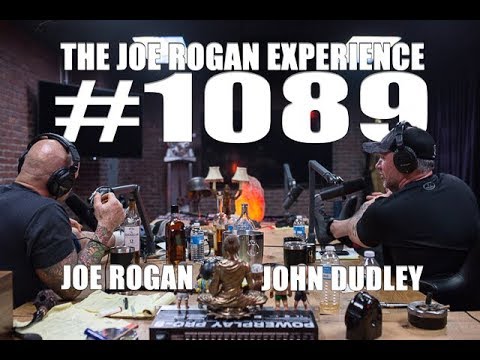
Joe Rogan Experience #1089 - John Dudley
John Dudley (guest), Joe Rogan (host), Jamie Vernon (guest), Narrator, Guest (guest), Guest (guest), Guest (guest), Guest (guest), Guest (guest), Guest (guest), Guest (guest)
In this episode of The Joe Rogan Experience, featuring John Dudley and Joe Rogan, Joe Rogan Experience #1089 - John Dudley explores joe Rogan and John Dudley Explore Hunting, Grit, Ghosts, and Growth Joe Rogan and archer John Dudley range across topics from American history and haunted places to Bigfoot movies, CGI, and childhood toys, before settling into deep dives on bowhunting, training, and personal development.
Joe Rogan and John Dudley Explore Hunting, Grit, Ghosts, and Growth
Joe Rogan and archer John Dudley range across topics from American history and haunted places to Bigfoot movies, CGI, and childhood toys, before settling into deep dives on bowhunting, training, and personal development.
They explore solo backcountry hunting, self‑filming, and the physical and mental demands of Western hunts, contrasting this with public misconceptions about hunting as simple or cruel.
A large portion of the conversation covers health: wild‑game cooking, intermittent fasting, stem cell treatments, injury recovery, massage, and how smart training and discipline support longevity in sports and life.
Throughout, they return to themes of authenticity, work ethic, learning from hardship, and ignoring envy—using stories about elite performers, military friends, and Dudley’s own background to illustrate what it takes to become “uncommon among the uncommon.”
Key Takeaways
Hunting is far more physically and mentally demanding than many people assume.
Rogan and Dudley describe multi‑day solo backpack hunts, heavy meat pack‑outs, and filming while hunting, framing Western bowhunting as closer to a backcountry endurance event than to the caricature of Elmer Fudd with a gun.
Get the full analysis with uListen AI
If you eat meat, you should understand how animals actually die and become food.
They argue that being present for a kill, field‑dressing, and cooking wild game creates a more honest relationship with meat than buying sanitized supermarket cuts, and praise Chris Pratt for publicly showing a home‑raised lamb becoming food.
Get the full analysis with uListen AI
Self‑imposed difficulty—competition, hunting, or training—reveals real character.
Dudley uses tough hunts as a “litmus test” for true friends, while Rogan compares standup, martial arts, and heavy sparring: the value is in learning who keeps going under pressure and how you react when things are hard.
Get the full analysis with uListen AI
Modern recovery tools like stem cells and serious bodywork can be game‑changing.
Both describe avoiding or delaying major surgeries with stem cell treatments, PRP, and targeted massage, emphasizing the importance of staying current on medical science to extend an athletic career and everyday function.
Get the full analysis with uListen AI
Intermittent fasting and diet awareness drastically change how your body feels.
They detail 14–16 hour fasting windows, low‑sugar, high‑fat breakfasts, and how occasional junk (like milkshakes) hits much harder when you normally eat clean—making you acutely aware of food’s impact on energy and mood.
Get the full analysis with uListen AI
Envy of others’ success is wasted energy; study them instead.
Responding to archers who resent his profile, Dudley says many have more raw talent but do far less with it; Rogan adds that anytime you’re mad someone else is successful, you’re better off asking, “What are they doing that I’m not?”
Get the full analysis with uListen AI
Deliberate practice and obsession separate the good from the truly elite.
Stories about Kobe Bryant shooting in the dark, David Goggins training to the brink, Cam Hanes’ daily grind, and Dudley’s own volume of arrows reinforce that extreme work ethic—often invisible to others—drives exceptional performance.
Get the full analysis with uListen AI
Notable Quotes
“Hunting is a Tough Mudder with a weapon.”
— John Dudley
“I’m not in show business. I’m in the Joe Rogan business.”
— Joe Rogan
“When things are going bad, if you can say the word ‘good,’ it means you’re still alive… and you still got some fight left in you.”
— Joe Rogan, quoting Jocko Willink
“There are guys that have ten times more talent than me and they do a tenth as much.”
— John Dudley
“You don’t know who you are if people only see you on the red carpet… they know who you are at mile 59 of a 200‑mile race when you’re shitting yourself over a cactus.”
— Joe Rogan
Questions Answered in This Episode
How did this episode change, challenge, or confirm your views on hunting and where your meat comes from?
Joe Rogan and archer John Dudley range across topics from American history and haunted places to Bigfoot movies, CGI, and childhood toys, before settling into deep dives on bowhunting, training, and personal development.
Get the full analysis with uListen AI
Which part of Dudley’s or Rogan’s training and recovery habits—fasting, stem cells, massage, kettlebells—seems most worth trying in your own life, and why?
They explore solo backcountry hunting, self‑filming, and the physical and mental demands of Western hunts, contrasting this with public misconceptions about hunting as simple or cruel.
Get the full analysis with uListen AI
Have you ever caught yourself resenting someone else’s success instead of analyzing what they do differently, and what might you change after hearing their take on envy?
A large portion of the conversation covers health: wild‑game cooking, intermittent fasting, stem cell treatments, injury recovery, massage, and how smart training and discipline support longevity in sports and life.
Get the full analysis with uListen AI
What “hard thing” in your life—sport, job, art, or personal project—functions as your version of a backcountry hunt in testing who you really are?
Throughout, they return to themes of authenticity, work ethic, learning from hardship, and ignoring envy—using stories about elite performers, military friends, and Dudley’s own background to illustrate what it takes to become “uncommon among the uncommon.”
Get the full analysis with uListen AI
How do you feel about rapidly advancing technologies (stem cells, VR, genetic engineering) after hearing their optimism and concerns—excited, uneasy, or both?
Get the full analysis with uListen AI
Transcript Preview
Whoa.
Five, four, three, two, one. (swooshes) Thunk. There's that sound that everybody knows. Thunk. Like if you play that sound, people know that's an arrow, right?
Yep.
Thunk. But it may be a throwing knife. Thunk. But you know it is an arrow.
Dang right, we do.
Dang right.
Dang right.
That's a, that's a Iowa boy right there.
(laughs)
That's some Midwest coming outta ya. Sometimes I hear you on your podcast and I'm like, "Man, he is so Midwest, it's hilarious."
Sorry about that. I'm act-
Don't apologize. It's awesome.
I'm actually more of a half-breed. I'm a-
Little bit of South, right?
Yeah, yeah. I was a redneck for a while, and then, then became a Yankee. My ... The people up North don't give a, they don't give a shit what people think North or South, but the S- the people from the South, my family, they're like, "You're part Yankee now." (laughs)
Yeah. Isn't that weird?
It's so weird.
They, they lost, that's why.
(laughs) Still thinking about it.
They lost that Civil War thing. Can you imagine? I mean, we are, we're several generations removed, but imagine growing up in like the late 1800s when it just happened and you're dealing with Yankees. There must have been a lot of murders, right? Where people killed Northerners and Northerners killed Southerners. And must've been a lot of that.
It, it was ruthless, I'm sure.
Ugh. How the fuck did that happen? That is a crazy time. If you think about the, the history of this country, that just 200 years ago, we were in, you know, less, we were in the middle of a bitter war from the, the North versus the South. Americans fighting Americans to the death. Big fields full of dead people. Um, my dad was at one of the fields. I forget which field it was. Um, but, uh, he said ... You know, it's one of those memorial places, uh, in the South. And he said, "The feeling-"
Gettysburg or something?
Yeah. You know what, it was Gettysburg. And he said, "You feel it." He's like, "You feel sadness there."
Yeah.
He's like, "It sound," I know it sounds crazy. And he was saying, "I don't even believe in that stuff, but you feel it." Like, you're there, you're like, "Oh."
Yeah. We've been in a few memorials. Um, a few memorials and a few big, you know, like, especially like military cemeteries.
Oh.
You just, uh ... You know another one I felt it, like exactly what you're saying? Um, I went to, um, a historic part of Custer where they lost the battle.
Oh, wow. Little Bighorn?
And I walked the whole hill-
Yeah.
... and everything. You can feel it there.
Wow. What is that? Do you think there's like memory in places?
Install uListen to search the full transcript and get AI-powered insights
Get Full TranscriptGet more from every podcast
AI summaries, searchable transcripts, and fact-checking. Free forever.
Add to Chrome