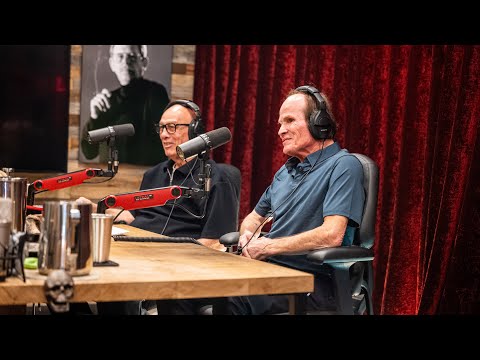
JRE MMA Show #173 with Benny "The Jet" Urquidez & William "Blinky" Rodriguez
Joe Rogan (host), Benny Urquidez (guest), William Rodriguez (guest), William Rodriguez (guest), Joe Rogan (host)
In this episode of The Joe Rogan Experience, featuring Joe Rogan and Benny Urquidez, JRE MMA Show #173 with Benny "The Jet" Urquidez & William "Blinky" Rodriguez explores kickboxing pioneers reflect on fighting evolution, honor, and forgiveness power Rogan reconnects with Urquidez and Rodriguez, emphasizing their role as foundational pioneers in full-contact karate and early international kickboxing, especially during an era with few rules, minimal safety standards, and little financial reward.
Kickboxing pioneers reflect on fighting evolution, honor, and forgiveness power
Rogan reconnects with Urquidez and Rodriguez, emphasizing their role as foundational pioneers in full-contact karate and early international kickboxing, especially during an era with few rules, minimal safety standards, and little financial reward.
They trace how rule sets (PKA vs. WKA/Japan vs. Muay Thai) shaped the sport’s evolution, discuss technical trends like calf kicks, and highlight how media/promotion decisions influenced kickboxing’s popularity in the U.S.
The conversation repeatedly returns to martial arts as a character-building path: conditioning, controlled sparring, defense-first training, and the “warrior code” (bushido/budo heart) that they feel has eroded under commercial pressures.
Rodriguez shares deeply personal stories of community violence intervention after his son’s murder—culminating in meeting and forgiving the man who killed his son—framing forgiveness as a transformative force stronger than physical skill.
Key Takeaways
Early “no rules” competition was the real laboratory for modern MMA.
They describe 1970s-era events with no weight classes or meaningful rule structure, forcing rapid adaptation and revealing which skills translated under pressure—an early blueprint for today’s mixed-rule combat sports.
Get the full analysis with uListen AI
Rule sets didn’t just change technique; they changed what the public learned to value.
PKA’s above-the-waist emphasis (and kick-count requirements) created a TV-friendly but strategically limited product that, in their view, delayed American audiences from appreciating leg kicks, clinch work, and “international” striking.
Get the full analysis with uListen AI
Calf kicks are a ‘rediscovered’ weapon, not a new one.
Rodriguez notes setting up wins with below-the-knee attacks decades ago, while Rogan connects it to current trends where Kyokushin-derived fighters (e. ...
Get the full analysis with uListen AI
Innovation often comes from necessity—Urquidez credits shin-guard creation to surviving Thai leg kicks in training.
Without local Muay Thai coaching available, he studied film and improvised protection for hard checking drills, describing early homemade shin guards with Velcro as a response to bare-shin training damage and long-term nerve concerns.
Get the full analysis with uListen AI
Controlled sparring is a competitive advantage, not ‘soft’ training.
They contrast gym “wars” that create concussions with Thai-style play sparring that preserves athletes for frequent competition; Rogan and Urquidez argue there’s a time for hard rounds, but constant damage erodes careers and performance.
Get the full analysis with uListen AI
Commercial incentives can distort ‘fighting truth,’ but audiences can be educated.
They criticize promoters and rule changes designed to satisfy casual viewers (e. ...
Get the full analysis with uListen AI
Martial arts’ highest impact may be social and spiritual, not competitive.
Rodriguez frames the Jet Center’s outreach and his decades-long violence-intervention work as proof that discipline and belonging can redirect lives; his story of forgiving his son’s killer is presented as the ultimate expression of martial arts ethos.
Get the full analysis with uListen AI
Notable Quotes
““My son got shot while he was learning how to drive a stick shift.””
— William “Blinky” Rodriguez
““I honestly, I thought that was his name.””
— Benny Urquidez
““I created the first… shin guards.””
— Benny Urquidez
““It’s high-level problem-solving with dire physical consequences.””
— Joe Rogan
““The power of forgiveness is more powerful than my left hook.””
— William “Blinky” Rodriguez
Questions Answered in This Episode
On the Hawaii “no rules” events: what *specific* techniques or tactics proved most reliable when there were no weight classes and minimal enforcement?
Rogan reconnects with Urquidez and Rodriguez, emphasizing their role as foundational pioneers in full-contact karate and early international kickboxing, especially during an era with few rules, minimal safety standards, and little financial reward.
Get the full analysis with uListen AI
Urquidez says he learned Muay Thai only from film—what were the biggest technical ‘Aha’ moments (clinch entries, elbows, checks) that changed how he fought?
They trace how rule sets (PKA vs. ...
Get the full analysis with uListen AI
How exactly did the Jet Center structure sparring so it produced elite fighters without turning every session into a concussion-heavy ‘war’?
The conversation repeatedly returns to martial arts as a character-building path: conditioning, controlled sparring, defense-first training, and the “warrior code” (bushido/budo heart) that they feel has eroded under commercial pressures.
Get the full analysis with uListen AI
Rodriguez describes using calf kicks between the ankle and calf—what set-ups and footwork patterns did he rely on, and how would he teach them to MMA strikers today?
Rodriguez shares deeply personal stories of community violence intervention after his son’s murder—culminating in meeting and forgiving the man who killed his son—framing forgiveness as a transformative force stronger than physical skill.
Get the full analysis with uListen AI
Rogan argues PKA’s rules ‘sold kickboxing badly’ in America—what would an ideal modern U.S. kickboxing product look like (rules, gloves, scoring, pacing, broadcast format)?
Get the full analysis with uListen AI
Transcript Preview
Joe Rogan Podcast, check it out!
The Joe Rogan Experience.
Train by day, Joe Rogan Podcast by night, all day. [upbeat music] Gentlemen, what's happening?
Ah, hey, Joe.
Where do we begin?
Where do you begin?
Yeah.
Let me tell you, when I first came to Los Angeles in 1994, there was two places that I had to go. One of them was the Comedy Store, and the other one was the Jet Center. And I started training at the Jet Center in '94, before you guys shut down, because you had the earthquake-
Right
... and you had the roof damage. So I was there before that happened, and I took your classes. I took your kickboxing classes because I remember it was very scary, 'cause you had a bunch of gang members in there.
[chuckles]
'Cause you were doing that, like, sort of outreach program where you're helping young gang members.
Yes.
So I had to spar with gang members. So I was training at the Jet Center until it shut down, and then I went briefly when you guys reopened in North Hollywood. I went to that place for a little bit, too.
Ah, the Jet Gym.
Yeah.
Yeah.
But then, uh, I started training at Majiro Gym-
Uh-huh
... which is in the, in the Valley.
[clears throat] Yeah.
But, uh, legends. You guys are legends, man.
Well, thank you, Joe.
True pioneers in martial arts.
For you to remember was, was, uh, really humbled me. You remembered-- you mentioned my, my son and why I was starting that.
Yes.
And you don't even know what it's grown into since that day, that you've seen what's going on.
Well, tell, tell the story about your son and how that whole thing started.
Well, you know, unfortunately, in some communities, drive-bys aren't uncommon, and so when it becomes a generational curse, you know, and, and, and, and kids are getting killed sometimes randomly, um, that happened to me. It came knocking on my door in a valley that's got two million people. Knocked on my door, and, and, uh, I was just... I was- I'm gonna put it this way: I had a calling on my life to, to do something about it, because it became a situation where, where families and community was like, "Well, yeah, well, that's what happens in our community." And I was saying, "That is not what happens in our community. This is our community." And so I began to move, I began to move, ironically, with some churches that, uh, that were- that had that kind of ministry in their ministry, and marked peace marches, et cetera. But, uh, my son got shot while he was learning how to drive a stick shift.
Wow.
And, uh, it took his life, and, and that's not normal, and that's not-- that should not be common. And, and, uh, so I'm still at it.
You're still doing that?
Still going on, thirty-six years later, put an organization together, and re- real, some with real lived experience, others with degrees, and really put together a whole, a nonprofit that speaks directly to it, where it's at. And, and, uh, so at the end of the day, um, yeah, it's over when we say it's over. You know what I mean?
Install uListen to search the full transcript and get AI-powered insights
Get Full TranscriptGet more from every podcast
AI summaries, searchable transcripts, and fact-checking. Free forever.
Add to Chrome