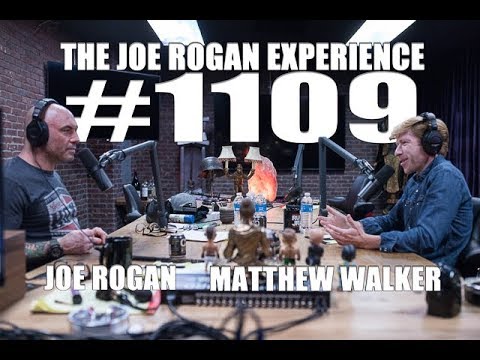
Joe Rogan Experience #1109 - Matthew Walker
Joe Rogan (host), Matthew Walker (guest)
In this episode of The Joe Rogan Experience, featuring Joe Rogan and Matthew Walker, Joe Rogan Experience #1109 - Matthew Walker explores sleep Scientist Reveals Hidden Dangers of Our Chronic Sleep Deprivation Neuroscientist Matthew Walker explains why adequate, high-quality sleep is foundational to health, performance, and longevity, not just a lifestyle choice. He details how modern habits—late-night light exposure, alcohol, marijuana, shift work, long work hours, and early school times—are quietly degrading our sleep and sharply increasing risks of cancer, Alzheimer’s, heart disease, obesity, and accidents.
Sleep Scientist Reveals Hidden Dangers of Our Chronic Sleep Deprivation
Neuroscientist Matthew Walker explains why adequate, high-quality sleep is foundational to health, performance, and longevity, not just a lifestyle choice. He details how modern habits—late-night light exposure, alcohol, marijuana, shift work, long work hours, and early school times—are quietly degrading our sleep and sharply increasing risks of cancer, Alzheimer’s, heart disease, obesity, and accidents.
Walker describes the brain mechanisms of non-REM and REM sleep, how dreams arise, why we forget them, and how sleep drives learning, skill mastery, creativity, emotional regulation, and even ‘cleaning’ toxic proteins linked to Alzheimer’s. He emphasizes that most people who think they function well on short sleep are objectively impaired but unaware of it.
The conversation ranges from vivid dream rebounds after quitting cannabis or alcohol, to hallucinations from extreme sleep loss, to the massive safety and performance costs of drowsy driving, sleep-deprived doctors, and underslept teenagers. Walker offers practical, evidence-based strategies to improve sleep and calls for systemic changes in medicine, education, and work culture.
Overall, the episode reframes sleep as the most powerful, democratic health intervention we have—and shows how profoundly we are undermining it.
Key Takeaways
Seven to nine hours of quality sleep is biologically non‑negotiable for adults.
Below seven hours, objective impairments in cognition, immunity, metabolism, cardiovascular health, and mood appear; the proportion of people who truly function optimally on six hours or less is effectively zero.
Get the full analysis with uListen AI
You cannot “bank” or fully repay lost sleep, and short sleep shortens life.
The brain recovers only part of missed sleep on subsequent nights, and even one week of six-hour nights measurably distorts the activity of hundreds of genes, including those tied to cancer, inflammation, and immune function.
Get the full analysis with uListen AI
Sleep is a powerful performance enhancer for learning, skills, and athletics.
Practice plus a full night of sleep boosts motor skill performance by 20–30%, improves automaticity, consolidates memory, and reduces injury risk; under-slept athletes fatigue faster, have worse cardio, and get injured more often.
Get the full analysis with uListen AI
REM and deep sleep perform distinct, critical jobs—including “cleaning” the brain.
Deep non-REM sleep supports body repair and clears toxic proteins like beta-amyloid linked to Alzheimer’s, while REM sleep fuels emotional processing, creativity, and dreaming; suppressing REM (with alcohol or cannabis) or truncating sleep undermines these functions.
Get the full analysis with uListen AI
Modern light exposure and schedules are biologically misaligned with our sleep systems.
Artificial light at night, screens before bed, very early work and school start times, and shift work all disrupt melatonin, circadian rhythms, and sleep quality, leading to higher rates of accidents, obesity, diabetes, depression, and cancer.
Get the full analysis with uListen AI
Drowsy driving and sleep-deprived medicine are major, under-recognized public health threats.
Sleep-related car crashes likely exceed those from alcohol or drugs, and residents working 30‑hour shifts vastly increase diagnostic and surgical errors; even a one-hour loss from daylight savings causes a spike in heart attacks.
Get the full analysis with uListen AI
Simple behavioral changes can significantly improve sleep quality and health.
Keeping a consistent sleep schedule, reducing evening light exposure, sleeping in a cool room, using hot baths to lower core temperature, managing caffeine and alcohol, and avoiding chronic fasting or late heavy meals all help restore healthier sleep.
Get the full analysis with uListen AI
Notable Quotes
“The shorter your sleep, the shorter your life.”
— Matthew Walker
“If sleep does not serve an absolutely vital function, it is the biggest mistake that the evolutionary process ever made.”
— Matthew Walker
“We are with sleep where we were with smoking 50 years ago.”
— Matthew Walker
“Sleep is the greatest legal performance‑enhancing drug that most people are probably neglecting in sport.”
— Matthew Walker
“Human beings are the only species that deliberately deprive themselves of sleep for no apparent reason.”
— Matthew Walker
Questions Answered in This Episode
If almost no one functions well on less than seven hours of sleep, how should employers and schools realistically redesign schedules to align with human biology?
Neuroscientist Matthew Walker explains why adequate, high-quality sleep is foundational to health, performance, and longevity, not just a lifestyle choice. ...
Get the full analysis with uListen AI
What are the most impactful, evidence-backed steps an average person can take this week to improve their sleep quantity and quality?
Walker describes the brain mechanisms of non-REM and REM sleep, how dreams arise, why we forget them, and how sleep drives learning, skill mastery, creativity, emotional regulation, and even ‘cleaning’ toxic proteins linked to Alzheimer’s. ...
Get the full analysis with uListen AI
Given the strong links between sleep loss and diseases like cancer and Alzheimer’s, why hasn’t sleep been made a central pillar of public health policy?
The conversation ranges from vivid dream rebounds after quitting cannabis or alcohol, to hallucinations from extreme sleep loss, to the massive safety and performance costs of drowsy driving, sleep-deprived doctors, and underslept teenagers. ...
Get the full analysis with uListen AI
How should medical training and hospital practices be restructured to protect both patient safety and physician health without sacrificing continuity of care?
Overall, the episode reframes sleep as the most powerful, democratic health intervention we have—and shows how profoundly we are undermining it.
Get the full analysis with uListen AI
To what extent can occasional extreme sleep loss (e.g., for work sprints, creative projects, or parenting) be offset by lifestyle changes, or is any regular pattern of deprivation inherently dangerous long-term?
Get the full analysis with uListen AI
Transcript Preview
And we're live. What's going on, mate? Did you sleep well last night?
I did.
(laughs)
I didn't sleep too badly. Uh, I mean, hotels are a tough thing. Um, and we actually know the science that, um, one-half of your brain will actually not sleep as deeply than the other when you're sleeping in a, an unusual room like a hotel room.
Really? That's what fucks me up.
Yeah.
'Cause when I'm on the road, you know, I'll do three different hotels in a week 'cause I'll do like, a Thursday, Friday, Saturday like, with gigs, and then by the time Sunday rolls around, I'm a mess.
In rough shape?
Yeah.
Yeah.
Is that what it is?
Yeah. And it's a, you know, it's a threat detection thing that-
Ah.
Um, I mean if you look at other species, they can do this much more impressively than we can. So dolphins or any sort of sea-dwelling mammal can actually sleep with half a brain. So one-half of their brain goes into deep sleep. The other half is wide awake.
That's how people at the DMV do it, those people that work at the Department of Motor Vehicles.
(laughs)
They're, they're, they work half asleep. You ever meet 'em?
I haven't, no. But-
Just, just teasing you.
I will, I, I, I-
If you're DMV listening going, "Fuck you, man. Next time you come in to get your license renewed."
There's my next NIH grant, I think, uh, looking at the DMV and sleep. But yeah, we-
TSA workers, same thing, same-
Same, same type of human.
That, I've come across.
Ah.
Yeah. Them too. I'm just kidding, fuckers. Relax. Um, so when you're in a hotel room, what is happening that your half your brain is not really sleeping?
Yeah, so there's different stages of sleep. There are two principle types. One is non-rapid eye movement sleep, or non-REM sleep. The other is REM sleep, uh, which is also known as dream sleep.
Right.
Um, and non-rapid eye movement sleep is further divided into four separate stages, um, which are unimaginatively called stages one through four. (laughs) We're a creative bunch as-
It's easy to remember.
... as, researchers. It is true. Uh, but I think it's also our low IQ. But it's the deep stages of sleep, three and four of that non-rapid eye movement, that's where a lot of sort of body replenishment takes place-
Mm-hmm.
... great for the cardiovascular system, metabolism, all of those good things. But that's the deep sleep that one-half of your brain will resist going into when you're sleeping in a foreign environment.
Ah.
So it stays in this kind of lighter stage, almost like a threat detection system.
Right.
Um, and you can imagine why, you know?
Install uListen to search the full transcript and get AI-powered insights
Get Full TranscriptGet more from every podcast
AI summaries, searchable transcripts, and fact-checking. Free forever.
Add to Chrome