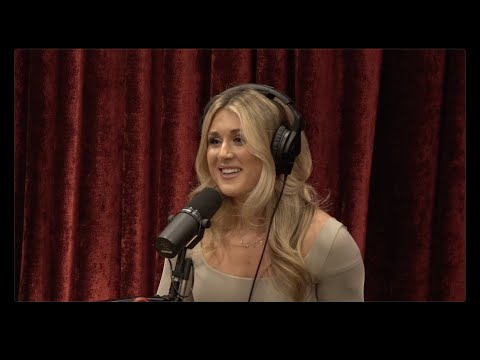
Joe Rogan Experience #2115 - Riley Gaines
Joe Rogan (host), Riley Gaines (guest)
In this episode of The Joe Rogan Experience, featuring Joe Rogan and Riley Gaines, Joe Rogan Experience #2115 - Riley Gaines explores riley Gaines Confronts Trans Ideology, Women’s Sports, And Cultural Capture Riley Gaines recounts her journey from elite collegiate swimmer to outspoken advocate after competing against transgender swimmer Lia Thomas and sharing a locker room with him at the 2022 NCAA championships. She details how institutions, from universities to sports bodies, enforced compliance with trans policies through trainings, media control, and threats to careers, while ignoring women’s privacy, safety, and fairness. With Joe Rogan, she broadens the discussion to language manipulation, COVID-era control, DEI, social media censorship, and what they see as a wider ideological and even Marxist-style project undermining objective reality. Gaines now works on legislation, public speaking, and media to define “woman” in law and to protect single-sex sports and spaces, arguing that ordinary people must speak up before they are personally affected.
Riley Gaines Confronts Trans Ideology, Women’s Sports, And Cultural Capture
Riley Gaines recounts her journey from elite collegiate swimmer to outspoken advocate after competing against transgender swimmer Lia Thomas and sharing a locker room with him at the 2022 NCAA championships. She details how institutions, from universities to sports bodies, enforced compliance with trans policies through trainings, media control, and threats to careers, while ignoring women’s privacy, safety, and fairness. With Joe Rogan, she broadens the discussion to language manipulation, COVID-era control, DEI, social media censorship, and what they see as a wider ideological and even Marxist-style project undermining objective reality. Gaines now works on legislation, public speaking, and media to define “woman” in law and to protect single-sex sports and spaces, arguing that ordinary people must speak up before they are personally affected.
Key Takeaways
Elite women athletes are forced to compete against biologically male athletes under current rules.
Gaines describes how Lia Thomas, ranked 462nd among men, became a national champion in women’s swimming under an NCAA policy requiring only 12 months of hormone therapy, with little apparent verification or regard for performance gaps.
Get the full analysis with uListen AI
Institutions often prioritize optics and inclusion narratives over fairness and women’s rights.
She recounts NCAA officials giving a tie-breaking trophy to Thomas for photo purposes, universities instructing women to accept male genitalia in locker rooms or seek counseling, and compliance staff claiming athletes “signed away” their speech rights with scholarships.
Get the full analysis with uListen AI
Women are being discouraged or intimidated from speaking out, which keeps many silent.
Female athletes were warned about losing jobs, being labeled transphobic, or even blamed as “potential murderers” if a trans-identifying teammate was ever harmed, creating a climate of fear that suppresses dissent.
Get the full analysis with uListen AI
Control of language is a central battleground in the sex and gender debate.
Gaines argues that terms like “gender-affirming care,” “sex reassignment,” “biological woman,” and “minor-attracted person” smuggle in contested ideas, dilute reality, and normalize practices—from male inclusion in women’s spaces to the softening of pedophilia.
Get the full analysis with uListen AI
The trans-in-sports issue is part of a broader pattern of institutional and cultural capture.
Rogan and Gaines connect COVID mandates, DEI, border policy, social media censorship, and corporate signaling as evidence that powerful entities can and do enforce compliance with irrational narratives, eroding trust and objective standards.
Get the full analysis with uListen AI
Legislative and market pushback are emerging as effective tools for course correction.
Gaines supports bills that define “woman” and restrict female categories to those who haven’t gone through male puberty, notes that over 20 states have passed fairness-in-women’s-sports laws, and points to consumer boycotts (e. ...
Get the full analysis with uListen AI
Personal resilience, family support, faith, and sports discipline are critical for withstanding backlash.
She credits her athletic background, intact family, and Christian faith for handling harassment, protests, and even being held in a room by activists at a college event, and urges others to speak up before they’re directly harmed.
Get the full analysis with uListen AI
Notable Quotes
““We were applauding our own erasure, our own demolition.””
— Riley Gaines
““How in the world can we, as female athletes, expect someone to stand up for us if we aren’t even willing to stand up for us?””
— Riley Gaines
““If being pro-woman is seen as anti-trans, then being pro-trans is inherently anti-woman—and what do we call someone who’s anti-woman? A misogynist.””
— Riley Gaines
““If they can get you to give up one of the most basic things, there’s no limits.””
— Joe Rogan
““There’s a lot of things that scare me, but a man in a dress will never be one of them.””
— Riley Gaines
Questions Answered in This Episode
Where should the line be drawn between inclusion and fairness in competitive sports, and who should have the authority to draw it?
Riley Gaines recounts her journey from elite collegiate swimmer to outspoken advocate after competing against transgender swimmer Lia Thomas and sharing a locker room with him at the 2022 NCAA championships. ...
Get the full analysis with uListen AI
How can young female athletes safely raise concerns about trans inclusion policies when their institutions threaten or silence them?
Get the full analysis with uListen AI
To what extent are language changes around sex and gender organically adopted versus strategically engineered by institutions and advocacy groups?
Get the full analysis with uListen AI
What practical safeguards could protect women’s privacy and safety in locker rooms, prisons, and dorms without dehumanizing trans-identifying individuals?
Get the full analysis with uListen AI
How can parents and students critically evaluate what schools and social media platforms are teaching about gender, while avoiding both hysteria and complacency?
Get the full analysis with uListen AI
Transcript Preview
(drumming) Joe Rogan podcast, check it out. The Joe Rogan Experience. Train by day, Joe Rogan podcast by night, all day. (instrumental music) Hello.
Hello.
Very nice to meet you.
Yes, and you!
You've been on a wild little journey, huh?
A journey that I-
(laughs)
... certainly never expected, never wanted.
Right.
Still don't want. Uh, so yeah.
Um, did you ever in your wildest dreams think that you would have to be a, an advocate for women's sports?
For sanity. (laughs)
For sanity, yeah. (laughs)
No. No. Uh, never did I imagine that anyone would have to be in the position that I'm in, nevertheless me. Uh, so like you said, it really has been a wild almost two years now. Um, I graduated college, uh, set to be a dentist in dental school, uh, wanting to specialize in endodontics, which weirdly enough is root canals. Uh, so to say that this is a totally different path than I could have ever anticipated, um, doesn't do it justice.
Yeah, it's a minor understatement. (laughs)
Yeah, right? Exactly.
So, eh, walk us through the beginnings of this for you. How... What, what was your first introduction to this insanity of biological men with gender dysphoria trying to compete with women?
So, I'll take you through my kind of timeline here.
Okay.
Started swimming when I was four years old, right? I come from a family of athletes. Uh, so, uh, my dad was an NFL player. My mom, she played D1 softball. My oldest sister, she played softball. Uh, went to Ole Miss. My brother, he's in college playing football now. All my uncles won Superbowls and all the stuff, so come from a family of athletes. Started swimming when I was four. Graduated when I was 22, so you know, 18 years of my life, I really dedicated to my sport. Uh, impossible to put into words, you know this, the time and the hours and the dedication and the sacrifices that it takes to compete and ultimately be successful at the highest level, but of course, I was willing to do this. I knew I had to. Uh, right, you don't get to go to prom. You don't get to have sleepovers with your friends on Friday night because guess what? Practice at 6:00 AM on Saturday. Um, all of that to really say it's a lifelong journey. College rolls around. Um, truth be told, I, I really could've gone anywhere that I wanted to swim. Um, I'm absolutely biased, and the SEC is the best conference, so I knew that was for me. Uh, but went to University of Kentucky. Could not have been a better place for me. Um, freshman year, right, there was a lot of adjusting. There was a lot of, uh, time and hours. I thought I worked hard before. I was wrong. Uh, we were in the water six hours every single day, with three of those hours being before 8:00 AM, right? So you practice from 5:00 AM to 8:00 AM, go to class, come back, practice again from 1:30 to 4:30. Um, ate your dinner, iced your shoulders, went to bed, did it all again the next day. Uh, we swam about 15,000 yards every single day, which is equivalent to like 10-ish miles, so lots of adjusting. Sophomore year, still improving though, still getting better. Sophomore year rolls around. Uh, we're, you know, I, I really started having this breakout season, started doing some, some pretty great things, uh, really had finally developed like a sense of consistency I think. Uh, and about three days before we were supposed to leave for our national championships, which of course, you know, the NCAA, think about basketball, the NCAA tournament, uh, equivalent in swimming. We're ready to go, the meet you work all year, really all your life for. Uh, about three days before we were supposed to leave in March of 2020, um, our coaches pull us out of the water, sit us down, say, "Look, you know, if you live in the dorm rooms, pack your stuff up. You have to leave campus tonight." Of course, COVID had hit. Um, I didn't really know what this meant at the time. There was still a lot of uncertainty around this, uh, so I thought this meant we got a weekend off, we got to go home, we'd quickly return. Uh, but of course that was not a correct assumption, uh, because upon going back home, home is Tennessee for me, right? There were no pools open. There were no gyms open, nothing like that, and so every day, I swam miles aimlessly in the lake. I'd put on a wetsuit, and I'd jump in the boat dock, and I'd swim down by Johnny Cash's house, and I came back, and I did the same route every single day. Um, because again I, I n- knew that I had to if I wanted to continue this breakout season I was having my junior year int- or my sophomore year into my junior year. Um, right? And the amount of snakes that I swam by-
Install uListen to search the full transcript and get AI-powered insights
Get Full TranscriptGet more from every podcast
AI summaries, searchable transcripts, and fact-checking. Free forever.
Add to Chrome