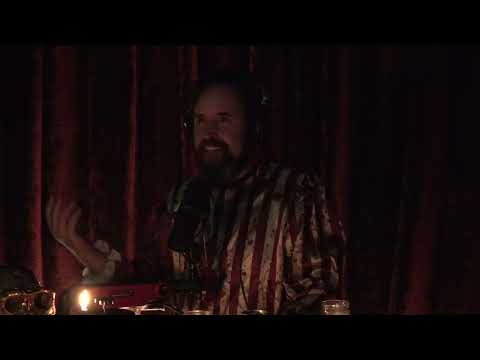
Joe Rogan Experience #1891 - Duncan Trussell
Narrator, Narrator, Joe Rogan (host), Duncan Trussell (guest), Narrator, Narrator, Narrator, Narrator
In this episode of The Joe Rogan Experience, featuring Narrator and Narrator, Joe Rogan Experience #1891 - Duncan Trussell explores rogan and Trussell Deconstruct Power, Propaganda, Psychedelics, and Inner Peace Joe Rogan and Duncan Trussell move from current events and censorship to a wide‑ranging, philosophical conversation about human nature, politics, technology, psychedelics, and inner life.
Rogan and Trussell Deconstruct Power, Propaganda, Psychedelics, and Inner Peace
Joe Rogan and Duncan Trussell move from current events and censorship to a wide‑ranging, philosophical conversation about human nature, politics, technology, psychedelics, and inner life.
They discuss government collaboration with social media on misinformation, Elon Musk’s Twitter takeover, and how propaganda, corporate money, and binary U.S. politics distort democracy.
The talk explores conspiracy thinking, cult psychology, Russian troll farms, AI and AR’s future, UFOs, ancient civilizations, and the possibility that reality is far stranger than we assume.
Threaded through is a recurring theme: the mind is hackable, suffering is optional to some degree, and real change starts with individuals learning to tame their own reactivity and reduce harm.
Key Takeaways
Beware of state–platform collusion over ‘misinformation’ and ‘malinformation.’
Rogan and Trussell argue that when security agencies quietly pressure tech companies to define and police ‘dangerous’ speech, the same institutions that often get facts wrong gain power to decide what the public is allowed to see, creating a serious conflict of interest.
Get the full analysis with uListen AI
Human minds are highly hackable—and the internet is a weaponized environment.
From Russian troll farms running top Christian pages to random trolls and possible hostile states, they describe social media as an ‘ocean of madness’ where suggestible people, limited critical thinking, and leader‑seeking instincts make mass manipulation easy.
Get the full analysis with uListen AI
The U.S. political binary produces bad choices and entrenched division.
They liken presidential elections to being forced to choose between two bad skaters in an Olympic final, arguing that money filters out better candidates, corporate speech fees function as legalized bribery, and party loyalty keeps people defending clearly flawed leaders.
Get the full analysis with uListen AI
AI and AR will soon allow personalized, persistent alternate realities.
Discussing tools like Stable Diffusion, Midjourney, and VR demos, they predict near‑term AR glasses that can reskin your environment in real time, leading to curated ideological ‘worlds’ and new kinds of propaganda, cults, and psychological escape—unless decentralized, open systems prevail.
Get the full analysis with uListen AI
Suffering is amplified by identification with thoughts; it can be reduced.
Drawing on Buddhist ideas, Trussell frames everything perceived as ‘your mind’ and compares clinging and resentment to stabbing yourself with an arrow someone else shot; recognizing this allows you to drop unnecessary self‑harm and gradually calm your internal climate.
Get the full analysis with uListen AI
Anger management and non‑reactivity have outsized real‑world impact.
They highlight how road rage, online outrage, and personal reactivity escalate into real violence (e. ...
Get the full analysis with uListen AI
Psychedelics and altered states can be powerful tools—but are culturally suppressed.
Rogan stresses that psilocybin has strong evidence for easing end‑of‑life anxiety and catalyzing perspective shifts, yet is blocked by people who’ve never tried it, while Trussell notes that such experiences can ‘loosen the tourniquet’ on our ego and reconnect us to something larger.
Get the full analysis with uListen AI
Notable Quotes
“We’re hackable, dude. People are really good at hacking us.”
— Joe Rogan
“The internet is an ocean of madness, and everybody thinks they can control the ocean.”
— Duncan Trussell
“You’re looking at two bad skaters in the Olympic final and you’re told, ‘Pick one. The fate of democracy depends on it.’”
— Duncan Trussell
“If you can help, help. If you can’t help, don’t hurt.”
— Duncan Trussell (paraphrasing the Dalai Lama)
“Most of the time, in the moment, everything’s actually fine. The problem is your mind is acting like you’re on the highway all day long.”
— Duncan Trussell
Questions Answered in This Episode
How should democracies balance the genuine threat of foreign disinformation with the danger of governments quietly deciding what counts as ‘truth’?
Joe Rogan and Duncan Trussell move from current events and censorship to a wide‑ranging, philosophical conversation about human nature, politics, technology, psychedelics, and inner life.
Get the full analysis with uListen AI
If AI- and AR-driven ‘personal realities’ become mainstream, what safeguards—technical or cultural—could prevent them from becoming new tools of manipulation or radicalization?
They discuss government collaboration with social media on misinformation, Elon Musk’s Twitter takeover, and how propaganda, corporate money, and binary U. ...
Get the full analysis with uListen AI
What practical steps can an average person take to reduce their own susceptibility to conspiracy thinking without shutting down open-minded exploration?
The talk explores conspiracy thinking, cult psychology, Russian troll farms, AI and AR’s future, UFOs, ancient civilizations, and the possibility that reality is far stranger than we assume.
Get the full analysis with uListen AI
Given the entrenched money and power around the current U.S. political system, is there any realistic path to moving beyond a dysfunctional two‑party binary?
Threaded through is a recurring theme: the mind is hackable, suffering is optional to some degree, and real change starts with individuals learning to tame their own reactivity and reduce harm.
Get the full analysis with uListen AI
How might widespread, responsible access to psychedelics change our collective ‘inner climate’—and what new risks would that introduce?
Get the full analysis with uListen AI
Transcript Preview
(drumming music) Joe Rogan podcast, check it out. The Joe Rogan Experience.
Train by day, Joe Rogan podcast by night, all day. (instrumental music)
(laughs) Hello, Duncan.
Hello!
I don't think this is gonna work.
(laughs)
(laughs) Oh my God, I can't see. Ugh.
Oh, fuck.
I can't, like ... I can't see at all.
All right.
I don't know how you're supposed to see out of that.
It is a deadly outfit.
I guess I'll just put that on when I wanna say something incriminating.
Yeah. S- What do you mean?
Well, the Thought Police. So pull up that article, Jamie, at the beginning of this podcast. We should probably go right into this. 'Cause apparently, the Department of Homeland Security (sniffs) and Twitter-
Yeah.
... were working together. Are we on?
(sniffs) Yeah.
I don't hear ... There we go. The Department of Homeland Security was, uh, they, they had a plan to police information and they were working with Twitter in some fashion. Like, look at this. "Quietly broadening its effort to curb speech it considers dangerous."
Yeah.
What does that mean?
I don't know.
"An investigation by The Intercept has found years of internal DHS memos, emails, and documents obtained via leaks and an ongoing lops and on- ... (clears throat) And an ongoing lawsuit as well as public documents illustrate the expansive effort by the agency to influence the tech platforms."
Shit.
"The work, much of which remains unknown to the American public," dun, dun, dun, "came into clearer view earlier this year when DHS announced a new Disinformation Governance Board-"
Good lord.
"... a panel designed to police misinformation, false information spread unintentionally; disinformation, false information spread internally."
Intentionally?
"And mal- ... Intentionally," excuse me. "And malinformation, factual information shared typically out of context, with harmful intent." Malinformation's a weird one.
Malinformation?
Yeah. 'Cause it's factual, but it's shared-
Oh.
... typically out of context.
Out of context. "With harmful intent." That's where you're like, "Y- look, you don't understand why mowed down those reporters-"
(laughs)
"... with a chopper. It's outta context. You can't just show the video."
"While the board was widely ridiculed, immediately scaled back, and then shut down within a few months, other initiatives are underway as DHS pivots to monitoring social media now that its original mandate, the War on Terror, has been wound down." So that's been wound down apparently.
Oh.
"Platforms have got to get comfortable with government. It's really interesting how hesitant they remain," Microsoft executive Matt Masterson, former DHS official, texted-
What?
... Jen Easterly. L- Look at that. "Platforms have got to get comfortable-"
Comfortable.
"... with government." Ugh.
What does that mean?
I don't know. Tim Pool sent me this this morning. I didn't get a chance to re- ... I was i- in the gym.
Install uListen to search the full transcript and get AI-powered insights
Get Full TranscriptGet more from every podcast
AI summaries, searchable transcripts, and fact-checking. Free forever.
Add to Chrome