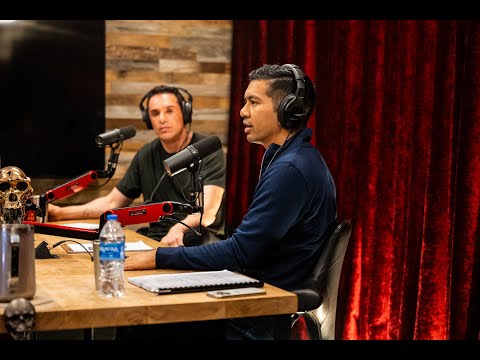
Joe Rogan Experience #2166 - Enhanced Games
Christian Angermayer (guest), Joe Rogan (host), Dr. Aron D’Souza (guest), Christian Angermayer (guest), Narrator, Narrator
In this episode of The Joe Rogan Experience, featuring Christian Angermayer and Joe Rogan, Joe Rogan Experience #2166 - Enhanced Games explores rogan Debates Enhanced Games: Superhuman Sports, Drugs, and Autonomy Joe Rogan speaks with Enhanced Games president Dr. Aaron D’Souza and co‑founder/investor Christian Angermayer about launching a new Olympic-style event where performance-enhancing drugs are allowed under medical supervision.
Rogan Debates Enhanced Games: Superhuman Sports, Drugs, and Autonomy
Joe Rogan speaks with Enhanced Games president Dr. Aaron D’Souza and co‑founder/investor Christian Angermayer about launching a new Olympic-style event where performance-enhancing drugs are allowed under medical supervision.
They argue the current Olympic system is economically exploitative and hypocritical on doping, while performance enhancement is already widespread and could be made safer, more transparent, and scientifically valuable.
The conversation extends into broader issues: drug policy, body autonomy, psychedelics, aging as a disease, and how science, capitalism, and media can shift public perception on banned substances.
They also discuss format (five core sports), funding, broadcast interest, transgender categories, and why they believe world records will be broken at the inaugural Enhanced Games in 2025.
Key Takeaways
The Enhanced Games aim to normalize and supervise enhancement instead of pretending sports are clean.
D’Souza cites data that nearly half of Olympians admit to recent banned drug use and that many world records are linked to doping. ...
Get the full analysis with uListen AI
The Olympic business model is highly profitable yet structurally unfair to athletes.
The IOC pays no direct salaries to competitors while billions flow through broadcasting and sponsorships and host cities overspend on temporary infrastructure. ...
Get the full analysis with uListen AI
Legality and “banned in sport” are not the same—and most WADA-banned substances are legal medicines.
They highlight that substances like TRT, many peptides, and stimulants are FDA-approved and legally prescribable, yet banned by private sports bodies. ...
Get the full analysis with uListen AI
Body autonomy and informed consent are the ethical core of their argument for enhancement.
All three contend adults should be free to modify their bodies and minds—whether with steroids, GLP‑1s, psychedelics, or modafinil—provided they understand the data, risks, and do it with qualified medical oversight instead of black-market “bro science.”
Get the full analysis with uListen AI
Drug risk is often misperceived; evidence shows legal drugs like alcohol and sugar can be more harmful than many illegal ones.
They reference Prof. ...
Get the full analysis with uListen AI
Psychedelics and enhancement are framed as tools for healthspan and mental health, not just vanity.
Angermayer describes his role in the ‘psychedelic renaissance’ (Compass, Atai), criticizes their political suppression in 1970, and stresses rigorous, large-scale trials. ...
Get the full analysis with uListen AI
Human enhancement is headed toward gene editing and brain–computer interfaces, and sport must decide how to respond.
They suggest CRISPR-edited children, GLP‑1 weight-loss users, and future cyborg-like athletes will force a rethinking of “natural” competition. ...
Get the full analysis with uListen AI
Notable Quotes
““Instead of trying to reform it, let’s take a blank slate and invent the third Olympiad from scratch.””
— Dr. Aaron D’Souza
““The premise is: let’s cut the shit. Everybody’s enhanced—let’s just do it out in the open with clinical supervision and safety.””
— Joe Rogan
““Medicine today is about making sick people less sick. It legally can’t help a healthy 39‑year‑old who wants to be extraordinary.””
— Dr. Aaron D’Souza
““I think it’s a natural right: you want to be at your best at any time in your life, and it should be your decision what ‘best’ means.””
— Christian Angermayer
““At the first Enhanced Games, athletes will break world records. When that happens, everyone will say, ‘What is he on and how do I get it?’””
— Dr. Aaron D’Souza
Questions Answered in This Episode
If performance-enhancing drugs are medically supervised and legal, where should society draw the line—if anywhere—on acceptable enhancement in sports?
Joe Rogan speaks with Enhanced Games president Dr. ...
Get the full analysis with uListen AI
Could the Enhanced Games unintentionally pressure all elite female athletes to masculinize themselves with testosterone just to remain competitive?
They argue the current Olympic system is economically exploitative and hypocritical on doping, while performance enhancement is already widespread and could be made safer, more transparent, and scientifically valuable.
Get the full analysis with uListen AI
How might transparent, data-driven enhancement in sport accelerate mainstream acceptance of anti-aging and cognitive-enhancement therapies for the general public?
The conversation extends into broader issues: drug policy, body autonomy, psychedelics, aging as a disease, and how science, capitalism, and media can shift public perception on banned substances.
Get the full analysis with uListen AI
Given that alcohol and ultra-processed foods rank as highly harmful, should they be marketed around sports at all—and how would removing them change sports economics?
They also discuss format (five core sports), funding, broadcast interest, transgender categories, and why they believe world records will be broken at the inaugural Enhanced Games in 2025.
Get the full analysis with uListen AI
As gene editing and brain–computer interfaces advance, what new categories or rules will be needed to keep any sense of meaningful competition between ‘natural’ and ‘enhanced’ humans?
Get the full analysis with uListen AI
Transcript Preview
(drumbeats) Joe Rogan podcast, check it out. The Joe Rogan Experience.
Train by day, Joe Rogan podcast by night, all day. (rock music plays) Gentlemen, good to see you.
Good to see you.
Please introduce yourselves.
Uh, I'm Dr. Aaron de Souza, president of the Enhanced Games. And I'm Christian Angermayer, co-founder of the Enhanced Games.
And, uh, this is a very exciting idea. And how did this come about? What, what was the impetus behind this?
I've been studying the Olympics and the Olympic movement my en- entire life. You know, I'm 39 years old. When I was a undergraduate at university, it was just after the Sydney Olympics and, you know, it was always something that inspired me. And I thought to myself, you know... I l- I learned some key statistics. 44% of Olympians admit to using banned performance-enhancing drugs within the last year, according to research commissioned by the World Anti-Doping-
44%.
44%.
And the other, you know, probably lying.
Are losing. (laughs)
(laughs)
Exactly. Uh, and, and so, you know, and then I learned that the average American Olympian only earns thir- $30,000 a year. And I thought to myself, "There's something really wrong in the system." And instead of, you know, trying to reform it, let's take a blank slate, uh, slate of paper and invent the third Olympiad from scratch.
Mm. Well, the Olympics is kind of a scam because it generates billions of dollars in revenue and the people that are there to perform make almost none of that.
That's correct. The i- actually the International Olympic Committee doesn't pay any of the athletes, uh, in... Incidentally, they may get some money in sponsorship or from their National Olympic Committee-
Yeah.
... but ultimately, the billions in dollar- billions of dollars in revenue come into the Olympics and none of that goes to the athletes. It gets wasted building stadiums. It gets wasted paying officials. And we thought there was a way to do a better, more honest model that inspires us to believe in the future of science and technology in the 21st century.
And you could do apolitically too if you chose to.
Uh-
You know, are you, are you guys doing it by nation or are you doing it just, like, human beings?
Human beings. Uh-
Better.
I th- yeah. I think the era of nationalism, uh, is, is over, right? Look at the Eurovision Song Competition recently. Um-
What is that? (laughs)
Oh, it was when, you know, Israel was performing and there were huge protests out front of the competition. It's a very Eu-
What was the competition?
It's a very European thing. It's called European Song Contest. I'm European.
Song Contest.
A song contest.
Oh, Song Contest. Okay.
Yes. It's every country, every year, makes a very cheesy song.
Install uListen to search the full transcript and get AI-powered insights
Get Full TranscriptGet more from every podcast
AI summaries, searchable transcripts, and fact-checking. Free forever.
Add to Chrome