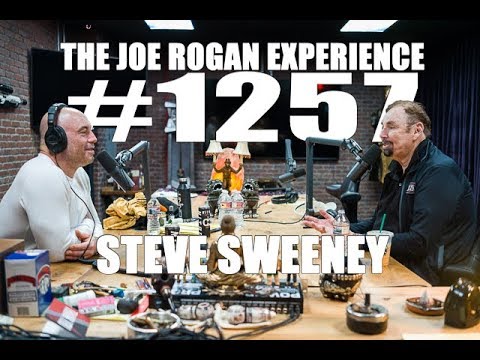
Joe Rogan Experience #1257 - Steve Sweeney
Steve Sweeney (guest), Joe Rogan (host), Narrator
In this episode of The Joe Rogan Experience, featuring Steve Sweeney and Joe Rogan, Joe Rogan Experience #1257 - Steve Sweeney explores boston comedy legend Steve Sweeney on stand-up, fights, survival, reinvention Joe Rogan and Boston comedy veteran Steve Sweeney reminisce about the brutal, legendary 1980s Boston stand-up scene, from Chinese restaurants and mobbed‑up clubs to open mics and cocaine-fueled nights. They dive into what really makes a stand-up, emphasizing bombing, tough rooms, and developing emotional “scar tissue” over raw funniness or TV credits. Sweeney talks about sobriety, his work teaching meditation and impulse control to inmates, and his late‑career shift into producing and starring in the indie film “Sweeney Killing Sweeney,” featuring many Boston comics. Along the way they veer into boxing history, street fights, homelessness, politics fatigue, religion, and why Rogan prefers comics to actors.
Boston comedy legend Steve Sweeney on stand-up, fights, survival, reinvention
Joe Rogan and Boston comedy veteran Steve Sweeney reminisce about the brutal, legendary 1980s Boston stand-up scene, from Chinese restaurants and mobbed‑up clubs to open mics and cocaine-fueled nights. They dive into what really makes a stand-up, emphasizing bombing, tough rooms, and developing emotional “scar tissue” over raw funniness or TV credits. Sweeney talks about sobriety, his work teaching meditation and impulse control to inmates, and his late‑career shift into producing and starring in the indie film “Sweeney Killing Sweeney,” featuring many Boston comics. Along the way they veer into boxing history, street fights, homelessness, politics fatigue, religion, and why Rogan prefers comics to actors.
Key Takeaways
Great stand-up is forged in bad rooms, not just talent.
Both men stress that enduring hostile crowds, shithole venues, and bombing repeatedly is what develops the thick skin, timing, and instincts that separate professionals from people who are just “funny.”
Get the full analysis with uListen AI
Industry credits can’t replace real material and onstage skill.
Sweeney describes TV‑famous comics dying onstage because they lack strong material, while Boston club killers with no fame could out‑perform them any night of the week.
Get the full analysis with uListen AI
The business will try to define you; you must define yourself.
They note that show business constantly looks for types (the ‘fat guy,’ ‘Black guy,’ etc. ...
Get the full analysis with uListen AI
Sobriety radically changes how the road and the work feel.
Sweeney jokes that quitting drinking ‘hurt his career,’ but seriously explains that long, low-paying road gigs feel far more depressing when you’re sober and hyper‑aware, even though life overall is better.
Get the full analysis with uListen AI
Helping addicts and inmates hinges on their readiness, not your wisdom.
In his jail work, Sweeney finds that if incarcerated people are ready to change, anything he says can help; if they’re not, nothing will. ...
Get the full analysis with uListen AI
Modern outrage often fills the vacuum left by reduced real hardship.
Rogan argues that in a relatively safe, prosperous country people turn minor slights and ‘microaggressions’ into crises, because they no longer face the life‑or‑death adversity that once demanded their focus.
Get the full analysis with uListen AI
Artistic careers can be long games; you can get better with age.
They highlight that comedy, unlike many jobs, allows you to keep sharpening skills over decades if you stay onstage and ignore the industry’s distractions, as evidenced by Boston veterans who are still improving.
Get the full analysis with uListen AI
Notable Quotes
“Doing standup is not about being funny. It's about going into these shitholes and developing this extra skin.”
— Steve Sweeney
“The business of stand-up comedy is really about what you do in front of that microphone and how the audience responds.”
— Joe Rogan
“Life is two things. Life is a gift, and life is short.”
— Steve Sweeney
“People are only happy if they have a certain amount of adversity they have to deal with. When there's less and less adversity, people become more and more outraged at smaller things.”
— Joe Rogan
“I wanted to be a writer. I didn’t wanna fucking write.”
— Steve Sweeney
Questions Answered in This Episode
How did the unique toughness and ethics of the Boston comedy scene shape today’s stand-up culture, especially around joke theft and ‘hack’ material?
Joe Rogan and Boston comedy veteran Steve Sweeney reminisce about the brutal, legendary 1980s Boston stand-up scene, from Chinese restaurants and mobbed‑up clubs to open mics and cocaine-fueled nights. ...
Get the full analysis with uListen AI
What practical mental habits or routines can comics (or anyone) adopt to build the kind of emotional resilience Sweeney describes from his early ‘shithole’ gigs?
Get the full analysis with uListen AI
Given Sweeney’s experience in jails, what actually works—and what clearly doesn’t—in helping people with substance abuse and impulse-control problems change their lives?
Get the full analysis with uListen AI
Is Rogan right that modern outrage is partly a side effect of reduced real hardship, and if so, how should media and creators respond to that dynamic?
Get the full analysis with uListen AI
What responsibilities, if any, do successful comics like Rogan have to document and preserve the stories of regional scenes like Boston that produced so many influential but lesser-known performers?
Get the full analysis with uListen AI
Transcript Preview
Look at you. I'm, I'm enjoying this. Jim, I wish we had a speed bag. That's my favorite thing.
Two, one, uh ...
Test. (claps hands)
Steve Sweeney, ladies and gentlemen. How are you?
Hey, I'm great. I can't believe-
Great to see you.
You know what? I've done so many things in my life, you know, movies, TV, (camera clicks) all this stuff, stand up, but Joe Rogan, oh my God. Back in Boston, "Jesus, you're on Joe Rogan?" (laughs) Yeah, I get ... You got fans, you know, that are, like, all these different ages and all different kinds of people. And, um, I'm very proud of you.
Thank you.
One of the things that happened, you don't remember this, but you opened for me.
Many times.
Louis C.K. opened for me. Nick DiPaolo opened for me. So people that want a little show business advice, open for me.
It helps.
And then you get to go by me and, uh, you know, I get to watch you guys become stars.
I've said-
While I'm playing fucking Chinese restaurants-
(laughs)
... in Saugus.
Some of the best standup comedy in the world is at Chinese restaurants in Saugus. And that's a fact, still to this day. All those people that live there, they don't know how good they have it.
Well, you know what it is? I ... You know, you work with these guys. You and I have worked with guys that are, like, genius, you know, a transcendent, whatever word you wanna use. But doing standup is not about being funny. It's about going into these shitholes and, like, developing this extra skin. You know, you s- you're a martial artist and sort of, you have s- kind of that mentality. But, you know, when I started, it was like, I came from... You know, I was an actor, I was very serious person. I was, like, an actor, you know, and I'd, I'd do, like, these obscure impressions. I'd... Paul Scofield and Laurence, (imitates British accent) Laurence Olivier, you know, Raisinets, and all this bullshit. And I'd be playing at places like The Sugar Shack.
(laughs)
Do you remember The Sugar Shack?
Yes, I do.
It was a Black, um, R&B joint, and I opened for B.B. King.
Wow.
Yeah, and I'm doing, like, John Lennon. (imitates British accent) "It was very important when we started the ..." And the Black dude, "Do some dirty shit, man. What the fuck are you doing?"
(laughs)
"Don't you know any jokes?"
(laughs)
So in the back, I get heckled. My first heckler, he said, "You suck." And I said, "Yeah, f- fuck you. Who are you?" He says, "I'm B.B. King. I hired you, motherfucker."
Oh, no.
Yeah, and then I was doing ... I, I will never forget this. Do you remember The Channel?
Install uListen to search the full transcript and get AI-powered insights
Get Full TranscriptGet more from every podcast
AI summaries, searchable transcripts, and fact-checking. Free forever.
Add to Chrome