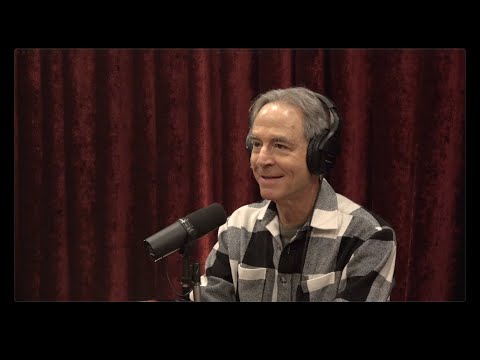
Joe Rogan Experience #2385 - Rick Strassman
Rick Strassman (guest), Joe Rogan (host), Guest (unidentified third person, likely producer/assistant) (guest), Narrator
In this episode of The Joe Rogan Experience, featuring Rick Strassman and Joe Rogan, Joe Rogan Experience #2385 - Rick Strassman explores dMT, Hebrew Prophecy, AI Messiah: Rick Strassman Reframes Reality Joe Rogan and Rick Strassman explore the striking parallels between DMT experiences and prophetic visions in the Hebrew Bible, especially in texts like Ezekiel and the Book of Enoch.
DMT, Hebrew Prophecy, AI Messiah: Rick Strassman Reframes Reality
Joe Rogan and Rick Strassman explore the striking parallels between DMT experiences and prophetic visions in the Hebrew Bible, especially in texts like Ezekiel and the Book of Enoch.
Strassman explains how learning Biblical Hebrew reshaped his understanding of scripture, suggesting early biblical events may have occurred in an alternate but consistent spiritual reality akin to the DMT realm.
They branch into topics like ancient cataclysms, giants and the Nephilim, psychedelics’ spiritual limits and dangers, AI as a potential 'messiah,' and modern ethical guidance from the Hebrew Bible.
Throughout, Strassman emphasizes ethical monotheism, the Golden Rule, and cautious, context-aware use of psychedelics, while Rogan connects these ideas to contemporary culture, technology, and human health.
Key Takeaways
Biblical prophetic visions closely resemble DMT phenomenology.
Strassman notes that Ezekiel’s visions—wheels within wheels, roaring sound, flames, strange beings—map uncannily onto modern high-dose DMT reports, suggesting a shared class of altered states.
Get the full analysis with uListen AI
Reading the Bible in Hebrew radically alters interpretation.
Because Biblical Hebrew is built on three-letter roots with wide meaning ranges, small grammatical changes can invert concepts (e. ...
Get the full analysis with uListen AI
Early biblical narratives may describe a distinct but real level of reality.
Strassman hypothesizes that stories like Adam and Eve, Noah, and the Tower of Babel happened in a parallel spiritual dimension—similar to the stable, revisitable DMT realm—that later 'merged' into our historical reality.
Get the full analysis with uListen AI
The Book of Enoch is intensely psychedelic but light on ethics.
While Enoch offers wild visionary material—watchers, angels mating with humans, giants consuming the earth—it contains little concrete ethical guidance, which Strassman suggests may be why it wasn’t canonized in the Hebrew Bible.
Get the full analysis with uListen AI
Psychedelics are powerful amplifiers, not automatic paths to wisdom.
Strassman stresses that psychedelics work on who you already are; they can inspire insight or trigger spiritual narcissism and psychosis (e. ...
Get the full analysis with uListen AI
Ethical monotheism and the Golden Rule remain central guideposts.
For Strassman, the Hebrew Bible’s core is: there is one God, and you must treat others as you wish to be treated; commandments function less as arbitrary rules and more as descriptions of spiritual cause and effect.
Get the full analysis with uListen AI
AI may become a 'messiah-like' force, raising moral questions.
Rogan and Strassman entertain the idea that AI—'born' of utterly non-biological 'virgin' computers—could outperform humans in most domains and even function as a messianic or antichrist-like entity, forcing us to justify human value and free will.
Get the full analysis with uListen AI
Notable Quotes
“When you’re in the DMT state, it’s just there, and it’s very consistent, very real. Certain things happen there.”
— Rick Strassman
“I started thinking about [the Hebrew Bible] as comparable to the DMT state… a parallel level of reality which was happening, and then slowly it began to segue into this reality.”
— Rick Strassman
“If there’s anybody that should believe that life isn’t real, it’s me.”
— Joe Rogan
“The two themes in the Hebrew Bible are: there’s one God, and the Golden Rule.”
— Rick Strassman
“Psychedelics can only work on who you are. I don’t think they necessarily generate their own information that they’re somehow transmitting to you.”
— Rick Strassman
Questions Answered in This Episode
If early biblical events occurred in an alternate dimension, what does that imply about the nature of history and spiritual truth?
Joe Rogan and Rick Strassman explore the striking parallels between DMT experiences and prophetic visions in the Hebrew Bible, especially in texts like Ezekiel and the Book of Enoch.
Get the full analysis with uListen AI
How much authority should modern interpretations of ancient texts have when those texts may be highly dependent on nuanced original languages?
Strassman explains how learning Biblical Hebrew reshaped his understanding of scripture, suggesting early biblical events may have occurred in an alternate but consistent spiritual reality akin to the DMT realm.
Get the full analysis with uListen AI
Could AI genuinely function as a 'messiah' or 'antichrist,' or is that just a metaphor we’re imposing on new technology?
They branch into topics like ancient cataclysms, giants and the Nephilim, psychedelics’ spiritual limits and dangers, AI as a potential 'messiah,' and modern ethical guidance from the Hebrew Bible.
Get the full analysis with uListen AI
Where is the ethical line between therapeutic psychedelic use and spiritual narcissism or delusion, and who should draw that line?
Throughout, Strassman emphasizes ethical monotheism, the Golden Rule, and cautious, context-aware use of psychedelics, while Rogan connects these ideas to contemporary culture, technology, and human health.
Get the full analysis with uListen AI
Are recurring myths of floods, giants, and divine punishment more likely to be metaphors, distorted memories of real cataclysms, or descriptions of non-ordinary realities?
Get the full analysis with uListen AI
Transcript Preview
(drumbeats) Joe Rogan podcast, check it out. The Joe Rogan Experience.
Train by day, Joe Rogan podcast by night. All day. (instrumental music)
So this is a book I wrote 11 years ago.
Oh, okay.
The DMT and the Zohar Prophecy.
I haven't gotten that one before.
Yeah. It compares ... Well, let's see, are we gonna ...
Yeah, just get a little closer to the mic. We're up.
Yeah.
We're rolling.
Yeah, it compares the, it compares the DMT state to the state of prophecy in the Hebrew Bible.
Do you think they're the same thing?
Well, the phenomenology is pretty similar. Like, if you read chapter one of Ezekiel, there's, um, flames and there's angels and there's wings and there's eyes on the back of wings.
Mm-hmm.
And there's roaring sound and, uh, blue ice above the person, he flies through space.
Mm-hmm.
Yeah.
Yeah.
Quite, quite psychedelic.
Yeah, wheel within a wheel.
Right.
Like, the, the des- description of the things that people ... Usually, they try to say that it's some sort of a UAP.
Right.
That's a, that's the common thing that people like to say, right?
(inhales deeply) Uh, well, it could be.
Which also might be connected.
(clears throat) It could be a DMT vision, though.
Oh, easily.
Yeah.
Well, d- you know the guys out of Jerusalem that think that the whole burning bush thing was DMT.
Yeah. Um, well, that was the first theophany of Moses.
Yeah.
Uh, first time he had a p- a prophetic experience. Yeah, and-
I mean, it's like, that's what it is. It's literally a plant that has high levels of DMT, and if you burned it and smoked it ...
(inhales deeply) Yeah.
It's kind of crazy that that's the way it comes. That it co- I mean, this is, it's ... I just re- and I, and I th- I really applaud you for learning ancient Hebrew so you could go back and read it in the, the original tongue, which is really fascinating. Didn't you say it took like 16 years to learn it?
Uh, that prophecy book took 16 years to write, and I had to learn-
(laughs)
... Hebrew while I was reading and, you know-
(laughs)
... doing the writing. What, what was i- wha- essent-
It's amazing.
Wha- what's cool is the, uh, Hebrew word for bush, burning bush, is the same as, as, um, Sinai, Mount Sinai.
(clicks tongue) Really?
Yeah, yeah, and-
The words the same?
Uh, the same root. Th- the in- the thing about the Hebrew language, at least, uh, for Biblical Hebrew, is every word is based on a three-letter root. Uh, so the word for bush contains those three letters and the word for s- um, you know, for Sinai contains th- tho- those same three letters.
Install uListen to search the full transcript and get AI-powered insights
Get Full TranscriptGet more from every podcast
AI summaries, searchable transcripts, and fact-checking. Free forever.
Add to Chrome