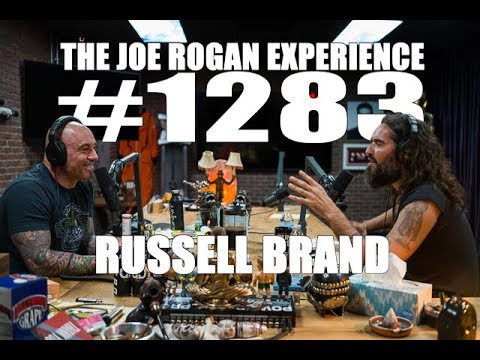
Joe Rogan Experience #1283 - Russell Brand
Joe Rogan (host), Russell Brand (guest), Narrator, Narrator, Narrator, Joe Rogan (host), Narrator, Narrator
In this episode of The Joe Rogan Experience, featuring Joe Rogan and Russell Brand, Joe Rogan Experience #1283 - Russell Brand explores russell Brand and Joe Rogan Debate Spirituality, Systems, and Self-Mastery Joe Rogan and Russell Brand weave between comedy and deep reflection, exploring how personal transformation, spirituality, and discipline intersect with politics, technology, and culture.
Russell Brand and Joe Rogan Debate Spirituality, Systems, and Self-Mastery
Joe Rogan and Russell Brand weave between comedy and deep reflection, exploring how personal transformation, spirituality, and discipline intersect with politics, technology, and culture.
They discuss addiction, martial arts, and mentorship as pathways to self-knowledge, contrasting Rogan’s discipline-first approach with Brand’s spiritual and therapeutic lens.
On a societal level, they critique capitalism’s incentives, mass surveillance, factory farming, AI, and media polarization, arguing that systems now primarily serve institutional power rather than human flourishing.
Throughout, they return to the idea that real change starts with self-honesty and compassion, then radiates outward into how we organize communities, treat the vulnerable, and tolerate profound differences in belief and lifestyle.
Key Takeaways
Channel compulsive energy into structured disciplines instead of suppressing it.
Both Brand and Rogan describe addictive or obsessive tendencies; Rogan channels his into training and work, while Brand uses 12-step principles and BJJ, showing that the trait isn’t the problem—its direction is.
Get the full analysis with uListen AI
Seek mentors who awaken latent qualities you can’t access alone.
Brand argues that the right mentor can ‘switch on’ courage, calm, or competence in moments when you’re overwhelmed, accelerating growth far beyond what isolated self-improvement can do.
Get the full analysis with uListen AI
Train in environments where your ego and excuses can’t protect you.
Their stories about jiu-jitsu emphasize that rolling with better partners forces you to confront fear, humiliation, and physical reality, developing humility, resilience, and a more accurate self-image.
Get the full analysis with uListen AI
Hold firm personal ethics without demanding ideological conformity from others.
Brand is vegan and spiritually inclined; Rogan hunts and eats meat. ...
Get the full analysis with uListen AI
Judge systems by how they treat the most vulnerable, not the most successful.
They argue that entrenched poverty, homelessness, and predatory finance reveal capitalism’s real priorities, suggesting societies should aim for a minimum standard—roughly a middle-class life—for everyone.
Get the full analysis with uListen AI
Recognize that media and platforms are structurally biased toward conflict.
The discussion of Facebook algorithms, outrage, and online pile-ons shows that digital systems amplify anger because it drives engagement, so individuals must consciously resist being pulled into perpetual antagonism.
Get the full analysis with uListen AI
Explore altered states—but be brutally honest about your motives and risks.
Brand’s ambivalence about DMT and ayahuasca, given his addiction history, captures a crucial nuance: psychedelics can be profound tools for perspective and connection, but they’re dangerous if used as a clever loophole to get high.
Get the full analysis with uListen AI
Notable Quotes
“My morality and my spirituality is for me. It’s not something I go around inflicting on other people and telling them how they should behave.”
— Russell Brand
“If everyone lived like middle class, everybody would be a lot more fucking relaxed.”
— Joe Rogan
“Wisdom is acting on knowledge, and that is not the world we live in.”
— Russell Brand
“You wanna make as many people your ally as you can. You wanna make as many people your friend as you can.”
— Joe Rogan
“We don’t know what human beings are anymore. We reject our own sexuality, we reject our own bodies… We’re trying to turn ourselves into these emotionless, sexless, meaningless creatures.”
— Russell Brand
Questions Answered in This Episode
How can individuals meaningfully oppose destructive systemic incentives without simply burning themselves out or becoming cynical?
Joe Rogan and Russell Brand weave between comedy and deep reflection, exploring how personal transformation, spirituality, and discipline intersect with politics, technology, and culture.
Get the full analysis with uListen AI
Where is the ethical line between ‘using’ compulsive energy productively and just masking unresolved psychological or spiritual issues?
They discuss addiction, martial arts, and mentorship as pathways to self-knowledge, contrasting Rogan’s discipline-first approach with Brand’s spiritual and therapeutic lens.
Get the full analysis with uListen AI
If psychedelics and deep meditation both access ‘more real’ states, how should societies integrate those experiences into education, governance, or law without creating new dogmas?
On a societal level, they critique capitalism’s incentives, mass surveillance, factory farming, AI, and media polarization, arguing that systems now primarily serve institutional power rather than human flourishing.
Get the full analysis with uListen AI
What concrete policies or experiments could move a country toward Brand and Rogan’s vision where the ‘baseline’ life is roughly middle class for everyone?
Throughout, they return to the idea that real change starts with self-honesty and compassion, then radiates outward into how we organize communities, treat the vulnerable, and tolerate profound differences in belief and lifestyle.
Get the full analysis with uListen AI
How can people maintain strong personal convictions (e.g., veganism, hunting, religion) while still building the kind of cross-tribal alliances they say are essential?
Get the full analysis with uListen AI
Transcript Preview
Boom, and we're live.
Yes.
Russell, why is it then when people start getting, like, super spiritual, they start dressing like you?
(laughs)
You dress like a guru.
We circulate a memo-
(laughs)
... saying, "It's now time to stop wearing socks-
(laughs)
... stop shaving, and make eye contact for a bit too long."
Oh, uncomfortable eye contact.
And uncomfortable. Keep a bit starey.
How long are you gonna go with the beard? I mean, that's, that's like, you're, you're full on, like, you're a yogi now.
I mean, it's gone beyond Jesus and into-
Yeah.
... Moses and the lesser prophets of the Old Testament.
Or, or a Navy SEAL. You're in that range, too.
Yeah.
Like, you could be some wild man.
That's, that's a mistake that wouldn't... (laughs)
(laughs)
Like, if there was an assault course in front of us, that, that, the potential for me being a Navy SEAL would start to break down. I once went on a, an assault course with some US Marines in that place near San Diego, I can't remember the name of that base, and climbing up that rope using your-
Hmm.
... leg muscles, it was not good value.
Didn't enjoy it?
I liked the camaraderie.
Yeah.
And I really l- uh, like, I, as I've written about and talk about quite a lot, when I'm around very, in very male environments, I kind of really like it. I really get off on it, but I have to watch myself not getting too excitable. It's even in this environment as a matter of fact. I have to keep myself-
(laughs)
... a little bit chilled out. And like-
Why? What do you mean? What does it do to you?
Well, I guess what it is, is, my early life, I grew up mostly around my mum, and I don't have brothers and sisters and stuff like that, so my male role modeling occurred later in life. And I think it probably-
Hmm.
... relates to this spiritual thing. I think it meant that I was, I'm very open to sort of spiritual experience, meditative experience, so I didn't have a lot of grounding physical experiences or bodily experiences, really, 'til adolescence and 'til se- and sexuality. That's the first time I really sort of got into the body. Didn't do sport as a kid. Didn't have, like, men going, "Right, this is what we do, this is how we shave, this is how you treat people, this is..." You know?
Mm-hmm.
I didn't really sort of get that kind of education. So now, still, if I'm around, like, soldiers, UFC fighters, I go... You know, you know I do BJJ-
Yeah.
... primarily as a result of these c- confron- well, let's not call them confrontations. (laughs)
Install uListen to search the full transcript and get AI-powered insights
Get Full TranscriptGet more from every podcast
AI summaries, searchable transcripts, and fact-checking. Free forever.
Add to Chrome