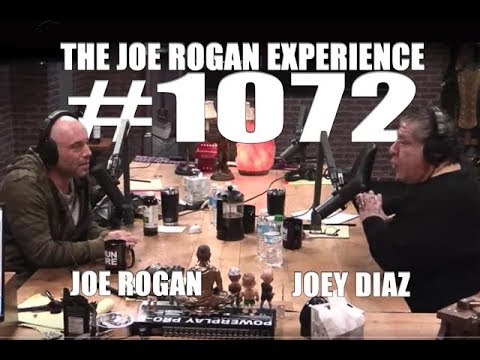
Joe Rogan Experience #1072 - Joey Diaz
Joey Diaz (guest), Joe Rogan (host), Jamie Vernon (host), Narrator, Narrator, Narrator, Joey Diaz (guest), Joe Rogan (host), Narrator, Narrator
In this episode of The Joe Rogan Experience, featuring Joey Diaz and Joe Rogan, Joe Rogan Experience #1072 - Joey Diaz explores immigrant mentality, cocaine confessions, and the brutal beauty of combat sports Joe Rogan and Joey Diaz weave a sprawling conversation that jumps from Cuban and Russian wrestling systems to elite MMA strategy, gambling addiction, cocaine-fueled insanity, and the evolution of standup comedy. They explore how countries like Cuba and Russia identify and develop combat athletes from childhood, and analyze fighters such as Lomachenko, GSP, Ngannou, Stipe, Rockhold, and Khabib. Diaz tells raw, often shocking stories about immigrant life, underground gambling, drugs, and hustling in New York and New Jersey, contrasting them with today’s sensitivities and regulations. The episode closes with a serious look at the craft of comedy, mutual influences, and the plan for Joey’s special, "Immigrant Mentality."
Immigrant mentality, cocaine confessions, and the brutal beauty of combat sports
Joe Rogan and Joey Diaz weave a sprawling conversation that jumps from Cuban and Russian wrestling systems to elite MMA strategy, gambling addiction, cocaine-fueled insanity, and the evolution of standup comedy. They explore how countries like Cuba and Russia identify and develop combat athletes from childhood, and analyze fighters such as Lomachenko, GSP, Ngannou, Stipe, Rockhold, and Khabib. Diaz tells raw, often shocking stories about immigrant life, underground gambling, drugs, and hustling in New York and New Jersey, contrasting them with today’s sensitivities and regulations. The episode closes with a serious look at the craft of comedy, mutual influences, and the plan for Joey’s special, "Immigrant Mentality."
Key Takeaways
Early, multi-disciplinary training can create generational combat sports talent.
They describe how Cubans and Russians identify kids for wrestling, judo, and boxing, often sending them abroad to train, and how Lomachenko’s mix of wrestling and years of Ukrainian dance produced world‑class balance and footwork.
Get the full analysis with uListen AI
Technical skill plus mindset separates great fighters from physical phenoms.
Using Ngannou vs. ...
Get the full analysis with uListen AI
Gambling addiction mirrors substance addiction in compulsion and destruction.
Diaz details bookmaking, numbers, sports betting, slots, and pool‑hall action, showing how small early wins and constant “today might be my lucky day” thinking bury people financially and psychologically just like drugs do.
Get the full analysis with uListen AI
Cocaine and heavy stimulant use can erase empathy and warp judgment for years.
Joey explains that blow “blocks the love,” turning sets into empty noise and requiring 12–18 months after quitting to feel human again, which he suggests you must factor in when judging behavior during and shortly after heavy use.
Get the full analysis with uListen AI
Street economies thrived on hope and exploitation in immigrant communities.
Stories about numbers rackets, dry cleaners as fronts, card rooms, and neighborhood beatings in the Bronx show how immigrants combined hustling, crime, and tight‑knit community enforcement long before state lotteries and legal betting.
Get the full analysis with uListen AI
Great standup is a blended lineage of influences, pressure, and constant writing.
They frame comedy like martial arts: you learn fundamentals from others, sharpen at a “gym” like The Comedy Store, bomb in tiny rooms, and then must throw away hours of material after a special and rebuild under intense expectation.
Get the full analysis with uListen AI
Culture is renegotiating sex, power, and offense—but memory and context matter.
While supporting women and condemning assault, Diaz pushes back on decades‑old, non‑criminal accusations torpedoing careers, arguing people change, drug context matters, and that society is still figuring out new lines in real time.
Get the full analysis with uListen AI
Notable Quotes
“His asset is his mind though, Joe. That immigrant mentality with American ingenuity.”
— Joey Diaz
“Ngannou’s like the big boss in a video game… and Stipe figured out how to beat him being 20‑plus pounds lighter.”
— Joe Rogan
“The system is designed to bury the degenerate gambler.”
— Joey Diaz
“Cocaine takes the pleasure patterns out of your brain… it took me 18 months just to become a human again.”
— Joey Diaz
“We’re not plagiarizing; we’re influenced. The armbar is the same—it’s how you do it.”
— Joey Diaz
Questions Answered in This Episode
How ethical is it for states to criminalize underground gambling while legalizing lotteries and casinos that target the same hopes of poor and immigrant communities?
Joe Rogan and Joey Diaz weave a sprawling conversation that jumps from Cuban and Russian wrestling systems to elite MMA strategy, gambling addiction, cocaine-fueled insanity, and the evolution of standup comedy. ...
Get the full analysis with uListen AI
To what extent should heavy drug use or possible brain trauma mitigate moral judgment of fighters’ or entertainers’ past behavior?
Get the full analysis with uListen AI
How much responsibility do managers, agents, and institutions bear for enabling predators like Weinstein compared to the individuals themselves?
Get the full analysis with uListen AI
In combat sports, is it more valuable to invest in early specialization like Cuba/Russia or in broad, Lomachenko‑style cross‑training and movement arts?
Get the full analysis with uListen AI
As standup comedy continues to globalize via podcasts and streaming, will the “Comedy Store model” of iron‑sharpening‑iron still be necessary to produce the next generation of great comics?
Get the full analysis with uListen AI
Transcript Preview
... the story. (laughs) Save the story.
Did not show up, so I'm flying him out after Luke Rockhold-
Are we live? Okay.
I'm gonna do a podcast with him with subtitles in Spanish, then I'm bringing him up here on Friday and we're gonna-
What? Really?
Yeah. I'm, I got a company to do it for me in Spanish with subtitles. And then I'm gonna bring him up here on Friday and we're gonna have a three-way about Cuba.
Whoa.
And what it was like to wrestle and the whole thing, if you don't mind.
Whoa.
I don't know if you'd mind. So I'll do mine about subtitles just in Español.
Okay.
Cómo hablan de Cuba, cómo tú te criaste. So, no, we will not clash with you.
Dude, the three-
You, y-
... of us together would be the greatest podcast ever.
You, you, yeah, 'cause I can interpret and you would be, would be, uh, it would be, uh, real MMA. You could really talk-
Yeah.
... about underhooks and-
Dude.
... Russia and-
That's a fantastic idea.
... early training in Cuba and where they shipped them, 'cause they ship you off when you're a young kid.
They do?
That's what a lot of people don't know. Yeah, they look at you and then they go, uh, "Pelotero." You don't have a choice. They look at you and they go, "Tú vas a luchadero," and that's it. Nah, they, they take you at a certain age and they, or they either send you to Nicaragua or Russia and you train. And that's why a lot of Cubans are judokas, because they go to Russia and learn judo.
Wow.
So he's gonna tell you how they shipped him off with... And, and they don't just tell your mom like, "We're taking him tomorrow."
That's a r- It's always been interesting to me because the Cubans and the Russians in particular were always thought of, of as being very technical. S- really the Russians. Russians are super technical. That was what, uh, a lot of people attributed George St-Pierre's success in wrestling. You know, George didn't wrestle in college or in high school, uh, but he trained with a bunch of Russian nationals in Montreal, and apparently phenomenal wrestlers. They have this incredible wrestling program. Like, when you see, when you see Nurmagomedov, the way he mauls people inside the octagon-
(laughs)
... like what in the fuck? Like that is like a, a perfect example of that like style of super hard, super technical wrestling. They're so good at it. There's so many. Do you see... You know, you see Lomachenko used to be a wrestler?
Yeah.
There's a video of Lo- Lomachenko, looks like he's doing Sambo. It looks like he's got a, like a gi on and it's him and some other cat, and he's like 11 years old or something like that. So his father put him in everything. His father made him... You know who Lomachenko is, right?
Install uListen to search the full transcript and get AI-powered insights
Get Full TranscriptGet more from every podcast
AI summaries, searchable transcripts, and fact-checking. Free forever.
Add to Chrome