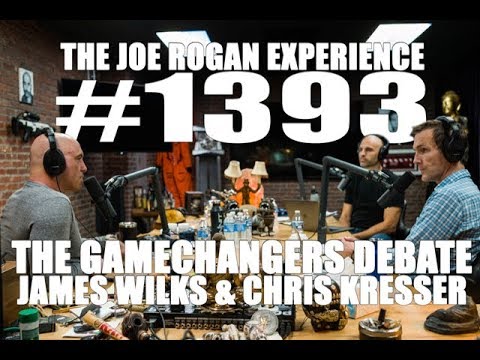
Joe Rogan Experience #1393 - James Wilks & Chris Kresser - The Game Changers Debate
Joe Rogan (host), James Wilks (guest), Chris Kresser (guest), Narrator, Chris Kresser (guest), James Wilks (guest), Narrator
In this episode of The Joe Rogan Experience, featuring Joe Rogan and James Wilks, Joe Rogan Experience #1393 - James Wilks & Chris Kresser - The Game Changers Debate explores game Changers Debate: Protein, B12, and What Counts as Evidence This episode is a three‑way debate between James Wilks (producer of *The Game Changers*), Chris Kresser (who previously ‘debunked’ the film on Rogan’s show), and Joe Rogan moderating. Wilks arrives with extensive notes and slides to systematically challenge Kresser’s criticisms of the documentary. They spar over evidence standards in nutrition science, focusing heavily on B12, protein quantity and quality, epidemiology vs. RCTs, industry‑funded research, and whether plant‑based or omnivorous diets are better supported by the scientific consensus.
Game Changers Debate: Protein, B12, and What Counts as Evidence
This episode is a three‑way debate between James Wilks (producer of *The Game Changers*), Chris Kresser (who previously ‘debunked’ the film on Rogan’s show), and Joe Rogan moderating. Wilks arrives with extensive notes and slides to systematically challenge Kresser’s criticisms of the documentary. They spar over evidence standards in nutrition science, focusing heavily on B12, protein quantity and quality, epidemiology vs. RCTs, industry‑funded research, and whether plant‑based or omnivorous diets are better supported by the scientific consensus.
Wilks repeatedly argues that Kresser misrepresented the film and made factual errors in his critique—especially on B12 supplementation, protein comparisons, and interpretations of large meta‑analyses on dairy and cancer. Kresser maintains that a well‑planned plant‑based diet can be healthy, but sees no strong evidence that a 100% plant‑based diet is superior to a plant‑rich omnivorous diet and stresses issues like nutrient deficiencies, amino acid profiles, and epidemiological caveats.
By the end, Rogan explicitly says Wilks “knocked it out of the park,” acknowledging that Wilks convincingly corrected several of Kresser’s earlier claims. The conversation, however, also highlights how complex and contested nutrition research is, how easily data can be framed in multiple ways, and how much hinges on study design, funding sources, and what’s being compared to what.
Key Takeaways
Be precise and honest when quoting studies—framing changes the meaning.
Wilks shows how re‑grouping percentages (e. ...
Get the full analysis with uListen AI
Vitamin B12 deficiency is common in omnivores too; supplements are a reliable backstop.
Both acknowledge many omnivores are B12‑deficient due to absorption issues, not intake; Wilks uses Kresser’s own materials to show roughly 40% of people have low‑normal B12 and argues the safest, simplest strategy for everyone—meat‑eater or vegan—is to supplement rather than rely on modern soil/water or animal foods alone.
Get the full analysis with uListen AI
Protein needs for athletes are high but reachable on plant‑based diets.
They largely converge on a consensus range of about 1. ...
Get the full analysis with uListen AI
Once total protein and leucine thresholds are met, source matters less for muscle gain.
Wilks argues that as long as you hit daily protein (1. ...
Get the full analysis with uListen AI
Industry funding systematically skews nutrition science and needs to be scrutinized.
They discuss how studies funded by sugar, meat, and dairy interests are 4–8x more likely to favor the sponsor’s product; Wilks criticizes NutriRECS for both its meat and earlier sugar analyses, arguing you can’t cite its red‑meat meta‑analysis without also accepting its “no reliable evidence sugar thresholds are harmful” conclusion.
Get the full analysis with uListen AI
Diet comparisons are only meaningful if you’re clear what each diet actually includes.
Both agree many ‘meat‑eater vs. ...
Get the full analysis with uListen AI
Scientific consensus currently favors predominantly plant‑based diets, not necessarily strict veganism.
Wilks cites WHO, FAO, the Academy of Nutrition and Dietetics, and major cardiology bodies recommending diets “predominantly” based on plants and recognizing well‑planned vegan diets as adequate for all life stages; Kresser accepts “mostly plants” but disputes any consensus that animal foods must be entirely excluded.
Get the full analysis with uListen AI
Notable Quotes
“If you’re claiming that a food is bad for you, the burden of proof is on you to show research that it is.”
— Chris Kresser
“Do you really want to put the interpretation of the data in the hands of someone that just got so many things wrong about B12?”
— James Wilks
“As long as you get enough protein, it doesn’t matter where it comes from. Once you hit that 1.6 to 2.2 grams per kilo, the amino acid profile stops mattering for muscle growth.”
— James Wilks
“The fundamental question in my mind is whether there is evidence that supports being on a 100% plant‑based diet versus a diet that includes a lot of plant foods and some animal foods.”
— Chris Kresser
“Coming in here, I felt like having you while he debunked it was going to be a waste of time. But you knocked it out of the park.”
— Joe Rogan
Questions Answered in This Episode
How should non‑experts decide which nutrition ‘experts’ to trust when qualified people interpret the same data so differently?
This episode is a three‑way debate between James Wilks (producer of *The Game Changers*), Chris Kresser (who previously ‘debunked’ the film on Rogan’s show), and Joe Rogan moderating. ...
Get the full analysis with uListen AI
If protein quantity and leucine thresholds are truly what matters most for hypertrophy, what practical plant‑based meal patterns best achieve that without heavy supplementation?
Wilks repeatedly argues that Kresser misrepresented the film and made factual errors in his critique—especially on B12 supplementation, protein comparisons, and interpretations of large meta‑analyses on dairy and cancer. ...
Get the full analysis with uListen AI
To what extent should industry funding disqualify a study from influencing guidelines, and how can we systematically adjust for this bias without throwing out massive swaths of data?
By the end, Rogan explicitly says Wilks “knocked it out of the park,” acknowledging that Wilks convincingly corrected several of Kresser’s earlier claims. ...
Get the full analysis with uListen AI
Given the acknowledged limitations of epidemiology, what kind of long‑term trials would actually be needed to fairly compare a high‑quality omnivorous diet to a high‑quality vegan diet?
Get the full analysis with uListen AI
Is it realistic—or even desirable—to base public dietary guidelines on what’s ‘optimal’ for elite athletes, versus what’s adequate and sustainable for the general population?
Get the full analysis with uListen AI
Transcript Preview
All right, here we go. Uh, first of all, um, welcome, James. Good to see you.
I really appreciate you having me on.
My pleasure. Um, and, uh, welcome again, Chris. Uh, so this is essentially, uh, giving you an opportunity to refute some of the things that Chris has said about your film. We should tell everybody that you... you're the producer of Game Changers?
Yeah, as one of... I'm one of two producers, yeah.
One of two producers. Uh, I know you also from, of course, from The Ultimate Fighter-
Yep.
... UFC. And Chris, this is your, what? Fourth appearance here, uh, up like that?
Fourth or fifth, yeah.
Th- fourth or fifth. Um, did you get a chance to see what Chris had said?
Yeah, I've watched it. Yeah.
You watched it, okay, well-
I've ma- I've made a bunch of notes there.
Excellent. Let's start from the beginning. Um, the beginning of the show, the beginning of your film, you talked about the gladiators and all that stuff, and the, the fact that you were shocked to find out that they, they had eaten a vegetarian diet.
Yeah.
Yeah.
I mean, and I'll... You know, that's been misrepresented, right? So, even before the film came out, people are like, "Oh, there's this vegan film coming out. It's vegan propaganda." People were judging the film before they'd seen it, right? And the vegan sort of community really pushed it, like, "Hey, look at this documentary." So, there's been things saying, "They claim that the gladiators were vegan," right? "And if we can just prove... They think that the whole film is based on this premise." That was just like an inciting incident for me to start digging into it. First of all, Fabian Kent said they were predominantly vegetarian, and I said they ate mostly plants. And that is what I couldn't believe, right?
Mm-hmm.
So, they, we didn't claim that they were vegan, didn't even claim that they were vegetarian, they were just fueled mostly by plants. You know, and people say, "Oh, you cherry-picked one location." It was the only known gladiator burial site in the world based on archeological and anthropological data at the time.
At the time where you read the study-
Yeah.
... 'cause there, there have been other studies that were-
Well, there's been, there's been some that have been questioned. So, like, there's one in York. There was one in York at the time that had a few gladiator skeletons and it was questioned whether that was the thing. But I'm, I'm happy to address every critique.
Okay.
But if, if you wouldn't mind, I just wanna make sure that Chris and I are on the same page about how, um, evidence is evaluated.
Sure.
So, Chris, would you consider yourself a nutrition expert?
Install uListen to search the full transcript and get AI-powered insights
Get Full TranscriptGet more from every podcast
AI summaries, searchable transcripts, and fact-checking. Free forever.
Add to Chrome