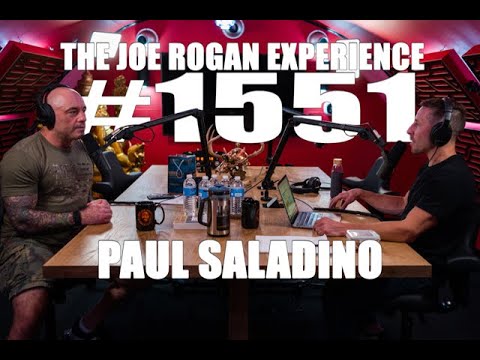
Joe Rogan Experience #1551 - Paul Saladino
Paul Saladino (guest), Joe Rogan (host), Narrator, Narrator, Narrator, Narrator, Narrator
In this episode of The Joe Rogan Experience, featuring Paul Saladino and Joe Rogan, Joe Rogan Experience #1551 - Paul Saladino explores carnivore Diet, Plant Toxins, and Rethinking Cholesterol With Paul Saladino Joe Rogan and physician Paul Saladino dive deep into the rationale behind an animal-based/carnivore diet, arguing that meat and organs are evolutionarily appropriate human foods while many plants contain defensive toxins. They distinguish between beneficial environmental stressors (like exercise, heat, and cold) and molecular stressors from plant compounds, questioning whether the latter offer a net benefit. Saladino challenges mainstream views on cholesterol and heart disease, suggesting LDL is not inherently harmful outside of metabolic dysfunction and highlighting vegetable oils and refined foods as bigger culprits. They also cover regenerative agriculture, hunting ethics, organ meats, fiber myths, and the psychological and cultural dynamics around veganism and diet dogma.
Carnivore Diet, Plant Toxins, and Rethinking Cholesterol With Paul Saladino
Joe Rogan and physician Paul Saladino dive deep into the rationale behind an animal-based/carnivore diet, arguing that meat and organs are evolutionarily appropriate human foods while many plants contain defensive toxins. They distinguish between beneficial environmental stressors (like exercise, heat, and cold) and molecular stressors from plant compounds, questioning whether the latter offer a net benefit. Saladino challenges mainstream views on cholesterol and heart disease, suggesting LDL is not inherently harmful outside of metabolic dysfunction and highlighting vegetable oils and refined foods as bigger culprits. They also cover regenerative agriculture, hunting ethics, organ meats, fiber myths, and the psychological and cultural dynamics around veganism and diet dogma.
Key Takeaways
Meat and organs may be more nutritionally complete than plants for humans.
Saladino argues there are no essential nutrients in plants that cannot be obtained in more bioavailable form from animal foods (e. ...
Get the full analysis with uListen AI
Many plant compounds act as chemical defenses, not benign superfoods.
He frames plant phytochemicals (e. ...
Get the full analysis with uListen AI
LDL cholesterol may not be harmful in metabolically healthy individuals.
Using epidemiological stratification and mechanistic reasoning, Saladino suggests elevated LDL in people with good metabolic markers (high HDL, low insulin, low inflammation) may not increase heart disease risk the way it does in insulin-resistant populations, and he points to his own zero coronary calcium score despite very high LDL.
Get the full analysis with uListen AI
Industrial seed oils and excess linoleic acid are strong candidates in chronic disease.
They highlight historical data showing explosive rises in vegetable oil consumption paralleling obesity, diabetes, and heart disease, and discuss how linoleic acid-rich oils may promote fat cell dysfunction, oxidative stress, and possibly cancer, in contrast to traditional animal fats.
Get the full analysis with uListen AI
Fiber is not strictly necessary for bowel health and can worsen symptoms for some.
Contrary to conventional wisdom, they cite interventional studies where reducing or eliminating fiber improved idiopathic constipation and GI symptoms, and note that many people report less bloating and gas on low- or zero-fiber carnivore-style diets.
Get the full analysis with uListen AI
Regenerative grazing can improve soil health and may be scalable.
Examples like White Oak Pastures and Roam Ranch show how managed grazing increases soil carbon and biodiversity, challenging the idea that grass-fed systems are inherently unsustainable and contrasting them with nutrient-depleting monocrop agriculture.
Get the full analysis with uListen AI
Dietary dogma on all sides can obscure nuanced, individual solutions.
They critique both vegan and carnivore “cult” mentalities, emphasizing that animal-based diets likely benefit many more people if framed flexibly (e. ...
Get the full analysis with uListen AI
Notable Quotes
“Most plants are not edible, but almost every animal is edible.”
— Paul Saladino
“We’ve assumed that plants are good for us. What if they’re not, and we’re misinterpreting the research?”
— Paul Saladino
“It makes no sense that something our ancestors have eaten forever, like red meat, is suddenly the thing killing us.”
— Paul Saladino
“When I did a total animal diet for a month, my energy was a flat line all day.”
— Joe Rogan
“Hunting an animal and eating it is one of the most spiritual experiences of my life.”
— Joe Rogan
Questions Answered in This Episode
How strong is the clinical evidence, beyond mechanistic and short-term studies, that plant defense chemicals cause significant harm in real-world diets?
Joe Rogan and physician Paul Saladino dive deep into the rationale behind an animal-based/carnivore diet, arguing that meat and organs are evolutionarily appropriate human foods while many plants contain defensive toxins. ...
Get the full analysis with uListen AI
What would large, long-term trials comparing animal-based diets, high-plant diets, and mixed diets—with matched seed-oil intake—actually show about heart disease, cancer, and longevity?
Get the full analysis with uListen AI
How can clinicians practically incorporate metabolic health context (insulin resistance, inflammation, HDL) into decisions about treating high LDL in patients?
Get the full analysis with uListen AI
If industrial seed oils are as problematic as suggested, what realistic strategies could shift the food system and consumer behavior away from them?
Get the full analysis with uListen AI
For someone interested in trying an animal-based or carnivore-ish diet, what biomarkers and symptoms should they monitor to distinguish genuine health improvements from placebo or early-adaptation effects?
Get the full analysis with uListen AI
Transcript Preview
(drumming) Joe Rogan Podcast, check it out. The Joe Rogan Experience.
Train by day, Joe Rogan Podcast by night. All day. (rock music) Um, listen, man. I've been telling everybody that, uh, I eat mostly meat. And they look at me like I'm gonna die. And it's kinda funny. And I, I've had these conversations with people and they were like, "Oh, well, if you eat too much meat..." Jamie, can we get more waters? We only have one water out here.
Yeah, sure.
I've been telling these people, like, e- that I eat only meat and they're like, "Well, you know, if you eat too much meat, it causes colon cancer, causes this, causes that." And one of the things that I say, and, uh, is a talking point that I actually stole from you, is that most plants are inedible, but almost all animals are edible. And when you say that to them, they look at you like, "Oh, shit." Like, if you just go out and eat, like, random plants, you'll get sick as fuck. That's real. So like, when I tell people I eat mostly meat, they look at me like, like you're doing something really stu- Like, Rob Lowe started laughing at me. I said I have, like, an animal-based diet, you know? Some people are plant-based, I'm animal-based.
I love that word.
Yeah, animal-based.
Yeah.
Just steal what they're saying.
(laughs) And make it better.
But what you said, what I've, I've heard you say, that is, that's an accurate way of describing it. Most plants are not edible, but almost every animal's edible.
I mean, and I think that if people spend time in the wilderness, n- regardless of the latitude, they'll start to appreciate this.
Yeah.
And I've s- mostly spent time in, in latitudes that are further from the equator than not. But even at the equator, if you go walking around the woods and, or the, the forest or the jungle there, and you try to eat leaves or stems or bark-
You're gonna die.
... you're gonna die.
(laughs)
Really freaking fast. (laughs)
Well, how about people who collect mushrooms? Like, they make mistakes, you know, like, uh-
So easy.
I remember there was a story about, uh, a guy in a nursing home. And, uh, he had went out and picked mushrooms for the people in the nursing home and cooked 'em up, and they all died.
(laughs)
Just, like, 'cause he fucked up.
Ugh.
He probably was an older guy, couldn't see, or maybe just forgot what's edible, or maybe he was just losing his mind. But the point is, most of these things you see are not edible.
And if you think about it from the perspective of a plant, it makes more sense.
Yeah.
But we never do that anthropomorphization, and we never think about that. But as I was learning about this and thinking about carnivore diets and animal-based diets, I had to learn a lot of stuff myself. I'm a, I was trained as a physician. I wasn't trained as an anthropologist, and I took ecology in college, but when you look at, like, the, what we know about the timeline of life on Earth, 500 plus million years of plant and animal co-evolution. And there's a lot of people who have speculated this, that essentially plants evolve, animals evolve. Animals start eating plants, plants evolve defenses, animals evolve defenses against the defenses. And there's a whole series of enzymatic systems in our liver, the phase one and phase two detoxification systems, they're called cytochrome P450 and other reactionary systems in our liver that are meant to detoxify things. And a lot of people speculate, and I think this is really reasonable, that the majority of the reason we have those is so that we could eat plants from time to time so we didn't starve during our evolution. But there's a, there's a real interesting interaction here. This is warfare. This is, this is-
Install uListen to search the full transcript and get AI-powered insights
Get Full TranscriptGet more from every podcast
AI summaries, searchable transcripts, and fact-checking. Free forever.
Add to Chrome