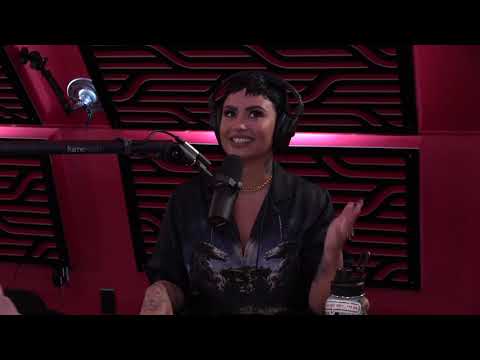
Joe Rogan Experience #1625 - Demi Lovato
Joe Rogan (host), Demi Lovato (guest), Narrator
In this episode of The Joe Rogan Experience, featuring Joe Rogan and Demi Lovato, Joe Rogan Experience #1625 - Demi Lovato explores demi Lovato Opens Up: Fame, Trauma, Sobriety, and Self-Ownership Journey Demi Lovato and Joe Rogan have a long-form, candid conversation about growing up as a child star, the psychological toll of early fame, and how bullying and family trauma shaped her mental health and addictions.
Demi Lovato Opens Up: Fame, Trauma, Sobriety, and Self-Ownership Journey
Demi Lovato and Joe Rogan have a long-form, candid conversation about growing up as a child star, the psychological toll of early fame, and how bullying and family trauma shaped her mental health and addictions.
Lovato details her experiences with eating disorders, hard drugs, a near‑fatal overdose, and the complicated path from strict abstinence-based recovery to what she now calls a “middle path” that includes controlled cannabis use.
They explore fame’s distortions—power dynamics with parents, paparazzi chasing minors, public expectations of perfection—and how Lovato is reclaiming autonomy over her career, body, identity, and relationships.
The discussion also touches on spirituality, intuition, meditation, jiu-jitsu, exercise, and how Demi is redefining success away from charts and image toward authenticity, close friendships, and everyday “normal” life.
Key Takeaways
Early fame can both save and damage a life.
Lovato credits music and the entertainment industry with giving her a reason to live when bullying and depression were overwhelming, while also acknowledging that child stardom created unhealthy power dynamics, isolation, and emotional confusion.
Get the full analysis with uListen AI
Bullying and cyberbullying can leave deep, long-term scars.
Middle school bullying, including a suicide petition and body‑shaming, directly fed Lovato’s eating disorder and mistrust of peers her own age, illustrating how online and social cruelty can become lifelong psychological trauma.
Get the full analysis with uListen AI
Addiction is often rooted in childhood trauma and learned behaviors.
Lovato connects her drug use and eating disorder to early exposure to her mother’s disordered eating and her father’s abuse, mirroring Gabor Maté’s view that addiction frequently grows from unresolved early pain rather than simple “bad choices.”
Get the full analysis with uListen AI
Strict abstinence isn’t the only recovery model, but it’s controversial.
After years of total sobriety, Lovato now follows a “California sober” approach that includes cannabis and a Vivitrol shot to block opiates, arguing that a realistic, managed middle path has kept her alive and functional—even as many in traditional recovery communities reject moderation outright.
Get the full analysis with uListen AI
Near-death experiences can permanently alter both body and priorities.
Her 2018 overdose caused three strokes, a heart attack, organ failure, and permanent blind spots in her vision, forcing her to accept lasting disability while reassessing what actually matters—relationships, health, and authenticity over chart positions.
Get the full analysis with uListen AI
Reclaiming autonomy is central to healing from industry and family control.
Lovato describes finally asserting control over her schedule, creative choices, appearance (e. ...
Get the full analysis with uListen AI
Non-chemical tools—meditation, movement, and community—are key stabilizers.
She relies on meditation, hiking, jiu-jitsu, trampolines, and supportive (often non‑industry) friendships to manage anxiety and stay grounded, showing how embodied practices and genuine social bonds can counterbalance the distortions of fame.
Get the full analysis with uListen AI
Notable Quotes
“I had to speak my truth and tell the world, ‘Hey, my truth isn’t going to be what you want it to be anymore.’”
— Demi Lovato
“Fame is weird as fuck. Humans idolizing other humans is such a weird concept.”
— Joe Rogan
“I’ve never felt more sure of who I am or even what I want out of life.”
— Demi Lovato
“It’s not realistic for me to look at my life and think, for the rest of my life I’m never going to ingest some substance.”
— Demi Lovato
“When you quiet your own voice for so long, it’s gonna overflow.”
— Demi Lovato
Questions Answered in This Episode
How should society rethink support systems for child performers so they aren’t forced into adult power dynamics and financial responsibility too early?
Demi Lovato and Joe Rogan have a long-form, candid conversation about growing up as a child star, the psychological toll of early fame, and how bullying and family trauma shaped her mental health and addictions.
Get the full analysis with uListen AI
Where is the line between a personalized, realistic recovery plan and enabling dangerous patterns for people with severe addiction histories?
Lovato details her experiences with eating disorders, hard drugs, a near‑fatal overdose, and the complicated path from strict abstinence-based recovery to what she now calls a “middle path” that includes controlled cannabis use.
Get the full analysis with uListen AI
What responsibilities do fans and media have when consuming intensely personal documentaries—are we learning, or just participating in a more polished form of voyeurism?
They explore fame’s distortions—power dynamics with parents, paparazzi chasing minors, public expectations of perfection—and how Lovato is reclaiming autonomy over her career, body, identity, and relationships.
Get the full analysis with uListen AI
How can someone distinguish between genuinely helpful spiritual or “healer” guidance and exploitative woo-woo that preys on vulnerability?
The discussion also touches on spirituality, intuition, meditation, jiu-jitsu, exercise, and how Demi is redefining success away from charts and image toward authenticity, close friendships, and everyday “normal” life.
Get the full analysis with uListen AI
What practical steps can non-celebrities take to reclaim autonomy from others’ expectations in the way Demi describes doing with her image, career, and relationships?
Get the full analysis with uListen AI
Transcript Preview
(drumbeats) Joe Rogan podcast, check it out. The Joe Rogan Experience. Train by day, Joe Rogan podcast by night. All day. (rock music plays) Are you one of those people that bring water with you everywhere you go?
I do.
Why do you do that?
Well, I like to put lemon in it. Uh, it makes me drink more 'cause I just like the taste, and it saves plastic.
Oh, look at you.
Yeah.
Environmentally conscious.
(laughs)
That's good. Uh, yeah, we start- we moved to, um, having these metal cups and have water in these things.
Oh, I didn't even know these were metal.
Yeah. Because we-
Cool.
... used to bring bottles of water in here.
Right.
Those plastic bottles. And after a while, you're like, "What am I doing?"
I know. I had an in- investment in a water company one time, and I actually ended up selling the investment because I, I don't wanna promote, like-
Bottles of water.
... all the plastic, yeah.
You know, they can make, um, plastic outta other stuff.
Yeah.
It's... They can make biodegradable plastic outta hemp, and th- they, they could be making water bottles outta stuff that would naturally biodegrade in the earth.
Yeah.
They could, but they don't. (laughs)
Yeah, exactly.
But, so we have a water filter machine, and then we just moved to metal, so that's our thing.
Nice.
What's all the stickers all over that thing?
I like to... Well, it was a very bland water bottle, and so-
So this is, like, your bottle. You have this one bottle-
This is my bottle, yes. (laughs)
... you take it everywhere.
Yes.
All right.
I left it in Mexico on a meditation retreat.
Oh, no.
They sent it back, like that's how important it is. Um, just a bunch of, like, stickers.
Did you go to one of those no talk meditation retreats? Did you do one of those?
No.
No?
No, no. (laughs)
(laughs) Those are-
I'm, I'm way too talkative for that shit. (laughs)
I have, uh, a couple of friends who've done those, and they're trying to tell me how awesome it is. I'm like, "Yeah, good luck."
I feel like I would just be the person that goes to their room and, like, starts talking to themselves-
(laughs)
... and, like, defeats the whole purpose of being there because I just wanna... I, I'm... If you tell me not to do something, I'm gonna go do it.
Yeah.
If you, like, pull a fire alarm, tell me not to, I'm gonna wanna do it.
Right, especially as an entertainer, right? Like, you're rebellious. That's kind of part of the gig, you know?
Install uListen to search the full transcript and get AI-powered insights
Get Full TranscriptGet more from every podcast
AI summaries, searchable transcripts, and fact-checking. Free forever.
Add to Chrome