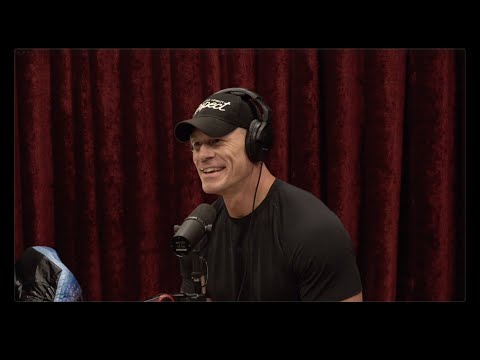
Joe Rogan Experience #2423 - John Cena
John Cena (guest), Narrator, Joe Rogan (host), Tony Hinchcliffe (guest), Tony Hinchcliffe (guest), Narrator, Tony Hinchcliffe (guest), Tony Hinchcliffe (guest), Tony Hinchcliffe (guest), Tony Hinchcliffe (guest), Tony Hinchcliffe (guest)
In this episode of The Joe Rogan Experience, featuring John Cena and Narrator, Joe Rogan Experience #2423 - John Cena explores john Cena on failure, fame, gratitude, and the grind of wrestling John Cena joins Joe Rogan and Tony Hinchcliffe to discuss his journey from struggling gym employee to WWE icon and Hollywood actor, emphasizing how chance opportunities, relentless work, and a willingness to fail shaped his career. He details his decade-long attempt to learn Mandarin and the geopolitical backlash from a Taiwan comment, using it to illustrate the gap between language and cultural fluency. The conversation dives into the brutal physical and emotional demands of pro wrestling, parallels with stand-up comedy, and the importance of humility, accountability, and gratitude. Cena also explains his upcoming retirement from WWE, his philosophy on purpose and success, and how repairing relationships—especially with his father—matters more than titles.
John Cena on failure, fame, gratitude, and the grind of wrestling
John Cena joins Joe Rogan and Tony Hinchcliffe to discuss his journey from struggling gym employee to WWE icon and Hollywood actor, emphasizing how chance opportunities, relentless work, and a willingness to fail shaped his career. He details his decade-long attempt to learn Mandarin and the geopolitical backlash from a Taiwan comment, using it to illustrate the gap between language and cultural fluency. The conversation dives into the brutal physical and emotional demands of pro wrestling, parallels with stand-up comedy, and the importance of humility, accountability, and gratitude. Cena also explains his upcoming retirement from WWE, his philosophy on purpose and success, and how repairing relationships—especially with his father—matters more than titles.
Key Takeaways
Knowing a language is not the same as knowing a culture.
Cena’s Taiwan comment in Mandarin sparked outrage in China and criticism in the U. ...
Get the full analysis with uListen AI
Radical accountability is more productive than blame.
Although others likely wrote the problematic line, Cena insists the mistake was his, using that stance to extract lessons (slow down, don’t react instantly, understand context) instead of hiding behind PR or conspiracy theories.
Get the full analysis with uListen AI
Opportunities often appear as small, risky yeses—take them.
From rapping on a bus to a dare that birthed “You can’t see me,” to doing tiny movie roles after being “run out of town” in Hollywood, Cena consistently says yes to uncomfortable chances and then outworks the opportunity.
Get the full analysis with uListen AI
Longevity in any craft requires loving the grind, not just the glory.
Cena contrasts short UFC/NFL careers with 20+ years of wrestling, pointing out that calculated risk, relentless touring, and constant iteration in non-televised shows—much like working small comedy rooms—build durable performers.
Get the full analysis with uListen AI
Pain tolerance and avoiding numbing shortcuts can be a competitive edge.
Despite multiple major surgeries, Cena never used prescribed opioids, preferring to feel pain so he could listen to his body, stay mentally sharp, and avoid the slippery slope of dependence that derails many careers.
Get the full analysis with uListen AI
Detach your self-worth from titles and peak positions.
He never set out to “be champion” but simply to wrestle and entertain; that mindset lowered ego pressure, opened him to mid-card roles, experiments, and pivots, and ironically led to one of the most decorated runs in WWE history.
Get the full analysis with uListen AI
A meaningful life is built on gratitude, presence, and repaired relationships.
Cena frames his post-retirement plan around being useful, curious, and fully present—reading, traveling, nurturing friendships, reconciling with his father—rather than chasing external status or guarantees in acting.
Get the full analysis with uListen AI
Notable Quotes
“Just because you know the language doesn’t mean you know the culture.”
— John Cena
“I think I might have been the only guy almost to get canceled for doing his homework.”
— John Cena
“The easy thing to do is sit on the couch and say, ‘It’s somebody else’s fault.’ The tough thing is recognizing life just handed you a moment and actually doing something.”
— John Cena
“I never wanted to be a champion. I just wanted to wrestle.”
— John Cena
“I’m not supposed to be here. I’m from West Newbury, Massachusetts. The best way to honor that luck is to try to live a good life.”
— John Cena
Questions Answered in This Episode
How should public figures balance using foreign languages to connect with fans against the risk of stepping into cultural or geopolitical landmines they don’t fully understand?
John Cena joins Joe Rogan and Tony Hinchcliffe to discuss his journey from struggling gym employee to WWE icon and Hollywood actor, emphasizing how chance opportunities, relentless work, and a willingness to fail shaped his career. ...
Get the full analysis with uListen AI
What practical exercises or habits can someone adopt to cultivate the kind of accountability Cena shows—especially when it would be easy to blame others?
Get the full analysis with uListen AI
In an era where everything is recorded and shared, how can young performers safely “learn to fail” in public without being permanently defined by their early missteps?
Get the full analysis with uListen AI
What can ambitious people learn from Cena’s choice to prioritize being in the arena (working, experimenting, contributing) over chasing top billing or titles?
Get the full analysis with uListen AI
How do you personally define a “useful” and “good” life, and what core values—like the ones Cena described—would guide your decisions after your primary career ends?
Get the full analysis with uListen AI
Transcript Preview
(drumbeats) Joe Rogan podcast. Check it out.
The Joe Rogan Experience.
Train by day, Joe Rogan podcast by night. All day. (instrumental music plays)
(instrumental music plays) We're rolling.
What's up? (claps hands) John Cena in the fucking house.
Hey, what you eating? Put these on? Yeah.
Yeah.
Yeah, let's put these on. Pretend we're professional.
(laughs)
What's up? Good to see you, man.
Thank... Man, thanks so much for having me. I appreciate you guys for being here.
My pleasure. And there's no way I'm having a pro wrestler on without Tony Hinchcliffe.
Of course.
It's impossible. He's the expert. He knows more about pro wrestling than I know about (laughs) UFC.
Yeah.
(laughs)
Sometimes I translate little things here and there.
That's cool. That's all right.
(laughs)
Yeah. He has to. He has to. And he's a giant fan of yours, too. You know who else is a giant fan of yours is Brian Simpson. Brian Simpson was going on last night about how intelligent you are. It was really interesting. You know, he-
You sure it was me?
Yeah, man.
(laughs)
(laughs)
Well, you do speak fucking Mandarin, which is kinda crazy.
Uh, yeah. Yeah.
How long did it take you to learn that?
Th- Uh, man, I, I was, I was doing that for quite a long time. I've since kinda, um, kinda declined on the studies. Uh, I, a wonderful takeaway from the study of Mandarin, um, just because you know a language doesn't mean you know the culture.
Ah.
So, that was a fantastic experience with, I... But I, I studied Mandarin for, like, a decade, and I would say, like, um, not even conversationally fluent. It, it was a really tough hill to climb for me.
Well, it seems like a really big hill.
Just, it's, uh, it's just different.
And then even if you could speak it-
You know, you get used to the language and the structure.
... can you read it? You know, the reading.
No.
It is crazy.
No, I didn't even bother to read. And, uh, like reading all the characters, understanding everything, uh, yeah. I didn't even bother.
How long did it take you to learn?
Uh, around 10 years.
Whoa. (laughs)
Yeah. And then, like, I mean, I, I would dream in Mandarin and, like, have conversations and kick down and that, so it, it became, like, uh, like a, a second language.
Wow.
But, you know, I, I lived in China for a little bit. I filmed a movie with Jackie Chan, so I was there for, like, six or seven months. I lived there in, um, man, we were Inner Mongolia, Yinchuan Province, so, like, uh, like, in China.
Wow.
Install uListen to search the full transcript and get AI-powered insights
Get Full TranscriptGet more from every podcast
AI summaries, searchable transcripts, and fact-checking. Free forever.
Add to Chrome