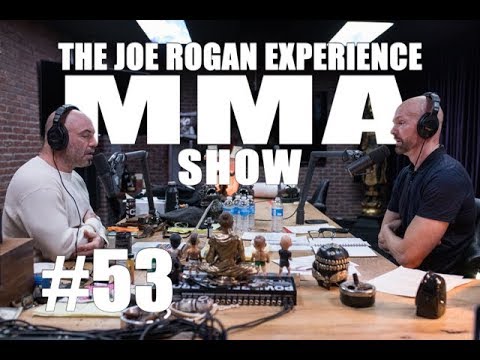
JRE MMA Show #53 with Jeff Novitzky
Joe Rogan (host), Jeff Novitzky (guest)
In this episode of The Joe Rogan Experience, featuring Joe Rogan and Jeff Novitzky, JRE MMA Show #53 with Jeff Novitzky explores uSADA’s Jeff Novitzky Explains Jon Jones’ Controversial Drug-Test Fallout Joe Rogan and UFC VP of Athlete Health and Performance Jeff Novitzky dissect Jon Jones’ Turinabol metabolite findings, explaining why regulators and anti‑doping scientists did not treat them as a new doping offense.
USADA’s Jeff Novitzky Explains Jon Jones’ Controversial Drug-Test Fallout
Joe Rogan and UFC VP of Athlete Health and Performance Jeff Novitzky dissect Jon Jones’ Turinabol metabolite findings, explaining why regulators and anti‑doping scientists did not treat them as a new doping offense.
Novitzky walks through the science of long‑term metabolites, picogram-level detection, and the emerging evidence of a “pulsing” effect that can cause old drug remnants to intermittently reappear in tests.
They contrast the Jones case with other UFC anti-doping precedents, discuss Nevada’s refusal and California’s decision to license the fight, and address public skepticism about favoritism and system integrity.
The conversation also covers supplement contamination, future changes to UFC/USADA protocols, and the need for fair, science-based anti-doping enforcement that still protects clean athletes.
Key Takeaways
Jones’ recent positives were treated as residual, not new doping.
USADA and independent lab experts concluded that the picogram-level M3 metabolite results in 2018 were leftover from an earlier exposure (pre‑July 2017), not evidence of re‑administration, due to the absence of parent drug and short/medium-term metabolites.
Get the full analysis with uListen AI
Ultra‑sensitive tests can detect drug remnants long after any benefit.
Modern WADA labs can now detect down to single-digit picograms—levels so tiny (fractions of a grain of salt split tens of millions of times) that they may reflect trace residues with no performance-enhancing effect, raising fairness concerns.
Get the full analysis with uListen AI
A ‘pulsing’ effect in chlorinated compounds complicates interpretation.
Studies on similar chlorinated drugs like clomiphene show metabolites disappearing and reappearing (“pulsing”) over many months, likely due to storage in adipose tissue and release during weight cuts or body-composition changes—mirroring what’s seen in Jones’ profile.
Get the full analysis with uListen AI
Regulators must balance optics with due process and science.
Nevada sought a public hearing and delayed, citing optics and caution, while California—already deeply familiar with the Jones file—accepted the expert opinions and licensed the fight, illustrating how process and familiarity shape regulatory decisions.
Get the full analysis with uListen AI
Strict liability remains, but intent and source still matter for sanctions.
Cases like Jones, Barnett, Romero, Means, and Mir show that athletes are responsible for what’s in their body, yet arbitration outcomes and sanction lengths hinge on proving (or failing to prove) intentional use versus contamination or inadvertent ingestion.
Get the full analysis with uListen AI
Supplement use is a major risk vector; third‑party certification is critical.
Novitzky stresses that many positives stem from contaminated products, and the UFC/USADA are working with leagues and certifiers to define a ‘platinum standard’ approved-supplement list that could function as a de facto safe harbor for fighters.
Get the full analysis with uListen AI
The UFC will increase testing and push for rational thresholds.
A new USADA contract will boost test volume by 30–40%, and the UFC supports WADA’s move toward picogram-level thresholds (e. ...
Get the full analysis with uListen AI
Notable Quotes
““There is no evidence that DHCMT has been re-administered.””
— Jeff Novitzky, citing Dr. Daniel Eichner (WADA-accredited lab director)
““All evidence available to me leads me to conclude that the violation was not intended nor could it have enhanced the athlete’s performance.””
— Jeff Novitzky, quoting arbitrator Richard McLaren on Jon Jones’ 2017 case
““When you’re getting down to detection of one, single-digit picograms, I have a concern… Are we going to talk about environmental contamination?””
— Jeff Novitzky
““If there was any indication that there would be a benefit from him, even though it technically wasn’t a violation, I’m not gonna stand by while anybody licenses that guy to fight.””
— Jeff Novitzky
““We’ve got to have a path of redemption for people… If he didn’t do anything, folks, you gotta stop saying he’s cheating.””
— Joe Rogan
Questions Answered in This Episode
How should anti-doping rules evolve to distinguish between meaningful doping and trace, non-beneficial residues detected at picogram levels?
Joe Rogan and UFC VP of Athlete Health and Performance Jeff Novitzky dissect Jon Jones’ Turinabol metabolite findings, explaining why regulators and anti‑doping scientists did not treat them as a new doping offense.
Get the full analysis with uListen AI
What independent mechanisms could further reassure fans that high-profile athletes aren’t receiving preferential treatment in borderline cases?
Novitzky walks through the science of long‑term metabolites, picogram-level detection, and the emerging evidence of a “pulsing” effect that can cause old drug remnants to intermittently reappear in tests.
Get the full analysis with uListen AI
Given the pulsing phenomenon, should athletes ever be considered fully ‘clear’ of certain drugs, or do rules need a new framework for long-lived metabolites?
They contrast the Jones case with other UFC anti-doping precedents, discuss Nevada’s refusal and California’s decision to license the fight, and address public skepticism about favoritism and system integrity.
Get the full analysis with uListen AI
How far should athlete responsibility extend when contamination can occur through everyday items like supplements, creams, or even environmental exposure?
The conversation also covers supplement contamination, future changes to UFC/USADA protocols, and the need for fair, science-based anti-doping enforcement that still protects clean athletes.
Get the full analysis with uListen AI
Would a mandatory, league-provided supplement program be ethical and practical, or would it create new conflicts of interest and competitive issues?
Get the full analysis with uListen AI
Transcript Preview
... four, three, two, one. Boom. Got a little thing going on here now, a little circle. Hello, Jeff. Merry Christmas.
What's up, Joe? You too.
How you living? (laughs)
(laughs) Not been the easiest week in, in my life or my career is last week, but hanging in there.
To make this a standalone so that people don't have to go r- figuring this out on their own, and I- I'm sure many, many fans that are tuning in already know the, the gist of the details, let's lay this out from the beginning. Jon Jones' initial failed test.
Yeah, so that was July of 2017. He tested positive for approximately 20, anywhere from 20 to 60 picograms of a long-term metabolite known as the M3 metabolite of a substance called dihydrocholormethyltestosterone, DH-CMT, also known as oral Turinabol.
And this was over a year ago. Um, what was determined to be the source of this stuff?
Never determined what the source was.
Hmm.
So Jon went through a full arbitration hearing, um, was never able to determine where it came from. Tested all the supplements he was using, you know, went through many, uh, interviews with USADA, had a full-on arbitration hearing. Uh, the source was never determined where it came from.
Why was his suspension so low or so short if it wasn't determined?
Well, I mean ... (laughs) So, I mean, there's many factors that, that go into what that suspension was. I w- I would argue in the tota- totality of the evidence that was presented in that arbitration that it, that it wasn't a short suspension, um, because really one key thing came out at arbitration. So Jon went to arbitration before an individual by the name of Richard McLaren. Richard McLaren has an arbitration group up in Canada, and McLaren is probably worldwide known as one of the most credible guys in anti-doping. I know you had the, the Icarus producer, director on.
Mm-hmm.
The McLaren report was the report that came from all that. He basically investigated the Russian state being involved in doping in the Sochi games and put out actually a series of reports on it detailing that up to 1,000 Russian athletes, um, you know, were breaking the rules and the Russian laboratory was helping them get around it. So-
Right.
... he's a very, very respected guy. He's independent of, obviously, the UFC. He's independent of USADA. Um, he acts on his own.
And his determination was?
His determination, um, and I'll read you kind of what he said.
Okay.
He said, "I find that all evidence available to me leads me to conclude that the violation was not intended nor could it have e- enhanced the athlete's performance." So A, non-intentional, so non-intentional ingestion. I mean, there's no argument that it was in his system, but he found the evidence to show non-intentional use, and then he went further saying that based on the numbers of what he saw in the evidence, there was not even a performance-enhancing benefit afforded to Jon for having this long-term metabolite in his system. And I think that's significant when you talk about, hey, 15 months, was that ... That's, you know, kinda light being that this is his second time through. I would argue that if there was an argument, that maybe it's on the higher end. And certainly, you know, we'll talk about the California commission. Andy Foster took that position, uh, in Jon's recent California hearing. He was a little bit critical of USADA. Um, he thought, you know, he's intimately familiar with this evidence, both in the previous case and this occurrence, that, and he also saw that there was no evidence that an independent arbitrator, you know, made this, uh, statement and decision of Jon intentionally cheating. Um, so if anything, you know, I'd say that potentially there could be an argument that, that it was, you know, on the higher end versus the lower end.
Install uListen to search the full transcript and get AI-powered insights
Get Full TranscriptGet more from every podcast
AI summaries, searchable transcripts, and fact-checking. Free forever.
Add to Chrome