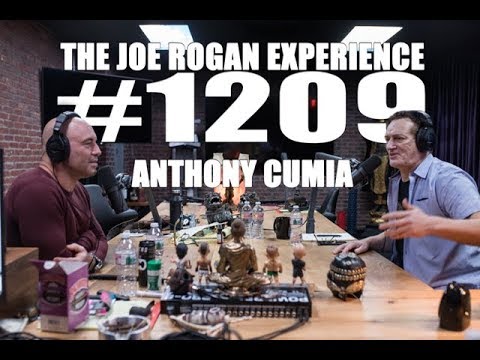
Joe Rogan Experience #1209 - Anthony Cumia
Anthony Cumia (guest), Joe Rogan (host), Narrator, Narrator, Narrator, Narrator
In this episode of The Joe Rogan Experience, featuring Anthony Cumia and Joe Rogan, Joe Rogan Experience #1209 - Anthony Cumia explores anthony Cumia, Censorship, Outrage Culture, and DIY Media Revolutions Joe Rogan and Anthony Cumia trace how Cumia’s basement webcast, *Live from the Compound*, directly inspired the early format and feel of Rogan’s podcast and broader independent digital broadcasting. They reflect on the evolution of technology—from dial‑up porn and RealAudio to VR gaming—and how cheap gear plus internet distribution destroyed traditional radio’s gatekeeping.
Anthony Cumia, Censorship, Outrage Culture, and DIY Media Revolutions
Joe Rogan and Anthony Cumia trace how Cumia’s basement webcast, *Live from the Compound*, directly inspired the early format and feel of Rogan’s podcast and broader independent digital broadcasting. They reflect on the evolution of technology—from dial‑up porn and RealAudio to VR gaming—and how cheap gear plus internet distribution destroyed traditional radio’s gatekeeping.
They dig into outrage culture, social media bans, and double standards in content moderation, using examples like Louis Farrakhan, Laura Loomer, Alex Jones, and the Proud Boys origin story, arguing that platforms now function as critical public utilities without consistent rules. Political discussion centers on Trump’s Twitter persona, media hysteria, and how Trump’s election exposed rot in politics, media, and Hollywood.
The conversation also explores male domestic life (man caves vs. full control), marriage misery as fuel for creativity, and the fragility of modern civilization in a digital‑dependent world—touching on grid failure, surveillance tech, and how easily society could unravel. Throughout, they return to free speech absolutism, the danger of retroactively judging past behavior, and the power of building your own platform.
They close by examining Cumia’s post‑ONA career, the internal dynamics that broke up Opie & Anthony, the challenges of running a subscription video network, and the strange new media landscape where comics, not broadcasters, set the tone for politics and culture.
Key Takeaways
Own your platform to escape gatekeepers and censorship risk.
Cumia’s basement show and Rogan’s podcast both demonstrate that relatively cheap tech and internet distribution can replace corporate radio, giving creators full control over content without advertiser‑driven censorship.
Get the full analysis with uListen AI
Outrage culture flattens moral distinctions and punishes nuance.
They argue that lumping Louis C. ...
Get the full analysis with uListen AI
Social media moderation is inconsistent and politically skewed.
Examples like Farrakhan’s antisemitic tweets staying up while conservative or anti‑Islam voices are banned highlight how platforms operate like essential communication utilities but enforce rules arbitrarily.
Get the full analysis with uListen AI
Movements that start as satire can mutate into real, uncontrollable forces.
Cumia describes the Proud Boys beginning as a joke about a timid staffer and Disney show tune, then evolving—via social media, real‑world confrontation with Antifa, and press framing—into a global, politicized ‘organization.’
Get the full analysis with uListen AI
Technology both empowers and endangers modern society.
From GPS, VR, and streaming games to Alexa and black‑box driving trackers, tech offers convenience and fun but also constant surveillance and a brittle dependency that could be catastrophic in a grid failure.
Get the full analysis with uListen AI
Politics has merged with entertainment, for better and worse.
Trump’s rally “crowd work,” Twitter insults, and cable‑news theatrics show that political communication now follows stand‑up and reality‑TV logic, revealing more authenticity but also incentivizing extremity and performance over substance.
Get the full analysis with uListen AI
Subscription models trade scale for independence and stability.
Running Compound Media as a paid network gives Cumia insulation from advertiser pressure but makes audience growth harder than free, ad‑supported podcasts—forcing constant balance between revenue, reach, and speech freedom.
Get the full analysis with uListen AI
Notable Quotes
“If it was not for you and your show, this would not exist.”
— Joe Rogan (to Anthony Cumia about *Live from the Compound* influencing JRE)
“Most men live lives of silent desperation.”
— Joe Rogan (quoting Thoreau while talking about miserable marriages and man caves)
“Guys who don't have kids, aren't married, and have disposable income—you get to see what guys really wanna do.”
— Anthony Cumia (on turning his home into a gaming and broadcasting playground)
“No one ever really wants equality. The fight for equality is where it's at.”
— Anthony Cumia (arguing that victim status has social currency that people are reluctant to give up)
“It’s not the government; we turned out to be Big Brother. We pick up our phone and rat each other out.”
— Anthony Cumia (on surveillance, social media, and crowd‑driven censorship)
Questions Answered in This Episode
Where should platforms like Twitter draw the line between private moderation rights and their de facto role as public utilities for global speech?
Joe Rogan and Anthony Cumia trace how Cumia’s basement webcast, *Live from the Compound*, directly inspired the early format and feel of Rogan’s podcast and broader independent digital broadcasting. ...
Get the full analysis with uListen AI
How can creators balance the freedom of subscription‑based models with the reach and discoverability of free, ad‑supported content?
They dig into outrage culture, social media bans, and double standards in content moderation, using examples like Louis Farrakhan, Laura Loomer, Alex Jones, and the Proud Boys origin story, arguing that platforms now function as critical public utilities without consistent rules. ...
Get the full analysis with uListen AI
To what extent did comedy and talk radio personalities like Opie & Anthony and Howard Stern shape today’s podcast culture and political discourse?
The conversation also explores male domestic life (man caves vs. ...
Get the full analysis with uListen AI
What mechanisms, if any, should exist to prevent satirical or ‘joke’ movements from evolving into real‑world extremist groups?
They close by examining Cumia’s post‑ONA career, the internal dynamics that broke up Opie & Anthony, the challenges of running a subscription video network, and the strange new media landscape where comics, not broadcasters, set the tone for politics and culture.
Get the full analysis with uListen AI
How vulnerable is modern society to long‑term power or internet outages, and what does our reaction to even brief blackouts reveal about social stability?
Get the full analysis with uListen AI
Transcript Preview
(laughs) I don't think that would pan out. I had a similar idea. (slaps table)
Anthony Cumia, we're live, sir.
I love it. Joe Rogan.
If it was not for you-
Oh my God.
... this, this would not exist. That is a fact.
Which is insane.
That is 100% actual fact. I was watching you doing Live from the Compound. Me and Brian Redband were sitting in my fucking living room, and we were watching you.
(laughs)
You were fucking playing karaoke. You were singing karaoke with a machine gun in front of a green screen.
(laughs) Yeah.
And I was like, "This guy, this guy just set up his own studio. Like, he already has Opie and Anthony Show." At the time, you guys were on Sirius XM.
Yeah.
And you just decided to do this thing in your basement, just for a goof.
Yeah, it was like a hobby.
It's like, guys who don't have kids, married g- uh, who are not married, don't have kids, don't have anybody telling them what to do, and they also have disposable income, then you get to see what guys really wanna do.
Yes.
They wanna sing karaoke with a machine gun in front of a green screen. (laughs)
Yeah, it was cra- crazy gun guy karaoke, so I could do that. If, if I was married, I would have a wife that would lose her mind at my living room. Like, my living room table that you're supposed to have a candle on and little tchotchkes and stuff, is a wide screen, uh, computer monitor and, uh, a gaming system right next to the table. I have a gaming computer that's just unbelievable, and I sit there and just play video games.
So, the table itself is a gaming monitor?
Yeah, the whole tab- well the, it's-
Is it one of those touchscreen ones?
No, it's, it's a giant wide monitor. It's like, uh, like 40 inches wide.
So, that's the table?
No, it's on the table.
Oh, on the table.
The t- yeah.
I was confused.
The table's this big, heavy metal thing, but-
Oh.
... but it's just everything. There's VR goggles up on the console by the TV. It's just, uh, sensors around the room for the VR. It's a, a playground. And you're absolutely right. Guys will spend their money on having fun if, if allowed to.
That's what this place is.
This place is insane, Joe.
And I can't do this in my house. You go to my house, it's my wife's house.
See? That's how it works.
I have one elk head on the wall. That's all I have. Everything else is gone.
That's all you're allowed. I laugh at guys when they have the, uh, the man cave.
Install uListen to search the full transcript and get AI-powered insights
Get Full TranscriptGet more from every podcast
AI summaries, searchable transcripts, and fact-checking. Free forever.
Add to Chrome