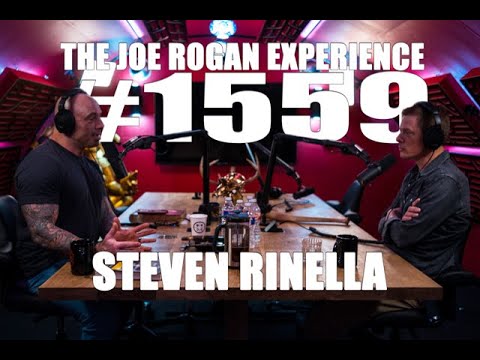
Joe Rogan Experience #1559 - Steven Rinella
Narrator, Narrator, Steven Rinella (guest), Joe Rogan (host)
In this episode of The Joe Rogan Experience, featuring Narrator and Narrator, Joe Rogan Experience #1559 - Steven Rinella explores joe Rogan and Steven Rinella Deconstruct Hunting, Media, and Modern America Joe Rogan and Steven Rinella range from absurd topics (animal dick bones and fossil laws) to serious issues like media bias, censorship, social media polarization, and the evolution of podcasting. They examine how authenticity and lack of gatekeepers made podcasts powerful and why legacy media struggles with that model. A large part of the conversation covers hunting culture, wildlife management (wolves, grizzlies, megafauna extinctions), and near‑death experiences in the backcountry. Woven through are anxieties about U.S. politics, social division, homelessness, and what it means to feel patriotic in a fractured America.
Joe Rogan and Steven Rinella Deconstruct Hunting, Media, and Modern America
Joe Rogan and Steven Rinella range from absurd topics (animal dick bones and fossil laws) to serious issues like media bias, censorship, social media polarization, and the evolution of podcasting. They examine how authenticity and lack of gatekeepers made podcasts powerful and why legacy media struggles with that model. A large part of the conversation covers hunting culture, wildlife management (wolves, grizzlies, megafauna extinctions), and near‑death experiences in the backcountry. Woven through are anxieties about U.S. politics, social division, homelessness, and what it means to feel patriotic in a fractured America.
Key Takeaways
Authenticity is podcasting’s core competitive advantage over legacy media.
Rogan argues that unfiltered, unscripted conversations with minimal crew are exactly what people trust, in stark contrast to over‑produced TV news where dialogue, topics, and even props (like flags) are managed by layers of executives.
Get the full analysis with uListen AI
Ignoring or delegitimizing unpopular speech corrodes the principle of free expression.
They criticize a new strain of left‑wing acceptance of censorship and deplatforming, noting that historically groups like the ACLU defended even neo‑Nazis’ speech to protect the underlying principle for everyone.
Get the full analysis with uListen AI
Algorithmic echo chambers intensify political polarization and distort reality.
Referencing The Social Dilemma, Rogan and Rinella highlight how social media rewards outrage, funnels users into ideological bubbles, and helps create the perception that the country is more irreparably divided than daily in‑person interactions suggest.
Get the full analysis with uListen AI
Exposure to real risk reveals the gap between imagined and actual performance under stress.
Rinella’s grizzly bear encounter shows how even experienced outdoorsmen can mentally “opossum out,” underscoring the importance of realistic training, risk assessment, and humility about how you’ll respond when it truly counts.
Get the full analysis with uListen AI
Wildlife and artifact laws hinge on subtle distinctions that many outdoorspeople miss.
Rinella explains that on U. ...
Get the full analysis with uListen AI
Predator restoration and management are as cultural and political as they are biological.
Their discussion of wolves in Colorado and grizzlies in B. ...
Get the full analysis with uListen AI
Economic precarity strengthens arguments for safety nets like universal basic income.
Rogan supports targeted UBI in contexts like the COVID pandemic, noting that mass inability to pay rent or buy food suggests a role for “big government” or robust charitable systems in stabilizing people through no‑fault crises, even while acknowledging incentive‑loss risks.
Get the full analysis with uListen AI
Notable Quotes
“If there’s 300 million people and 1% don’t like you, you’ve got three million critics.”
— Joe Rogan
“The way to make a lot of money off podcasting is the opposite way—leave it wild.”
— Joe Rogan
“I was playing opossum, and I don’t mean playing. It opossumed me out.”
— Steven Rinella, on his grizzly encounter
“I’m not anti‑wolf. I’m anti‑abuse of the Endangered Species Act.”
— Steven Rinella
“The biggest creature ever is alive right now… and my kids are like, ‘Yeah, T‑rex.’”
— Steven Rinella
Questions Answered in This Episode
How sustainable is Rogan’s commitment to total creative independence as his audience and business stakes continue to grow?
Joe Rogan and Steven Rinella range from absurd topics (animal dick bones and fossil laws) to serious issues like media bias, censorship, social media polarization, and the evolution of podcasting. ...
Get the full analysis with uListen AI
To what extent are social‑media‑driven echo chambers reversible, and what concrete mechanisms could reduce their polarizing effects?
Get the full analysis with uListen AI
Where should the line be drawn between protecting cultural/archaeological resources and allowing individuals to collect artifacts they discover?
Get the full analysis with uListen AI
How should wildlife agencies balance symbolic desires for apex predators (like wolves) with the lived realities of ranchers, hunters, and rural communities?
Get the full analysis with uListen AI
In a wealthy country, what’s the most effective blend of UBI, targeted welfare, and private charity for preventing homelessness without eroding personal initiative?
Get the full analysis with uListen AI
Transcript Preview
(drumming music) Joe Rogan podcast, check it out.
The Joe Rogan Experience.
Train by day, Joe Rogan podcast by night. All day. (rock music) You were just telling me about your friend who has a dick collection?
(laughs)
(laughs) I wish he was my friend still. It was, um ... When I was younger, I don't know how I h- I came into his orbit, but there was a fur buyer and taxidermist and muskrat trapper in Muskegon County, um, where I grew up in Michigan, and he had amassed a very impressive collection of baculums. And you brought this up because Frank von Hippel had given us this, uh, fossilized walrus, ancient walrus dick bone.
Pecker bone, swizzle stick.
(laughs)
Yeah. Uh, uh, a friend of mine, Clay Newcomb, he, uh, he, uh, he, he uses them for very ... Like, the bl- he, he saves the black bear ones and, and people use them as drink stirs and stuff.
The first deer I ever killed, you gave me one, and I was using it as a coffee stirrer for a while.
Oh, like, an a- no, it's not like, an actual bone bone in there.
It's ... Isn't there a bone bone in there?
No.
Well, you gave me one. You may- might not have given to me one from that. You gave me one from something else, like a hat.
Maybe a rac- maybe a raccoon or a bear or something. I'd have to look at it.
I don't know, but you gave me a dick bone, and I had it in my backpack for a long time.
Oh. Huh.
(laughs)
Yeah, so, he ha-
(laughs) How often do you give away dick bones that you don't even remember them?
(laughs) Well, I wi- I wish I had, I wish I had more to share.
(laughs)
This guy, this Bob Farris guy, we used to laugh 'cause he looked like Bob Farris looked exactly like Bob Dylan. Um, and he's gotta be around still. I remember being over his house one day and him advising someone over the phone within earshot of me. I remember this guy was going out to set muskrat traps. And I remember, uh, Bob Farris advising him, uh, "If anybody fucks with you, shoot them." And, uh, I was young enough that I didn't, like, get that that was a humor thing. You know, the whatever, just, like, a thing you'd say to your buddy to have a laugh.
Right.
And I remember being like, "Man, these guys are serious about muskrats." (laughs)
(laughs)
I was like, "I hope I don't run into that dude in the marsh." (laughs)
(laughs)
And now I'm like, "Oh, yeah, I could totally see saying that to somebody," and then we'd have a laugh and get off the phone.
Install uListen to search the full transcript and get AI-powered insights
Get Full TranscriptGet more from every podcast
AI summaries, searchable transcripts, and fact-checking. Free forever.
Add to Chrome