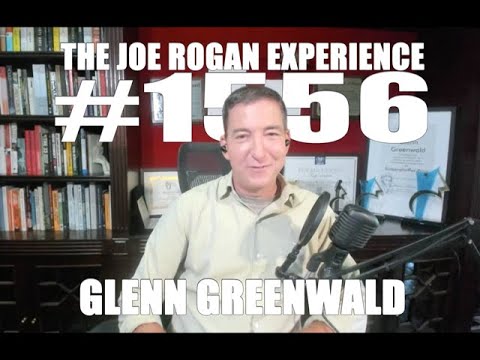
Joe Rogan Experience #1556 - Glenn Greenwald
Glenn Greenwald (guest), Joe Rogan (host), Guest (guest)
In this episode of The Joe Rogan Experience, featuring Glenn Greenwald and Joe Rogan, Joe Rogan Experience #1556 - Glenn Greenwald explores glenn Greenwald, Joe Rogan Expose Surveillance, Censorship, Media Decay, Fear Joe Rogan and Glenn Greenwald discuss Greenwald’s life in Brazil, his reporting on Edward Snowden and Brazilian politics, and the personal risk and pressure that come with high‑stakes journalism. They explore how U.S. mass surveillance inverted democracy’s basic bargain—government secrecy versus citizen privacy—and how whistleblowers like Snowden and Assange are punished while lawbreaking officials are rewarded. A major portion of the conversation critiques U.S. media, Big Tech censorship, and the cultural forces driving self‑censorship, polarization, and the collapse of trust in institutions. They end by reflecting on free speech, the dangers of ideological conformity, the psychological effects of fame and online mobbing, and the importance of independent, long‑form conversation as a path forward.
Glenn Greenwald, Joe Rogan Expose Surveillance, Censorship, Media Decay, Fear
Joe Rogan and Glenn Greenwald discuss Greenwald’s life in Brazil, his reporting on Edward Snowden and Brazilian politics, and the personal risk and pressure that come with high‑stakes journalism. They explore how U.S. mass surveillance inverted democracy’s basic bargain—government secrecy versus citizen privacy—and how whistleblowers like Snowden and Assange are punished while lawbreaking officials are rewarded. A major portion of the conversation critiques U.S. media, Big Tech censorship, and the cultural forces driving self‑censorship, polarization, and the collapse of trust in institutions. They end by reflecting on free speech, the dangers of ideological conformity, the psychological effects of fame and online mobbing, and the importance of independent, long‑form conversation as a path forward.
Key Takeaways
Whistleblowers expose crimes yet are criminalized while officials who lied and broke the law remain protected and rewarded.
Snowden revealed unconstitutional NSA mass surveillance and was exiled under threat of life imprisonment, while officials like James Clapper, who lied to Congress about spying on Americans, were never prosecuted and now hold media positions.
Get the full analysis with uListen AI
The core democratic principle has inverted: government is secretive while citizens are transparent and surveilled.
Greenwald argues a healthy society requires government transparency and citizen privacy, but post‑9/11 architectures and digital surveillance flipped this, granting states vast visibility into private lives while hiding their own actions behind classification.
Get the full analysis with uListen AI
Mainstream media often functions as an extension of state and party power rather than a check on it.
They describe how outlets uncritically echoed intelligence community narratives (e. ...
Get the full analysis with uListen AI
Big Tech censorship is being driven largely by political and media pressure from the liberal establishment.
Platforms initially wanted to be neutral carriers but have been pushed into policing ‘disinformation,’ often by former party operatives and aligned journalists; this centralizes control of public discourse in a tiny, unaccountable elite.
Get the full analysis with uListen AI
Self‑censorship has become pervasive among journalists and professionals who fear career destruction for dissenting views.
Greenwald recounts colleagues privately doubting Russiagate or raising taboo questions (e. ...
Get the full analysis with uListen AI
Free speech and open inquiry are being abandoned by parts of the left in favor of moralized censorship and purity tests.
They contrast earlier ACLU‑style defenses of neo‑Nazis’ right to march with current campaigns to deplatform heretics on trans issues, race, or politics, arguing that once censorship tools exist, they inevitably get turned on all dissidents, left and right.
Get the full analysis with uListen AI
Independent, long‑form media can rebuild trust by prioritizing honesty over alignment with institutions or tribes.
Rogan and Greenwald note that audiences increasingly seek out formats like podcasts and substack‑style outlets where hosts admit mistakes, show uncertainty, and host ideologically diverse guests—filling a vacuum left by scripted, conformist legacy media.
Get the full analysis with uListen AI
Notable Quotes
“If you have faith in mainstream news institutions, you're really irrational.”
— Glenn Greenwald
“Not only is the person who exposes crimes punished, the people who broke the law haven't paid any price.”
— Glenn Greenwald
“What is your fucking purpose? Why are you a journalist, if you don't defend people who expose the truth?”
— Glenn Greenwald
“Whenever there's a subject that you can't talk about, you're in a religion now. You're in a cult.”
— Joe Rogan
“Trump has broken the brains of so many people, and not in a temporary way.”
— Glenn Greenwald
Questions Answered in This Episode
How can democratic societies reestablish a balance where governments are transparent and citizens retain meaningful privacy in the digital age?
Joe Rogan and Glenn Greenwald discuss Greenwald’s life in Brazil, his reporting on Edward Snowden and Brazilian politics, and the personal risk and pressure that come with high‑stakes journalism. ...
Get the full analysis with uListen AI
What practical mechanisms could protect whistleblowers like Snowden and Assange while still addressing legitimate national security concerns?
Get the full analysis with uListen AI
To what extent should private tech platforms be treated as utilities or public squares subject to free‑speech constraints rather than as private publishers?
Get the full analysis with uListen AI
How can journalists and academics realistically push back against self‑censorship and social punishment for engaging with taboo topics?
Get the full analysis with uListen AI
What role should long‑form, independent media play in rebuilding public trust, and how can it avoid replicating the same tribal and ideological pressures it criticizes?
Get the full analysis with uListen AI
Transcript Preview
(drum music plays) Joe Rogan Podcast, check it out. The Joe Rogan Experience.
Train by day, Joe Rogan Podcast by night, all day. (rock music plays) Hello, Glenn.
Hello, Joe Rogan. How are you?
I'm great, man. It's great to finally make your acquaintant- acquaintance, digitally at least.
Yeah, yeah, we've been trying for a while. I've ... Like before the pandemic, um, so I'm glad we're at least finally able to do this version of it.
Yeah, I hope we do it in person eventually. That would be nice.
For sure, yeah.
What's it like down in Brazil?
In general or with-
No, I've, I've been to Brazil-
... everything that's going on?
Yeah, in g-
Yeah.
Like right now. I've been to Brazil multiple times. I love it down there.
Yeah, I mean, so obviously it's a, a fraught situation politically because the country in 2018 elected, you know, a genuine fanatic, someone who explicitly, um, prefers the military dictatorship that ruled the country until 1985 as opposed to democracy which succeeded it, Jair Bolsonaro. Um, and then beyond that, uh, the coronavirus has hit this country almost harder than any other, probably just right after the United States, but because of extreme poverty here and income inequality, um, you could probably make the case that it's hit this country harder than any other. Um, so politically, in terms of the pandemic and then of course economically, things are pretty bleak. But at the same time, Brazil, which is what made me fall in love with it in the first place, is always this country, as you know if you've visited, so bursting full of vibrancy and energy and potential and uniqueness, that I'm always kind of optimistic about it, no matter how grim things seem to be.
They're very, very friendly people. I really love it down there. It's a ... I've, I've ... I've first went there in 2003 for the, uh, Abu Dhabi, uh, World Jiu-Jitsu Championships, and so, uh ...
Right. Yeah, 'cause I guess you're ... The fighting that you like is super popular here, right? There are a lot of Brazilian-
Oh, yeah.
... MMA fighters and-
Oh, yeah.
Yeah.
I mean, the original UFC fighter was, uh, Royce Gracie who's a m- member of the famous Gracie clan that came out of Rio. So, uh, I've ... Yeah. I've been going there for 17 years, so I, I really do love it down there.
Yeah, you know, it's funny that it is ... I mean, it's a culture, as you say, where things are ... where the people are super nice. And before I lived here, I lived in, you know, Manhattan, where I lived and worked, which is pretty much the exact polar opposite of Brazil in terms of mentality of the people. And I remember, you know, I used to come to Rio. When I first started coming here, you would go to the grocery store or the supermarket and there'd be a line of, like, eight people, and the people in line would just stop and chat with the cashier, you know, for like three minutes. And I would, like, be ready to have an aneurysm because I had come from Manhattan-
Install uListen to search the full transcript and get AI-powered insights
Get Full TranscriptGet more from every podcast
AI summaries, searchable transcripts, and fact-checking. Free forever.
Add to Chrome