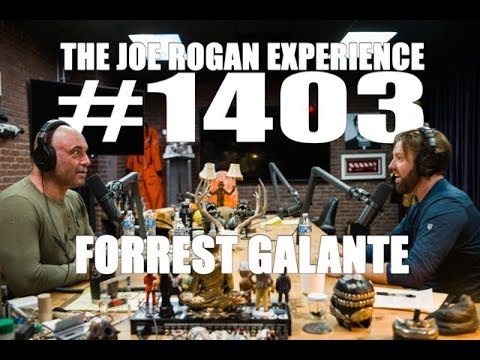
Joe Rogan Experience #1403 - Forrest Galante
Joe Rogan (host), Forrest Galante (guest), Jamie Vernon (host), Jamie Vernon (host), Jamie Vernon (host), Jamie Vernon (host)
In this episode of The Joe Rogan Experience, featuring Joe Rogan and Forrest Galante, Joe Rogan Experience #1403 - Forrest Galante explores joe Rogan and Forrest Galante Hunt Lost Species, Decode Wild Nature Joe Rogan and wildlife biologist/adventurer Forrest Galante discuss rediscovering ‘extinct’ animals, apex predators, and the brutal realities of nature. Galante recounts finding a supposedly extinct Galápagos tortoise and a rare Colombian caiman, and explains how such finds change conservation priorities and funding. They dive into cryptids like thylacines and orang pendek, shark attacks, wolves and orcas, invasive species such as feral pigs and axis deer, and how human activity reshapes ecosystems. Throughout, they explore animal intelligence, evolutionary oddities, and the ethical tension between letting nature run its course and intervening to protect wildlife and people.
Joe Rogan and Forrest Galante Hunt Lost Species, Decode Wild Nature
Joe Rogan and wildlife biologist/adventurer Forrest Galante discuss rediscovering ‘extinct’ animals, apex predators, and the brutal realities of nature. Galante recounts finding a supposedly extinct Galápagos tortoise and a rare Colombian caiman, and explains how such finds change conservation priorities and funding. They dive into cryptids like thylacines and orang pendek, shark attacks, wolves and orcas, invasive species such as feral pigs and axis deer, and how human activity reshapes ecosystems. Throughout, they explore animal intelligence, evolutionary oddities, and the ethical tension between letting nature run its course and intervening to protect wildlife and people.
Key Takeaways
Finding a ‘lost’ species can instantly transform its conservation prospects.
Galante’s rediscovery of the Fernandina Island tortoise and the yellow caiman shows that once an “extinct” species is found, funding, research, and protection efforts surge, because conservationists now have a tangible target instead of a historical footnote.
Get the full analysis with uListen AI
Wildlife “management” is as much about people as it is about animals.
Maintaining populations of rediscovered species or dangerous predators requires local scientists, long-term monitoring, genetic work, and navigating hunting pressure, politics, and community needs—not just proving the animal exists.
Get the full analysis with uListen AI
Cryptid chases blend romance and science—and sometimes yield real biology.
Stories about thylacines, giant ground sloths, or orang pendek attract attention because people crave mystery; while most reports are noise, the interest can fuel real expeditions and occasionally uncover misclassified or remnant populations.
Get the full analysis with uListen AI
Invasive species can remake entire landscapes if not aggressively controlled.
Feral pigs across North America and axis deer in Lanai illustrate how a handful of introduced animals can explode into tens of thousands, devastate vegetation and native fauna, yet become culturally or economically valued as food—complicating eradication efforts.
Get the full analysis with uListen AI
Top predators rapidly adapt to human-caused changes, sometimes with lethal results.
Examples include orcas specializing on salmon and then starving when runs collapse, great white sharks shifting ranges with warmer waters, wolves learning to target livestock or hunters’ kills, and crocodiles patterning human behavior at riverbanks.
Get the full analysis with uListen AI
Animal intelligence and sensory worlds are far stranger and richer than we assume.
Octopus and cuttlefish can instantaneously rewrite their skin, orcas maintain culture-specific diets, bees cook hornets with collective body heat, and parasites like Toxoplasma can alter host behavior—challenging human-centric ideas about cognition and control.
Get the full analysis with uListen AI
Effective conservation needs uncomfortable honesty about hunting, economics, and risk.
They acknowledge that trophy hunting has saved some African species by giving them monetary value, but corruption and bad operators can negate those gains; likewise, keeping wolves, lions, sharks, and crocs on the landscape means accepting some level of danger and cost.
Get the full analysis with uListen AI
Notable Quotes
““I’m the hide‑and‑seek guy. I go in and look for them.””
— Forrest Galante
““We don’t want our great‑grandkids saying, ‘Imagine if we could’ve seen a grizzly bear.’””
— Forrest Galante
““Nature, you cruel, beautiful bitch.””
— Joe Rogan
““Crocodiles will hunt human beings. They will study the pattern, learn the behavior, and just wait.””
— Forrest Galante
““We have all the pieces of the puzzle to make it work. We can still save this stuff.””
— Forrest Galante
Questions Answered in This Episode
How should conservationists balance the romantic appeal of searching for ‘extinct’ species with the need to protect known, critically endangered ones?
Joe Rogan and wildlife biologist/adventurer Forrest Galante discuss rediscovering ‘extinct’ animals, apex predators, and the brutal realities of nature. ...
Get the full analysis with uListen AI
To what extent should trophy hunting be accepted or rejected as a conservation tool when it clearly funds some successes but also drives corruption and abuse?
Get the full analysis with uListen AI
How might human behavior or policy change if people fully grasped how parasites and environmental toxins can subtly alter our decisions and risk-taking?
Get the full analysis with uListen AI
Where should we draw the ethical line between letting nature take its course (eagles vs. octopus, crocs vs. villagers) and intervening to save individual animals or people?
Get the full analysis with uListen AI
What would a realistic, large-scale strategy look like for managing invasive megafauna like feral pigs or axis deer without collapsing local food culture and economies?
Get the full analysis with uListen AI
Transcript Preview
(singing) And (snaps fingers) what's happening, brother? How are ya?
Hey, Joe. I'm good, man.
Good to see you, man.
It's great to be here. Thanks for having me.
I've been following your exploits on, uh, social media and, uh, the yellow caiman.
Yes. (laughs)
Dude, that is a wild-looking creature.
Isn't it? It's unbelievable.
And it was thought to be extinct?
Uh, yeah, so this one's... It's a little confusing. It, um... It's a species that was last seen in... When the last one died in a zoo in the '80s, and because of the region that it occupies in Colombia, which has always been controlled by FARC rebels, nobody had been back down there to look for it. And, uh, myself, and there's actually this amazing Colombian scientist named Sergio Riena, were both kind of going and, and prodding and trying to see if we could get in, and, and we both found it within a month of each other.
Oh, wow.
Yeah. (laughs)
Now, it's a... It was a beautiful-looking creature. Look at that thing.
Right? (laughs)
Such a wild, green, yellow color. So wild-looking.
It's u- super unique. I mean-
Dude, you're just holding that thing by the neck?
Yeah. We just had a little wr- wrestling match, him and I, so... (laughs)
You don't even have body control. Don't you wanna take mount here, maybe get a back mount, get some hooks in?
(laughs)
(laughs)
No, he was, he was good at it. You know, reptiles, they tire out, so they're not like mammals.
Oh.
Um, once they expend all their energy, that's kind of it. Um, but yeah, absolutely amazing.
D- Are they similar to regular crocodiles or alligators in that they don't have to eat for, like, a year?
Yeah. The... So, caiman... I mean, caiman don't have the... as slow of metabolism as certain other species, but they are... They're a member of the alligator family, so to speak, and they can go very long times without food.
What a crazy animal. Like, looks like a monster.
Yep.
I mean, look at-
Look at it. (laughs)
... the teeth on that thing. Swallows things basically whole, just-
Yep.
... spins to take chunks off of things, swallows 'em whole, doesn't have to eat for a year, can go underwater for how long without holding its breath?
It's, like, 40, 45 minutes, some of them.
(laughs)
Yeah. Some species, yeah.
(laughs) So you have no idea it's there.
Right.
It's just waiting for you. And they're fairly small, right? There's, like, a 90-pound animal when it's fully grown, a caiman?
Uh, well, these ones, it's so little is known about this particular species of caiman that it's hard to say. I would say, yeah, 100 pounds is probably about right.
Install uListen to search the full transcript and get AI-powered insights
Get Full TranscriptGet more from every podcast
AI summaries, searchable transcripts, and fact-checking. Free forever.
Add to Chrome