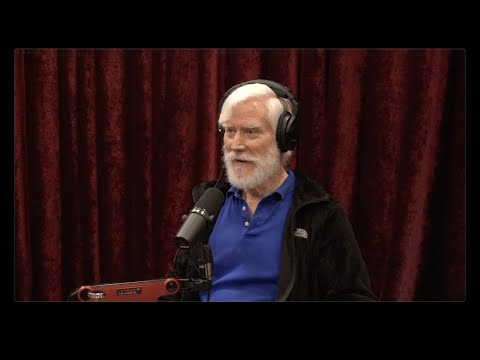
Joe Rogan Experience #2259 - Thomas Campbell
Thomas Campbell (guest), Joe Rogan (host), Narrator
In this episode of The Joe Rogan Experience, featuring Thomas Campbell and Joe Rogan, Joe Rogan Experience #2259 - Thomas Campbell explores physicist Tom Campbell Explains Reality As Consciousness-Generated Virtual Simulation Tom Campbell, a physicist and consciousness researcher, argues that our physical universe is a virtual reality rendered by a larger consciousness system in which we are avatars being played by individuated units of consciousness.
Physicist Tom Campbell Explains Reality As Consciousness-Generated Virtual Simulation
Tom Campbell, a physicist and consciousness researcher, argues that our physical universe is a virtual reality rendered by a larger consciousness system in which we are avatars being played by individuated units of consciousness.
He recounts his path from mainstream nuclear physics into meditation, out-of-body experiences, and work with Robert Monroe, using these to build a logical, information-based model of reality he calls My Big TOE (Theory of Everything).
Campbell claims consciousness is fundamental, evolution is about lowering entropy by becoming more loving and cooperative, and many so‑called paranormal phenomena (intuition, telepathy, remote viewing, UFOs, crop circles) are normal functions of this consciousness system.
He outlines practical implications: developing intuition, changing our cultural ethic from materialistic self-interest to caring, and running large-scale experiments and AI work to scientifically validate consciousness as primary.
Key Takeaways
Cultivate the intuitive mind alongside intellect.
Campbell argues our culture over-develops logic and under-develops intuition, which blocks access to broader information (e. ...
Get the full analysis with uListen AI
Treat reality as a learning simulation focused on your choices.
In his model, life is an entropy-reduction training ground; the only thing that really matters is the quality of your choices—especially under stress—not external outcomes. ...
Get the full analysis with uListen AI
Shift from fear and control to love and cooperation.
He frames low-entropy (evolved) consciousness as caring, helpful, and cooperative, and high-entropy as fear-based, manipulative, and self-centered. ...
Get the full analysis with uListen AI
Be skeptical but open to anomalous experiences.
Campbell suggests paranormal events (e. ...
Get the full analysis with uListen AI
Use a low-effort, low-attachment approach to psi practices.
For things like remote viewing or out-of-body work, strong need, anxiety, or over-effort engages the analytical mind and shuts down intuition. ...
Get the full analysis with uListen AI
Redefine success as inner growth, not material accumulation.
From his perspective, a materialist ethic (power, control, acquisition) is dysfunctional and leads to unhappiness, whereas generosity, kindness, and service reliably correlate with well-being, regardless of wealth or status.
Get the full analysis with uListen AI
Expect accelerating change and prepare by maturing emotionally.
He predicts the coming decades—with the internet, AI, and information explosion—will dramatically accelerate societal change. ...
Get the full analysis with uListen AI
Notable Quotes
“We live in a virtual reality. This physical reality is computed.”
— Thomas Campbell
“Consciousness is awareness with a choice. That’s all it is.”
— Thomas Campbell
“We’re here to evolve the quality of our consciousness—basically, to become love.”
— Thomas Campbell
“Existence is weird. And you accept it.”
— Thomas Campbell
“If it’s not your experience, it can’t be your truth.”
— Thomas Campbell
Questions Answered in This Episode
If reality is a virtual simulation, what concrete evidence or experiments would most convincingly distinguish that from a purely physical universe?
Tom Campbell, a physicist and consciousness researcher, argues that our physical universe is a virtual reality rendered by a larger consciousness system in which we are avatars being played by individuated units of consciousness.
Get the full analysis with uListen AI
How can an individual practically balance developing intellect and intuition in a modern, highly analytical society?
He recounts his path from mainstream nuclear physics into meditation, out-of-body experiences, and work with Robert Monroe, using these to build a logical, information-based model of reality he calls My Big TOE (Theory of Everything).
Get the full analysis with uListen AI
Where is the line between helpful, mind-opening anomalous experiences and ungrounded belief or self-deception?
Campbell claims consciousness is fundamental, evolution is about lowering entropy by becoming more loving and cooperative, and many so‑called paranormal phenomena (intuition, telepathy, remote viewing, UFOs, crop circles) are normal functions of this consciousness system.
Get the full analysis with uListen AI
If AI can become conscious via a consciousness ‘logging on,’ what ethical obligations would we have toward such systems?
He outlines practical implications: developing intuition, changing our cultural ethic from materialistic self-interest to caring, and running large-scale experiments and AI work to scientifically validate consciousness as primary.
Get the full analysis with uListen AI
How would education, politics, and economics need to change if society widely accepted that our core purpose is to reduce entropy by becoming more loving?
Get the full analysis with uListen AI
Transcript Preview
(drumbeats) Joe Rogan podcast, check it out. The Joe Rogan Experience.
Train by day, Joe Rogan podcast by night, all day. (instrumental music plays) Mr. Campbell, how are you, sir?
I'm just fine, Joe.
(laughs)
How are you today?
I'm great. It's very nice to meet you.
Yeah. Well, it's great meeting you. You know, I, I've been getting email over the last five years that says, "Hey, Tom, you need to be on the Joe Rogan show. Tom, why haven't you been on the Joe Rogan show?" And I get that. And I say, "Hey, guys, you just don't walk into the Joe Rogan show and say, 'Hey, here I am, I wanna talk to Joe.' You guys are gonna have to write Joe and see if you can't, uh, get him to invite me." Well, something happened. Uh, either one of those got to you or you just found out about it, uh, on your own. But I'm glad to be here.
I'm glad you're here too. Uh, I pretty much found it organically. I think someone suggested it. I think people have suggested it over the years, your books. And then, uh, I started reading one, and I got very interested in it. I was like, "Wow, this is pretty crazy." Like, well, let's, let's just get people to the beginning of, uh, My Big TOE.
Okay.
How did, uh, how did, how did you first begin with the research?
Well, actually, it all started while I was, uh, in graduate school working on my PhD. And I was, uh, you know, I'd passed all my, uh, tests and everything, so I was doing research. And the research I did was experimental, experimental nuclear, but it was low energy nuclear. And we had this big, like four or five story tall Van de Graaff generator that, uh, produced the high speed particles. You know, now that's different from the high energy particle, you know, which is hugely expensive, and you wait in line for long times to get on one of those accelerators. But this was owned by the university. And, uh, when that machine was working, you took data, and if you were awake for three days in a row taking data, well, that was just one of the prices you paid. Because if you stopped, "Oh, I gotta go to bed," uh, there's a good chance that the machine would break and it wouldn't be working, uh, when you got back. So if it was working, you stayed with it. And I saw this ad on a door that said, "Learn how to meditate." And it had a bullet point, bullet point, and then one of them jumped out at me and said, "You can get by with less sleep."
(laughs)
I said, I, I said, "I need that." You know? So I went and, uh, took my banana and paid $25, special student price, and learned how to meditate. And it turned out it was a natural for me. Very first time I tried, I thought I had been sitting there for maybe 10, 15 minutes, got up when somebody tapped me and said, "It's time to go." And I thought, "I only just started." And it turned out I'd been there like an hour and a half. And it's like, "Oh, I just lost part of my life." You know?
Install uListen to search the full transcript and get AI-powered insights
Get Full TranscriptGet more from every podcast
AI summaries, searchable transcripts, and fact-checking. Free forever.
Add to Chrome