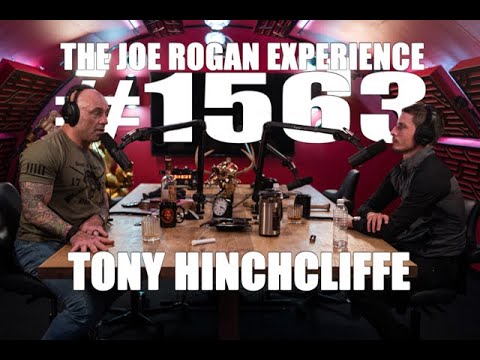
Joe Rogan Experience #1563 - Tony Hinchcliffe
Narrator, Joe Rogan (host), Tony Hinchcliffe (guest), Narrator, Narrator, Narrator, Narrator, Narrator
In this episode of The Joe Rogan Experience, featuring Narrator and Joe Rogan, Joe Rogan Experience #1563 - Tony Hinchcliffe explores rogan and Hinchcliffe riff on COVID, combat sports, chimps, chaos Joe Rogan and Tony Hinchcliffe have a sprawling, informal conversation that jumps from COVID’s impact on cities and comedy to golf, boxing, pool, wild animal attacks, con artists, and cancel culture.
Rogan and Hinchcliffe riff on COVID, combat sports, chimps, chaos
Joe Rogan and Tony Hinchcliffe have a sprawling, informal conversation that jumps from COVID’s impact on cities and comedy to golf, boxing, pool, wild animal attacks, con artists, and cancel culture.
They contrast life in locked‑down California with relatively open Texas, discuss the meditative addiction of golf, and then dive deep into technical talk on golf, pool, and elite boxing strategy and careers.
A major chunk of the discussion focuses on shocking animal stories (chimps, lions, koalas), human cruelty and fairness, scams like Theranos and Bernie Madoff, and how media, censorship, and endless news cycles shape public attention.
They close by reflecting on The Comedy Store’s golden era, the damage of COVID restrictions on live comedy, and the potential for rebuilding a new comedy hub in Texas.
Key Takeaways
Population density and policy drastically change how COVID feels on the ground.
Rogan and Hinchcliffe describe Texas as relaxed and functioning while LA feels fearful and shuttered, arguing that less density plus different leadership create more room for safe, open businesses.
Get the full analysis with uListen AI
Skill‑heavy hobbies like golf or pool can be meditative and mentally protective.
Rogan notes that golf, like archery or pool, demands so much focus on mechanics and touch that it pulls you away from your phone and daily stress, acting as a form of moving meditation.
Get the full analysis with uListen AI
Elite performance in sports comes from strategy and efficiency, not just talent.
Their breakdown of Mayweather, Pacquiao, Bernard Hopkins, and others emphasizes distance control, game‑planning, and damage minimization as the real edge, not just power or toughness.
Get the full analysis with uListen AI
Animals with high intelligence and social awareness can exhibit terrifying targeted cruelty.
Stories about chimp attacks show chimps intentionally destroying faces, fingers, and genitals as a response to perceived unfairness, illustrating that a sense of “justice” without human ethics can be brutally dangerous.
Get the full analysis with uListen AI
Big frauds often ride on narrative, hero worship, and willful blindness.
Their Theranos and Madoff discussion highlights how people badly wanted a female Steve Jobs or a consistently winning investor, so they ignored red flags and skepticism until real harm was done.
Get the full analysis with uListen AI
Endless news and social media cycles quickly erase outrage and accountability.
They argue that stories like Jeffrey Epstein’s death burned hot and then vanished because new controversies constantly replace them, making sustained focus and reform much harder.
Get the full analysis with uListen AI
Comedy needs smart workarounds, not indefinite shutdowns, to survive pandemics.
Rogan outlines a model of rapid on‑site testing, limited crowds, and clear rules as a realistic path to bringing back real shows, criticizing inconsistent regulations that let restaurants operate but block outdoor, distanced comedy.
Get the full analysis with uListen AI
Notable Quotes
“When you come to a place that has less humans, you realize, 'Oh, that's better.'”
— Joe Rogan
“Putting is the most like archery. It’s all touch.”
— Joe Rogan
“Chimps don’t just try to kill you. They try to take away what it means to be a human.”
— Joe Rogan
“Getting good at anything from scratch is one of the most important things a person can do.”
— Joe Rogan
“Those were the golden years of The Comedy Store... and then it ended.”
— Joe Rogan
Questions Answered in This Episode
How much of people’s COVID risk tolerance is driven by actual data versus local culture and leadership messaging?
Joe Rogan and Tony Hinchcliffe have a sprawling, informal conversation that jumps from COVID’s impact on cities and comedy to golf, boxing, pool, wild animal attacks, con artists, and cancel culture.
Get the full analysis with uListen AI
What separates a truly elite performer (in golf, boxing, comedy, or anything) from someone who just practices a lot but never improves?
They contrast life in locked‑down California with relatively open Texas, discuss the meditative addiction of golf, and then dive deep into technical talk on golf, pool, and elite boxing strategy and careers.
Get the full analysis with uListen AI
What ethical line should we draw around keeping highly intelligent animals (chimps, orcas, dolphins) in captivity for zoos or entertainment?
A major chunk of the discussion focuses on shocking animal stories (chimps, lions, koalas), human cruelty and fairness, scams like Theranos and Bernie Madoff, and how media, censorship, and endless news cycles shape public attention.
Get the full analysis with uListen AI
Why do certain frauds like Theranos or Madoff succeed for so long even when experts raise concerns—what social or psychological forces are at play?
They close by reflecting on The Comedy Store’s golden era, the damage of COVID restrictions on live comedy, and the potential for rebuilding a new comedy hub in Texas.
Get the full analysis with uListen AI
How can live performance industries like stand‑up balance public health with economic survival without relying solely on government mandates?
Get the full analysis with uListen AI
Transcript Preview
(drumming music plays) Joe Rogan podcast. Check it out. The Joe Rogan Experience.
Train by day, Joe Rogan podcast by night. All day. (rock music plays) Hello, Tony.
Yeah. Salud, my friend.
Oh.
Good to see you on the right side of America.
Feels good out here.
Feels good, right?
Whole different feel.
Feels normal.
Yeah.
People aren't terrified.
Correct.
They got everybody scared as fuck in California.
It's horrible, man. Everything's shut down. Everything feels bad.
(sighs)
It's sad.
It is sad. It's-
The more, the more businesses are completely closed, the sadder it is. It's seeing stuff that you know.
Yeah.
And the memories that you have there.
It's also ... I think it's harder to bounce back in big places. I think it's harder for big places to bounce back, 'cause you get like all these stores closed down. Like all the stores that got hit hard with the looting on Melrose-
Yeah.
... like they're still closed, right?
Most of them.
Have any of them come back?
Most of them. Yeah. Yeah.
When you drive down M- ... The last time I was there, it's like boarded up, boarded up, boarded up, for lease, for lease, for lease. I'm like, this takes a long time to come back.
It feels that way, for sure.
Yeah.
Some places are open, but i- it's not the same vibe.
Yeah. Out here, they're not interested in shutting things down the same way, especially the governor. He's like, "We gotta keep businesses open." And, and he's right. Like you, you can do it safely. I mean, I think you could do it safely here better than California because there's lower numbers, there's less people.
Yeah.
There's not ... Just, you know, and everyone's not as smooshed in together and everyone's more relaxed because of that. Like it makes you realize, when you come to a place that has less humans, it makes you realize like, "Oh, that's better." Like there's plenty of people out here. It's not like it- we're in the farms in the country in the middle of nowhere in the mountains. It's not like that.
Yeah.
It's a city. But it's a l- less populated city and everything's just a little more (sighs)
Yeah, relaxed. LA is a giant county.
Yeah.
It, it, it ... People think it's a city, and it's just a massive, huge place.
And it smooshes in with Orange County-
Right.
... which is even more populated, right?
Yeah.
I mean, how ... Is A- ar- w- no. Not ... LA's probably more populated than Orange County, but-
Oh, yeah, yeah, yeah.
Orange County's so dense, though. There's ... The traffic in Orange County on the 405 is mind-blowing. It's mind-blowing.
Install uListen to search the full transcript and get AI-powered insights
Get Full TranscriptGet more from every podcast
AI summaries, searchable transcripts, and fact-checking. Free forever.
Add to Chrome