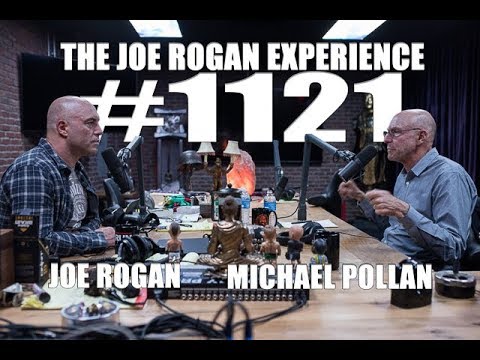
Joe Rogan Experience #1121 - Michael Pollan
Joe Rogan (host), Michael Pollan (guest)
In this episode of The Joe Rogan Experience, featuring Joe Rogan and Michael Pollan, Joe Rogan Experience #1121 - Michael Pollan explores michael Pollan Explores Psychedelics, Consciousness, Healing, and Cultural Taboo Joe Rogan interviews author Michael Pollan about his book on psychedelics, focusing on how substances like psilocybin and LSD are being reconsidered by science and medicine. Pollan describes clinical research showing dramatic benefits for depression, anxiety, addiction, and end‑of‑life distress, especially when psychedelics are administered in guided, controlled settings. They discuss the neuroscience of ego dissolution, the role of the default mode network, and how these experiences can reset rigid mental patterns. The conversation also explores cultural stigma, historical and religious connections, policy issues, and Pollan’s own late‑in‑life psychedelic experiences.
Michael Pollan Explores Psychedelics, Consciousness, Healing, and Cultural Taboo
Joe Rogan interviews author Michael Pollan about his book on psychedelics, focusing on how substances like psilocybin and LSD are being reconsidered by science and medicine. Pollan describes clinical research showing dramatic benefits for depression, anxiety, addiction, and end‑of‑life distress, especially when psychedelics are administered in guided, controlled settings. They discuss the neuroscience of ego dissolution, the role of the default mode network, and how these experiences can reset rigid mental patterns. The conversation also explores cultural stigma, historical and religious connections, policy issues, and Pollan’s own late‑in‑life psychedelic experiences.
Key Takeaways
Guided psychedelic therapy can profoundly reduce depression and anxiety, especially around death.
Johns Hopkins and NYU studies using high‑dose, guided psilocybin sessions with cancer patients showed about 80% experienced significant, lasting reductions in depression and anxiety, often transforming their relationship with mortality after a single session.
Get the full analysis with uListen AI
Set, setting, and professional guidance dramatically affect safety and outcomes.
Pollan emphasizes that mindset and environment, plus a trusted guide, reduce the risk of panic or paranoia and help people surrender to the experience rather than resist it, turning “bad trips” into manageable, often productive, “challenging trips.”
Get the full analysis with uListen AI
Psychedelics quiet the brain’s default mode network, loosening rigid thought patterns.
Brain imaging shows psychedelics reduce activity in the default mode network, associated with ego, self‑criticism, and repetitive thinking; this “turning down” acts like fresh snow on a hill, allowing new mental paths instead of the same worn grooves.
Get the full analysis with uListen AI
These substances are non‑addictive yet remain Schedule I, blocking rational regulation.
Classic psychedelics tend to be anti‑addictive and physiologically safer than many legal drugs, but Schedule I status (high abuse potential, no accepted medical use) now conflicts with emerging evidence of therapeutic value and hinders both research and safe, regulated access.
Get the full analysis with uListen AI
Psychedelics may help treat addiction by shifting perspective, not by pharmacology alone.
In smoking and alcohol studies, people often quit lifelong habits after one or two sessions because the experience gives them a powerful, emotionally charged insight—like seeing smoking as deeply incompatible with a newly felt sense of life’s meaning and possibility.
Get the full analysis with uListen AI
Cultural stigma keeps many profound experiences hidden and poorly integrated.
Pollan notes that many otherwise conventional professionals quietly report life‑changing psychedelic experiences they’ve never shared due to illegality and ridicule, filing them away as “weird drug experiences” instead of sources of psychological insight.
Get the full analysis with uListen AI
The mental health crisis creates openness to new tools like psychedelics and ketamine.
With rising depression, suicide, and addiction and little innovation since SSRIs, even mainstream psychiatric leaders and some conservative funders are supporting psychedelic and ketamine research as promising new interventions.
Get the full analysis with uListen AI
Notable Quotes
“LSD is an unspecific amplifier of mental activity.”
— Michael Pollan (quoting Stanislav Grof)
“Think of your mind as a hill covered in snow, and your thoughts are sleds going down that hill… What psychedelics do is flatten the snow.”
— Michael Pollan (paraphrasing a Dutch neuroscientist)
“Psychedelics would be for the study of the mind what the microscope was for biology or the telescope for astronomy.”
— Michael Pollan (quoting Stanislav Grof)
“Our culture is changing. People have had powerful psychedelic experiences they don’t talk to anybody about.”
— Michael Pollan
“I’m not an advocate for psychedelics. I’m an advocate for the research at this point.”
— Michael Pollan
Questions Answered in This Episode
How should a future legal framework for psychedelics balance medical use, personal freedom, and safety, especially for vulnerable populations?
Joe Rogan interviews author Michael Pollan about his book on psychedelics, focusing on how substances like psilocybin and LSD are being reconsidered by science and medicine. ...
Get the full analysis with uListen AI
What are the ethical obligations of underground psychedelic guides who operate where the law and medical oversight are absent?
Get the full analysis with uListen AI
If psychedelics can reliably induce ego dissolution, how might that reshape our notions of self, responsibility, and moral behavior?
Get the full analysis with uListen AI
To what extent could widespread, well‑guided psychedelic use shift cultural values around materialism, death, and mental illness?
Get the full analysis with uListen AI
How can researchers and storytellers communicate the depth of psychedelic experiences without either sensationalizing them or trivializing them as mere “drug trips”?
Get the full analysis with uListen AI
Transcript Preview
That quickly? Two? One? Boom, and we're live. Mr. Pollan, how are you?
Hey, good.
Poor sucker.
Good to be here.
Put the fist away. There you go.
Okay.
What's happening, man? How are you?
Uh, good. Good to be in LA.
Uh, good to have you here.
Thanks.
I've been a fan of your work for a long time, man, and I got really excited when I found out that you were writing a book on psychedelics. And, uh, um, I'm just, uh, I think it's a, an amazing subject, and I'm, I'm glad someone who's respected like yourself-
(laughs)
... is getting it. It's a q- crackpot subject, right? It's one of those subjects where like, "Oh, no, Michael Pollan found drugs."
(laughs)
Like, "What's he doing?" (laughs) "He's having a crisis."
You know-
"He's out there doing mushrooms."
... it was a bit re- it is a bit of a departure, I think, that there are people who were expecting another book on food or agriculture.
Yeah.
And, uh, were a little surprised. Um, but so far, people have been following me, you know, uh, who cared about food and ag, and they're, there's more overlap than I ever would've guessed.
I think you caught the perfect wave. I think your book is coming out right when John Hopkins Research Center-
Yeah.
... is starting to put out these, uh, studies on it. People are starting to recognize that MDMA has amazing results for post-traumatic stress disorder from veterans, and marijuana is becoming legal in more and more states. It's like you're catching this wave.
Yeah, and I didn't know that. I, you know, you never know where the culture's gonna be 'cause you start a book years before. And-
How long, uh, did you start it?
Well, I started the research in, uh, 2014. I wrote a piece for The New Yorker called The Trip Treatment, uh, which is online, um, and it was, um, my first foray into this work. I went down to Hopkins and spent a lot of time at NYU, and at the time, they were doing this really interesting trial where they were giving psilocybin to people with cancer diagnoses, many of whom were terminal. And that seemed like such a weird idea to me that I, I was curious to explore it, and I spent a lot of time talking to patients, many of whom were dying, uh, about how this single psyl- high-dose psilocybin experience, a guided psilocybin experience, and we should talk a little bit about how the guided changes things for, you know, it's not ... The, the image people have is popping some mushrooms in your mouth and maybe going to a concert or going to the beach, but this is a very d- controlled internal experience. Uh, completely reset these people's attitude toward death, and, and-
Install uListen to search the full transcript and get AI-powered insights
Get Full TranscriptGet more from every podcast
AI summaries, searchable transcripts, and fact-checking. Free forever.
Add to Chrome