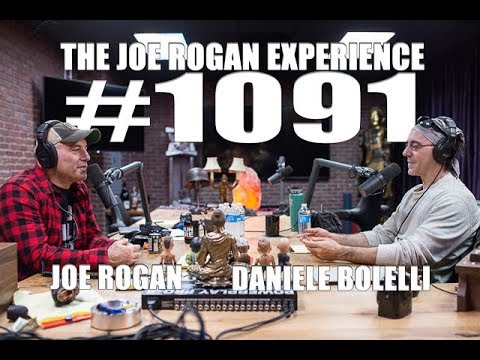
Joe Rogan Experience #1091 - Daniele Bolelli
Joe Rogan (host), Daniele Bolelli (guest), Guest (secondary, likely in-studio commentator) (guest), Guest (secondary, likely in-studio commentator) (guest), Guest (secondary, likely in-studio commentator) (guest), Guest (very brief interjection) (guest)
In this episode of The Joe Rogan Experience, featuring Joe Rogan and Daniele Bolelli, Joe Rogan Experience #1091 - Daniele Bolelli explores history, Human Nature, And Violence: Daniele Bolelli On Rogan Joe Rogan and historian/podcaster Daniele Bolelli discuss how history reveals the extremes of human behavior—from genocides and massacres to individual acts of courage and moral resistance.
History, Human Nature, And Violence: Daniele Bolelli On Rogan
Joe Rogan and historian/podcaster Daniele Bolelli discuss how history reveals the extremes of human behavior—from genocides and massacres to individual acts of courage and moral resistance.
They dive into specific historical events like the Sand Creek Massacre, My Lai, Native American history, the Mongol conquests, and figures such as Jack Johnson, Crazy Horse, Theodore Roosevelt, and Caravaggio.
The conversation branches into modern issues—tribalism, cults, political polarization, technology, nuclear weapons, AI, and social media—using history as a lens to understand current societal dynamics.
They also explore martial arts history, Roosevelt’s judo, Brazilian jiu-jitsu’s evolution, and how storytelling (podcasts, films, biographies) can make complex history accessible and compelling.
Key Takeaways
History podcasts can turn dry research into powerful, accessible storytelling.
Bolelli spends hundreds of hours combing through dense historical texts to extract vivid stories and then presents them like engaging lectures, showing that format and narrative matter as much as facts in getting people to care about history.
Get the full analysis with uListen AI
Ordinary people can commit horrors—or show great courage—depending on context.
Using Sand Creek and My Lai, Bolelli contrasts soldiers who massacred civilians with those who refused illegal orders, emphasizing that most people are not inherently evil but weak, and that environment and choice determine whether they resist or conform.
Get the full analysis with uListen AI
Dehumanizing 'the other' is a recurring engine of violence across cultures.
From Native American massacres and inter-tribal warfare to modern conflicts, both hosts note how seeing outsiders as less than fully human makes atrocities psychologically and socially easier to carry out.
Get the full analysis with uListen AI
Attempts to tightly control behavior and ideas often backfire.
Whether it’s Victorian sexual repression, political correctness on campus, cult rules, or alcohol prohibition for teens, they argue that heavy-handed prohibition tends to intensify obsession and rebellion rather than eliminate the underlying impulse.
Get the full analysis with uListen AI
Modern tribalism is supercharged by algorithms and social media feedback loops.
They discuss how online echo chambers, likes, and outrage content reward extreme, black‑and‑white thinking on both left and right, reinforcing group identity at the expense of nuance and intellectual honesty.
Get the full analysis with uListen AI
Rapid technological power has far outpaced our psychological maturity.
From nuclear near‑misses to AI and weaponized robotics, Rogan and Bolelli suggest humans wield tools we barely understand or control, likening it to giving a baby a gun and hoping it makes wise choices.
Get the full analysis with uListen AI
Studying individual lives can illuminate big historical patterns.
Bolelli’s biographical episodes on figures like Jack Johnson, Crazy Horse, Roosevelt, and Caravaggio show how personal choices, character, and contradictions embody broader themes of race, power, art, violence, and resilience.
Get the full analysis with uListen AI
Notable Quotes
“I don’t think the average person is evil. I think the average person is weak.”
— Daniele Bolelli
“In case you are wondering, this is the good times.”
— Joe Rogan
“That’s what fascinates me: what makes one guy say, ‘Yes sir’ and shoot a three-year-old, and the next guy in the same situation say, ‘No, that’s not who I am.’”
— Daniele Bolelli
“Totalitarianism is horrible regardless of which adjective is attached to it.”
— Daniele Bolelli
“We’re such a weird animal. If you could study us without being us, you’d be like, ‘What the fuck are we doing?’”
— Joe Rogan
Questions Answered in This Episode
How can education systems practically cultivate the kind of moral courage shown by soldiers who refused to participate in massacres like Sand Creek or My Lai?
Joe Rogan and historian/podcaster Daniele Bolelli discuss how history reveals the extremes of human behavior—from genocides and massacres to individual acts of courage and moral resistance.
Get the full analysis with uListen AI
To what extent should historians explicitly connect past atrocities to present-day political tribalism, and when does that risk oversimplifying or politicizing history?
They dive into specific historical events like the Sand Creek Massacre, My Lai, Native American history, the Mongol conquests, and figures such as Jack Johnson, Crazy Horse, Theodore Roosevelt, and Caravaggio.
Get the full analysis with uListen AI
Given that suppression often backfires, what are more effective ways for societies to handle taboo behaviors, harmful ideologies, or extremist speech?
The conversation branches into modern issues—tribalism, cults, political polarization, technology, nuclear weapons, AI, and social media—using history as a lens to understand current societal dynamics.
Get the full analysis with uListen AI
How might our current era of algorithm-driven echo chambers and AI-enabled weapons be remembered by future historians compared to previous turning points like the nuclear age?
They also explore martial arts history, Roosevelt’s judo, Brazilian jiu-jitsu’s evolution, and how storytelling (podcasts, films, biographies) can make complex history accessible and compelling.
Get the full analysis with uListen AI
What responsibilities do storytellers—whether podcasters, filmmakers, or teachers—have when turning traumatic or violent history into compelling narratives for mass audiences?
Get the full analysis with uListen AI
Transcript Preview
Boom, and we're live. Daniele Polelli, the man with the most beautiful accent in the world.
I just read, uh, iTunes review saying, "It's kind of weird listening to this guy describing this horror story with the accent from... it sounds like he's making you pizza while he's talking."
(laughs)
And the thing is, they don't know I am making them pizza while I'm talking. That is what's happening.
Yeah. And if they s- could see you, you look like a professor that was kidnapped by a biker gang-
(laughs)
... and for- forced to... came in here with this red brotherhood jacket on, this leather jacket from these Native Americans with his big red fist on it.
(laughs)
He's got a bandanna on.
(laughs)
You, you just... You're missing a motorcycle, that's all you're missing.
Right? That's, uh, that's next.
You could be in, like, some Easy Rider type movie.
Right?
I could see it.
Just carrying a shotgun too. I dig that.
Yeah. So, uh, are you digging doing this podcast?
Are you kidding me?
History on Fire.
Oh, man. I'm, I'm loving it. I'm having fun. Well, let's put it away. I love doing it. It's a royal pain in the ass, the research. 'Cause the-
Well, your podcast, much like Dan Carlin's, is very different. I always feel ashamed calling my podcast a podcast 'cause it's just, you sit down and talk. But yours is like... It's an audio lesson on history, an in-depth audio lesson on, like, very extreme aspects of history.
Yeah. It gets... A- and, you know, that part I enjoy because the storytelling part is awesome.
Yeah.
You get to spin a story, make it exciting, connect it with pop culture, do something that's fun. That's the part that I love. It's the month prior to that of just brutal research, just combing through boring historical book after boring historical book to find those little nuggets that are amazing-
Yeah.
... and then spin it into a narrative. That's the part that gets a little old sometimes where you're like, "Man, I... Do I really need to read 200 hours of stuff for this one thing?" It's like, that's a lot.
Yeah. I can only imagine. Now, when you do that, when you're going over, combing over all these different, uh, history books and all these different, uh, papers written on-
Mm-hmm.
... various times, do you... are you, like, extracting chunks and, like, putting them in Microsoft Word and then going over it and then, like... How do you... Do you form it... Well, the question is kind of, like, do you form it as a script-
Yeah.
... or how much of it... So everything is completely written out?
No.
No?
Not exactly because otherwise then it sound like-
Install uListen to search the full transcript and get AI-powered insights
Get Full TranscriptGet more from every podcast
AI summaries, searchable transcripts, and fact-checking. Free forever.
Add to Chrome