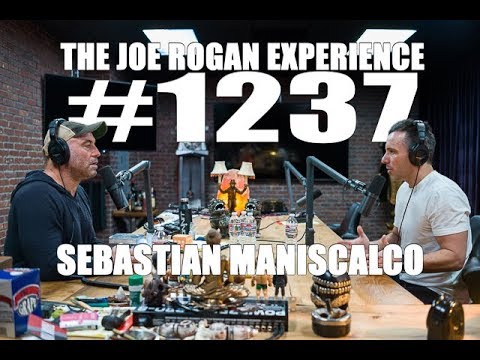
Joe Rogan Experience #1237 - Sebastian Maniscalco
Joe Rogan (host), Sebastian Maniscalco (guest), Narrator, Narrator, Narrator, Narrator, Narrator
In this episode of The Joe Rogan Experience, featuring Joe Rogan and Sebastian Maniscalco, Joe Rogan Experience #1237 - Sebastian Maniscalco explores sebastian Maniscalco, Standup Craft, Fame, Family, and Finding Balance Joe Rogan and Sebastian Maniscalco dive into how they each build standup material, from Rogan’s disciplined nightly writing and audio review process to Sebastian’s story-based, largely unwritten and memory-driven approach.
Sebastian Maniscalco, Standup Craft, Fame, Family, and Finding Balance
Joe Rogan and Sebastian Maniscalco dive into how they each build standup material, from Rogan’s disciplined nightly writing and audio review process to Sebastian’s story-based, largely unwritten and memory-driven approach.
They compare philosophies on retiring material, handling massive venues like Madison Square Garden, and how timing, silence, and presence transform live comedy—especially in big rooms.
The conversation branches into social media, hospitality, cooking (especially meat), fitness, and the challenges of staying healthy and grounded while touring and raising a young family.
Sebastian also describes acting in major films like Scorsese’s ‘The Irishman,’ reflecting on imposter syndrome, parental influence, and how success forces him to relearn boundaries, priorities, and work-life balance.
Key Takeaways
Comedians can succeed with radically different writing processes.
Rogan relies on nightly writing, set recordings, and structured bit development, while Maniscalco builds his act from lived stories, audio recordings, and memory rather than written notes—showing there’s no single “correct” method.
Get the full analysis with uListen AI
Silence and timing are powerful, underused tools in comedy.
Both emphasize that pauses, facial expressions, and letting a joke “breathe” can amplify laughs, especially in large venues, but many comics rush due to fear of silence.
Get the full analysis with uListen AI
Material strategy changes once a special is released.
Rogan retires material aggressively to force new writing and growth, whereas Maniscalco keeps strong bits in rotation live, adding tags and variations, accepting some overlap with what’s on Netflix.
Get the full analysis with uListen AI
Deliberate review loops accelerate improvement.
Rogan records every set, listens on the drive home, voice-notes new ideas, then writes while the performance is fresh; this tight feedback loop helps quickly expand and refine bits.
Get the full analysis with uListen AI
Fame and social media require boundaries to protect the core craft.
Both wrestle with social media—Bert Kreischer’s success via constant sharing versus Maniscalco’s discomfort posting anything that isn’t funny—and agree too much press and online noise can drain energy needed for top-tier standup.
Get the full analysis with uListen AI
Health and fitness must be intentionally engineered on the road.
Maniscalco now travels with a trainer, prepped meals, and uses lower-impact work like Pilates, swimming, and even pickleball to stay functional, after years of late-night steak dinners and traditional lifting wrecked his body.
Get the full analysis with uListen AI
Success magnifies the need for priorities and perspective.
Despite selling out Madison Square Garden and landing a Scorsese role, Maniscalco still battles overwork, imposter syndrome, and deeply honest family feedback, and is learning to say no to protect his performance and time with his children.
Get the full analysis with uListen AI
Notable Quotes
“My act is more recalling stories than sitting in a room going, 'Oh, I think this is funny.'”
— Sebastian Maniscalco
“I always feel like my newest bits are better than my older bits, because I still think I get better at it.”
— Joe Rogan
“Sometimes the silence is even better than saying anything.”
— Sebastian Maniscalco
“If that starts to slack, then everything else falls apart.”
— Sebastian Maniscalco, on protecting his standup
“I want to keep the same kind of lifestyle I had when I wasn’t successful.”
— Sebastian Maniscalco
Questions Answered in This Episode
How would Sebastian’s act change if he adopted even a small amount of Rogan-style nightly writing and structured review?
Joe Rogan and Sebastian Maniscalco dive into how they each build standup material, from Rogan’s disciplined nightly writing and audio review process to Sebastian’s story-based, largely unwritten and memory-driven approach.
Get the full analysis with uListen AI
Is there an ethical or artistic obligation for comedians to retire material once it’s widely available on streaming platforms?
They compare philosophies on retiring material, handling massive venues like Madison Square Garden, and how timing, silence, and presence transform live comedy—especially in big rooms.
Get the full analysis with uListen AI
How can performers in any field better use silence and pacing—not just content—to create stronger moments with an audience?
The conversation branches into social media, hospitality, cooking (especially meat), fitness, and the challenges of staying healthy and grounded while touring and raising a young family.
Get the full analysis with uListen AI
What’s the healthiest way for artists to balance social media reach with privacy, mental health, and authenticity?
Sebastian also describes acting in major films like Scorsese’s ‘The Irishman,’ reflecting on imposter syndrome, parental influence, and how success forces him to relearn boundaries, priorities, and work-life balance.
Get the full analysis with uListen AI
After working with Scorsese, De Niro, Pacino, and Pesci, how might Sebastian’s view of himself as a performer—and of what’s possible next—have shifted?
Get the full analysis with uListen AI
Transcript Preview
Here we go. Four, three, two, one. (slaps table) And we're live, you fucking handsome bastard. Look at ya.
Oh, yeah.
Look at ya.
Stunning.
(laughs)
(laughs)
What's going on, man?
What's going on? Um, every... Well, I've done this once before, and I've watched you, you know, throughout the years. And when I come in here, I get a little, um, nervous.
Why?
You're a guy who knows a lot about everything, and I don't know a lotta, like-
I don't know a lot about everything. I know enough to make it seem like I know a lot about everything.
Whatever you're doing, it, it's, y- y- y- you know more than I do, right?
Mm-hmm.
Like, like we were on your treadmill out there.
Right.
And you go, "It's 13%..." What did you say? I, I-
13% more difficult than regular running.
Okay. Like, I forgot the fact, what you just said from the time we walked in-
(laughs)
... I, I, I lost it. So I don't, I don't have the retention-
Mm.
... that, that I wish I had, so-
I gotta get you some Alpha Brain.
I need something.
Do we have any here?
Yeah.
Is that what I'm missing in my, my, my diet?
No.
Alpha Brain?
I don't know. I mean, uh-
(laughs)
... it's, uh, what's interesting though is that people come up to me with shit that happened just a few years ago, and I'm like, "I don't remember that at all." Like, I think you have a certain amount of room in your brain. And, uh, my brain is always deleting stuff that it doesn't think it needs anymore and then shoving in new things. Like sometimes someone will tell me about something, I'm like, "What are you talking about?" And they're like, "You don't remember? There was the guy with no arms who drove us around." I went, "What?" And then I have to go, "Oh, yeah." And it's like I find the folder in my head, and like-
Yeah.
... "Oh, there it is." "Yeah, yeah, yeah, yeah, yeah. And then we went to the pool hall and da-da-da-da-da." And then I'll remember. Gotcha.
But, but if... Yeah. It's just, uh, for whatever reason, this, uh, I can only, I only keep things that I'm interested in.
Gotcha.
Yeah.
I just wish I could retain a lot of the things I either see or hear to then recall it in a conversation.
You can, but you gotta write things down, and you gotta, like, wanna recall things.
Yeah. That's a problem. I don't do a lot of writing as far as like a notepad or anything to just take notes, um.
Do you, when you write your act, do you write it in your head or do you write it on paper or on a computer?
Install uListen to search the full transcript and get AI-powered insights
Get Full TranscriptGet more from every podcast
AI summaries, searchable transcripts, and fact-checking. Free forever.
Add to Chrome