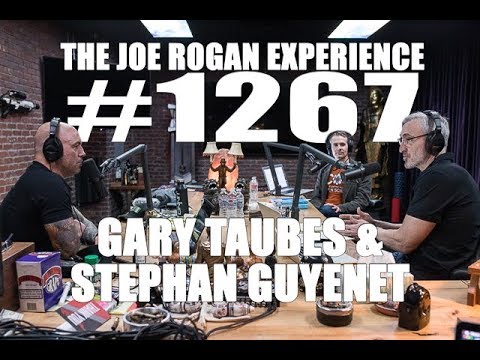
Joe Rogan Experience #1267 - Gary Taubes & Stephan Guyenet
Joe Rogan (host), Stephan Guyenet (guest), Gary Taubes (guest), Stephan Guyenet (guest), Gary Taubes (guest), Narrator
In this episode of The Joe Rogan Experience, featuring Joe Rogan and Stephan Guyenet, Joe Rogan Experience #1267 - Gary Taubes & Stephan Guyenet explores brain vs. Insulin: Joe Rogan Moderates Big Obesity Mechanism Showdown Joe Rogan hosts a long-form debate between Gary Taubes and Stephan Guyenet on the root causes of obesity and metabolic disease. Guyenet argues that body fatness is primarily regulated by the brain—via appetite, energy expenditure, and hormones like leptin—interacting with a modern, highly palatable food environment. Taubes argues obesity is fundamentally a disorder of fat storage driven by hormones (especially insulin) and that refined carbohydrates and sugar are the key culprits, with overeating and inactivity being downstream effects. They clash repeatedly over how to interpret genetics, feeding studies, historical population data, and the role of sugar, with little consensus but clear articulation of two competing paradigms.
Brain vs. Insulin: Joe Rogan Moderates Big Obesity Mechanism Showdown
Joe Rogan hosts a long-form debate between Gary Taubes and Stephan Guyenet on the root causes of obesity and metabolic disease. Guyenet argues that body fatness is primarily regulated by the brain—via appetite, energy expenditure, and hormones like leptin—interacting with a modern, highly palatable food environment. Taubes argues obesity is fundamentally a disorder of fat storage driven by hormones (especially insulin) and that refined carbohydrates and sugar are the key culprits, with overeating and inactivity being downstream effects. They clash repeatedly over how to interpret genetics, feeding studies, historical population data, and the role of sugar, with little consensus but clear articulation of two competing paradigms.
Key Takeaways
The brain actively regulates body fatness via non-conscious circuits.
Guyenet presents evidence from genetics, leptin biology, and drug mechanisms showing that differences in obesity risk are largely explained by brain-related genes and brain-acting weight-loss drugs, indicating that appetite and energy expenditure are centrally regulated.
Get the full analysis with uListen AI
Calories and energy balance still strongly predict fat gain and loss.
Guyenet emphasizes studies where overfeeding—whether from fat or carbohydrate—produces similar fat gain, and where reducing total calories (via low-carb or low-fat) leads to weight loss, arguing that macronutrient ratio is secondary to total energy intake.
Get the full analysis with uListen AI
Taubes reframes obesity as a fat-storage disorder driven by insulin.
Taubes argues that insulin’s known effects on fat cells (promoting fat storage and inhibiting fat release) mean that high-carb, especially sugary diets can trap even small daily surpluses of energy as fat, making overeating and lethargy consequences rather than causes.
Get the full analysis with uListen AI
Sugar likely contributes to obesity and metabolic disease, but may not be sufficient alone.
Both agree sugar is problematic, but Guyenet points to populations with high sugar or honey intake yet low obesity (Hadza, pygmies, Kuna) and to declining sugar intake in some countries despite rising obesity, to argue that broader diet quality and lifestyle matter heavily.
Get the full analysis with uListen AI
Measurement quality and study design profoundly shape conclusions.
They debate self-reported vs. ...
Get the full analysis with uListen AI
Different paradigms lead to different interpretations of the same data.
Whether one starts from a brain-centric, energy-balance view or a fat-cell/insulin-centric view largely determines how one explains the same observations (e. ...
Get the full analysis with uListen AI
Low-carb diets are useful tools, regardless of the exact mechanism.
Guyenet explicitly says he is not “anti–low carb” and acknowledges low-carb diets can effectively control weight and blood sugar, while objecting to the stronger claim that carbs and insulin are the primary or exclusive drivers of obesity.
Get the full analysis with uListen AI
Notable Quotes
“The thing that regulates the size of fat cells is the brain.”
— Stephan Guyenet
“Obesity is a disorder of excess fat accumulation. Let’s look at what regulates fat accumulation in the human body.”
— Gary Taubes
“It’s easy to tell stories. It’s not easy to tell stories that are supported by scientific evidence.”
— Stephan Guyenet
“What we have to do is find out if this is true, because people are dying out there.”
— Gary Taubes
“I think we’ve just begun this debate… I think legitimately people have to really kind of figure this out for themselves.”
— Joe Rogan
Questions Answered in This Episode
If both energy balance and hormonal regulation matter, what would an integrated, brain-plus-insulin model of obesity look like in practice?
Joe Rogan hosts a long-form debate between Gary Taubes and Stephan Guyenet on the root causes of obesity and metabolic disease. ...
Get the full analysis with uListen AI
How reliable are free-living dietary and activity measurements, and how much should we trust long-term nutrition epidemiology versus tightly controlled short trials?
Get the full analysis with uListen AI
To what extent can evidence from traditional or hunter-gatherer populations be applied to sedentary, highly industrialized societies?
Get the full analysis with uListen AI
What kind of definitive experiment could realistically adjudicate between the brain-centric and carbohydrate–insulin models of obesity?
Get the full analysis with uListen AI
How should public health guidelines balance simple messages (e.g., ‘eat less sugar’) with the scientific complexity highlighted in this debate?
Get the full analysis with uListen AI
Transcript Preview
Four, three, two, one. (clearing throat) And we're live. All right, so to set this up, um, when Gary was on last, Gary Taubes? S- Stephan, how do I say your last name?
Stephan Guyenet.
Guyenet.
Yeah.
Guyenet.
It's like D-N-A.
Like D-N-A, but with a G.
Right.
Got it. Okay. Um, when you were on last, Stephan had, uh, some opposition to some of the things that you were saying. We talked about getting him on and you on together. We finally pulled it off. Took... There was a lot of wrangling, there was a lot of back and forth, and cat wrangling-
(laughs)
... but we got it. We're here. Um, give me your position on... This is all for, for folks listening, this is all about obesity and the m- the mechanism for obesity. Is that fair to say?
Yeah, yeah. So essentially, uh, the main points that we wanna talk about today are-
Try to keep this a fist from your face.
Okay, sure.
Just pull-
So-
Just pull... You can move it around.
Um, what causes obesity and what causes insulin resistance, which is behind a lot of our, um, chronic diseases that are common in society.
And please, uh, give us your background.
Yeah, so I have a, a BS in biochemistry, a PhD in neuroscience. After getting my PhD in neuroscience, I went on to study the neuroscience of obesity at the University of Washington, and particularly the brain circuits that regulate body fatness. Hopefully, we'll get a chance to talk about those today. And then I went on, um, to become a science consultant, science communicator, and write a book called The Hungry Brain that is, um, my attempt to explain for a non-specialist audience what, uh, what causes obesity. And, uh, yeah, so that's my background.
Now, what is your disagreement with Gary's position?
Everything. (laughs)
Everything?
Yeah, so, uh-
(laughs)
How about-
Ask Gary.
... how about I just-
Mm-hmm, sure.
Can I start by explaining-
As... Please do.
... what I believe-
Yeah.
... cause obesity?
Yeah.
Okay, I'm gonna be long-winded here. Is that okay?
It's okay.
Okay.
Go right ahead.
All right.
We have hours.
(laughs) Okay, cool. So first, uh, a little bit of housekeeping. I'm gonna be citing a lot of evidence today, and so I want-
Just please bring this up to your face.
Okay, sure, sure.
Just move it around.
Sure, sure.
If you wanna sit back, just r-
How's that?
Yeah, you're perfect.
Okay.
Beautiful.
I'm gonna be citing a lot of evidence today, and I want people to be able to follow along at home, and so I've put many of the references that I'm gonna be citing on-
Install uListen to search the full transcript and get AI-powered insights
Get Full TranscriptGet more from every podcast
AI summaries, searchable transcripts, and fact-checking. Free forever.
Add to Chrome