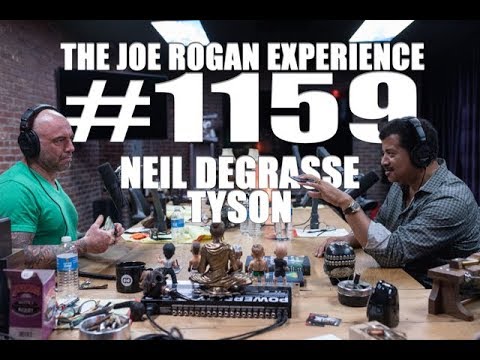
Joe Rogan Experience #1159 - Neil deGrasse Tyson
Joe Rogan (host), Neil deGrasse Tyson (guest), Narrator, Narrator, Narrator, Narrator
In this episode of The Joe Rogan Experience, featuring Joe Rogan and Neil deGrasse Tyson, Joe Rogan Experience #1159 - Neil deGrasse Tyson explores neil deGrasse Tyson Explains Curiosity, Space, War, and Future Survival Neil deGrasse Tyson joins Joe Rogan to explore how modern education kills innate childhood curiosity and why cultivating lifelong learners matters more than formal degrees. They discuss popular science media, Tyson’s projects (StarTalk, Cosmos), and his books on astrophysics and the hidden military entanglements of space science. A large portion of the conversation examines how astronomy and physics directly feed military power, navigation, surveillance, and technologies like GPS, MRIs, X‑ray scanners, and even microwave ovens. They also delve into space policy, asteroid threats, flat‑Earth thinking, climate for science literacy, and why a Space Force and robust planetary defense may be essential for humanity’s long‑term survival.
Neil deGrasse Tyson Explains Curiosity, Space, War, and Future Survival
Neil deGrasse Tyson joins Joe Rogan to explore how modern education kills innate childhood curiosity and why cultivating lifelong learners matters more than formal degrees. They discuss popular science media, Tyson’s projects (StarTalk, Cosmos), and his books on astrophysics and the hidden military entanglements of space science. A large portion of the conversation examines how astronomy and physics directly feed military power, navigation, surveillance, and technologies like GPS, MRIs, X‑ray scanners, and even microwave ovens. They also delve into space policy, asteroid threats, flat‑Earth thinking, climate for science literacy, and why a Space Force and robust planetary defense may be essential for humanity’s long‑term survival.
Key Takeaways
Education should create lifelong curiosity, not relief when school ends.
Tyson argues that if students celebrate the end of school by throwing papers in the air, the system has trained them to see learning as a chore. ...
Get the full analysis with uListen AI
Science communication works when it’s entertaining and emotionally engaging.
Shows like StarTalk, Radiolab, and Cosmos succeed because they make complex topics fun, often using comedians and pop culture scaffolding to hook people who ‘don’t like science’ and then layering the science onto familiar celebrities and stories.
Get the full analysis with uListen AI
Astrophysics and the military are deeply intertwined, even if invisibly.
From Columbus using eclipse tables to intimidate natives, to Los Alamos hiring astrophysicists to model fusion for hydrogen bombs, to Hubble’s design building on spy satellites, Tyson shows that astronomy has long provided tools for navigation, targeting, surveillance, and power projection.
Get the full analysis with uListen AI
Basic research often leads to transformative technologies decades later.
Quantum mechanics and nuclear physics seemed abstract in the 1920s, yet now underpin computing, GPS, MRI, and a large share of global GDP. ...
Get the full analysis with uListen AI
Space investment is tiny but critical for vision and innovation.
NASA’s budget is about 0. ...
Get the full analysis with uListen AI
Objective truths differ from personal and political ‘truths’.
Tyson distinguishes: objective truths are experimentally verified and independent of belief; personal truths are faith or deeply held beliefs that can’t be imposed on others in a free society; political truths are claims repeated so often they’re accepted regardless of evidence.
Get the full analysis with uListen AI
Humanity must plan seriously for asteroid defense and space hazards.
Events like Chelyabinsk and Tunguska show that even non‑impact airbursts can injure thousands or flatten forests. ...
Get the full analysis with uListen AI
Notable Quotes
“Children don’t need to be taught to be curious. They are curious to the point of destruction. They’re all born scientists.”
— Neil deGrasse Tyson
“You spend the first years of a child’s life teaching it to walk and talk, then you spend the rest of its life telling it to shut up and sit down.”
— Neil deGrasse Tyson
“Most of the people who say, ‘Don’t spend money up there, spend it down here,’ think NASA has more budget than it actually does.”
— Neil deGrasse Tyson
“It’s just as intellectually lazy to believe everything you see as it is to deny everything you see.”
— Neil deGrasse Tyson
“If the dinosaurs could, they would have had a space program to not go extinct.”
— Neil deGrasse Tyson
Questions Answered in This Episode
How would education need to change structurally to prioritize curiosity and scientific thinking over standardized testing and memorization?
Neil deGrasse Tyson joins Joe Rogan to explore how modern education kills innate childhood curiosity and why cultivating lifelong learners matters more than formal degrees. ...
Get the full analysis with uListen AI
Where should society draw ethical boundaries on the military use of space‑derived technologies and astronomical knowledge?
Get the full analysis with uListen AI
Given the small share of the budget NASA receives, what arguments are most effective in persuading skeptical taxpayers to support space exploration and planetary defense?
Get the full analysis with uListen AI
How can individuals realistically improve their own ‘science literacy’ to distinguish objective truths from political spin or persuasive pseudoscience (e.g., flat‑Earth videos)?
Get the full analysis with uListen AI
What concrete global governance model would best manage asteroid defense, orbital debris cleanup, and potential ‘Space Force’ activities without escalating conflict in space?
Get the full analysis with uListen AI
Transcript Preview
So, why aren't there flying cars?
(laughs)
(laughs)
You're just jumping right in. You don't say hi. You don't say-
I said hi already.
... how's the wife and k- how's the wife and kids? (laughs)
How is everybody, man? How's life? How's your book? It's been on the Times bestseller list for how many weeks?
Oh, the, the Astrophysics for People in a Hurry. That's been on the, on the New York Times bestseller list for 67 weeks.
That's pretty intense.
It's cra- that's, that's a lot for any book, much less for a science book. And so, that tells me, while all these Trump books are wafting in and out, this is bobbing like a cork, like a cork on the ocean waves as the book of the moment th- that either praises Trump or criticizes, or criticizes him come in and off of that list.
Mm.
So this tells me that there is this unserved hunger that people have. There's a curiosity that this is serving. And it's (laughs) to, Astrophysics for People in a Hurry, that's kind of a, that's very purposefully juxtaposed. It's like, Neurosurgery in Four Easy Steps. You know, if you saw a book with that title, you'd have to pick it up.
(laughs)
(laughs) 'Cause you'd wonder what's going on.
Well, not to kiss your ass again, but I always say this about you and I think it's important. You make learning stuff about astrophysics fun. And that's what's missing, you know. It's not that people don't like to be educated, that they don't like to learn. They just don't wanna be bored.
That's a perceptive point because, you know, think of the image we have of, let's say you're in a school where most people don't go to college, uh, you're in high school. And then last day of school comes. What do people do? They toss their papers in the air as they run down the steps, "School's out. No." What, what's the Rock song?
(sings) School's out for summer.
(sings) School's out for...
Summer.
... at summer. Was it forever?
And then ever. Ever, yeah.
Then forever.
Ever, yeah.
Right? So that attitude must mean the school didn't train you to embrace curiosity.
Right.
That learning was a chore, and now the chores are over.
Yeah.
So I think the educational system needs an adjustment. Forget whether or not you go to college, 'cause you're gonna spend more years not in school than in school even if you do go to college. What you want, I think, are lifelong learners, lifelong curiosity.
Yes.
Where once you are trained and, and, and, and, and your curiosity is stimulated, the curiosity we all had as children. You're ... Children don't need to be taught to be curious. They are curious to the point of destruction of whatever it is they touch. "Oh, what is this egg on the counter? What is this glass? What is this plate? What's under a rock? What happens if I pull a leg off a daddy longleg?" You know, they are-
Install uListen to search the full transcript and get AI-powered insights
Get Full TranscriptGet more from every podcast
AI summaries, searchable transcripts, and fact-checking. Free forever.
Add to Chrome